
















|
Getting your Trinity Audio player ready...
|
By: Jerome Brookshire
In a season that began with soaring expectations and the promise of postseason contention, the New York Mets now find themselves mired in a spiraling crisis that has confounded analysts and inflamed an already restless fanbase. As reported on Sunday by The Daily Mail, the team’s alarming losing streak has taken on an almost mythic dimension, with supporters grasping not only for tactical explanations but for symbols—however improbable—upon which to project their mounting frustration.
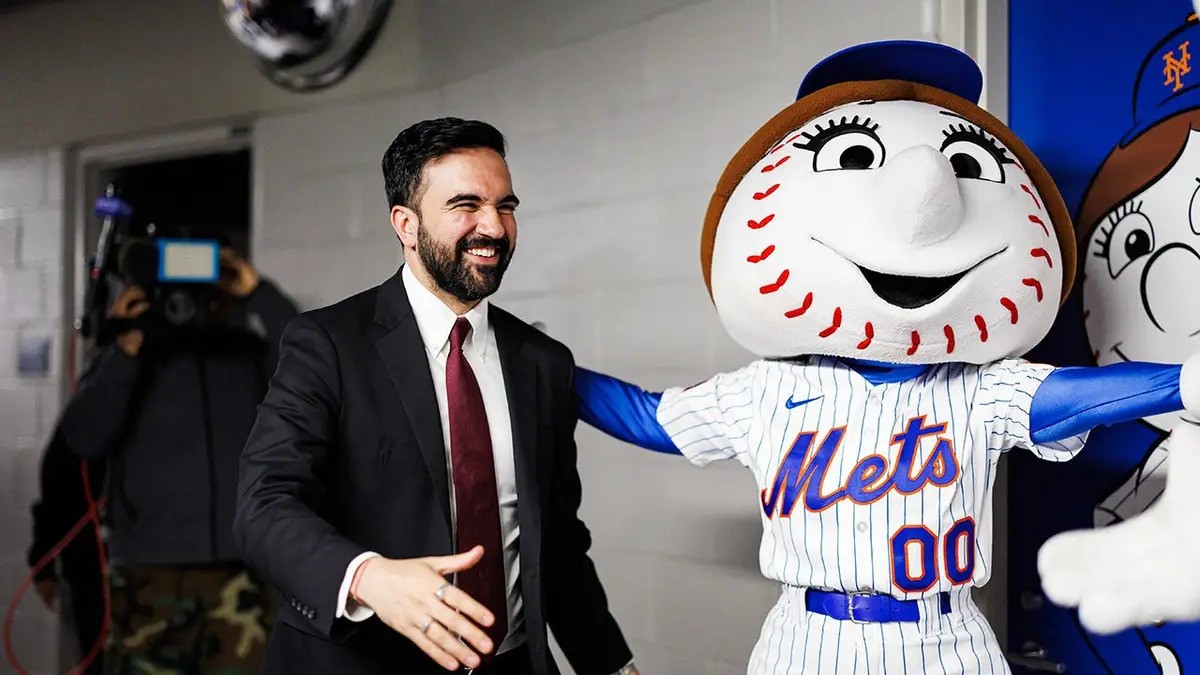
At the center of this peculiar narrative stands an unlikely figure: New York City Mayor Zohran Mamdani. What was intended as a routine and lighthearted appearance at Citi Field has, in the eyes of many beleaguered fans, evolved into the supposed genesis of the Mets’ extraordinary decline. A now-viral video—circulating widely across social media platforms and accumulating millions of views—depicts the mayor being warmly greeted by the team’s beloved mascots, Mr. and Mrs. Met. Yet in the unforgiving calculus of sports superstition, the timing of that encounter has proven to be anything but benign.
Since that visit on April 15, the Mets have failed to secure a single victory, extending their losing streak into double digits. By Sunday, the team had suffered its eleventh consecutive defeat, a run of futility that has prompted both introspection and incredulity. According to the information provided in The Daily Mail report, the so-called “Mamdani Curse” has rapidly gained traction among fans, becoming a shorthand explanation for a sequence of losses that defies easy rationalization.
Such attributions, while rooted in humor and hyperbole, reveal deeper currents within the psyche of a fanbase accustomed to both triumph and disappointment. Baseball, perhaps more than any other sport, is steeped in ritual and superstition. When performance falters in ways that statistics alone cannot fully explain, supporters often turn to symbolic narratives to make sense of the chaos. In this case, the image of a mayoral visit coinciding with an abrupt collapse has proven irresistible.
Yet beyond the realm of superstition lies a far more tangible reality: a team struggling to perform at even a baseline competitive level. The Mets’ current slide represents a dramatic reversal of fortune for a franchise that entered the season with one of the highest payrolls in the league and a roster laden with star talent. Chief among these is Juan Soto, whose presence was expected to anchor a formidable offensive lineup. Instead, the team has endured prolonged scoring droughts, with hitters failing to capitalize on opportunities and producing runs at a pace that falls well below expectations.
As The Daily Mail report noted, the offensive stagnation has been particularly pronounced during critical moments of games, where the inability to convert scoring chances has repeatedly tipped the balance in favor of opponents. This pattern has not only contributed to the length of the losing streak but has also eroded confidence within the clubhouse, creating a feedback loop in which frustration begets further underperformance.
Manager Carlos Mendoza has found himself at the epicenter of this scrutiny. Tasked with guiding a roster of considerable talent, he now faces mounting criticism from fans and commentators alike. Questions have been raised regarding his management of the bullpen, particularly in high-leverage situations where strategic decisions can determine the outcome of closely contested games. Additionally, doubts have emerged about his capacity to galvanize the team during periods of adversity, a quality often deemed essential for leadership at the highest level of professional sport.
The convergence of these factors—offensive inefficiency, strategic uncertainty, and waning morale—has created an environment in which losses have become both frequent and, increasingly, expected. In such a context, the emergence of a symbolic scapegoat is perhaps less surprising. The notion of a “curse,” while ostensibly whimsical, serves as a vessel through which fans can express their discontent without directly confronting the more complex and uncomfortable realities of the team’s performance.
Mets Cancel Jewish Heritage Night
In the ever-evolving cultural mosaic of New York City, where identity, tradition, and civic life intersect in myriad forms, few institutions carry as much symbolic weight as its professional sports franchises. Yet in recent weeks, a seemingly routine scheduling decision by the New York Mets has ignited an unexpectedly fervent debate—one that touches upon questions of inclusion, identity, and the shifting contours of public expression in an era marked by heightened tensions surrounding Jewish life worldwide.
As reported on Friday by The Jewish Telegraphic Agency, the controversy centers on the apparent absence of a Jewish Heritage Night from the Mets’ recently announced slate of themed events for the 2026 season. While such themed celebrations have long served as a means of honoring the diverse communities that define the borough of Queens, the omission of a dedicated Jewish observance has prompted a wave of speculation, criticism, and, in some quarters, palpable unease.
The issue first gained traction through a series of social media posts, but it was an essay published by writer Kevin Deutsch that brought the matter into sharper public focus. Deutsch argued that the absence of a Jewish Heritage Night represented not merely an administrative oversight but a potential reflection of broader societal currents, including what he described as an increasingly hostile climate toward Jewish identity and expressions of support for Israel. His assertions, amplified by commentators and advocacy figures, quickly transformed what might have been a niche concern into a widely discussed cultural flashpoint.
To understand the resonance of this controversy, one must consider the historical context in which Jewish Heritage Night at Citi Field has previously unfolded. As the JTA report recounted, past celebrations were marked by a blend of reverence and levity, combining ceremonial elements with playful nods to Jewish culture. The 2023 event, for instance, featured an array of distinctive moments—from a ceremonial first pitch by an Israeli diplomatic representative to a lighthearted performance involving a matzah ball thrown toward home plate.
Musical interludes, including performances by the singer Matisyahu, and the unmistakable strains of Adam Sandler’s “The Chanukah Song” filled the stadium, while the Mets’ mascot participated in a traditional celebratory dance. The evening, by all accounts, embodied a spirited acknowledgment of Jewish heritage within the broader tapestry of the team’s fan base.
Yet, as the JTA report noted, such dedicated observances have not been a consistent annual fixture. Even prior to the current controversy, the Mets occasionally alternated Jewish Heritage Night with events such as Celebrate Israel Night, reflecting a degree of flexibility in their approach to cultural programming. The more significant shift, however, occurred in 2024, when the organization announced a comprehensive reconfiguration of its heritage initiatives.
Under this new framework, individual heritage nights were largely supplanted by a multi-day initiative known as “A Celebration of Queens Culture.” Designed to reflect the extraordinary diversity of the borough—home to more than one hundred distinct cultural communities—the program sought to move beyond discrete, single-night observances in favor of a more integrated and expansive model. In a statement cited by the JTA, the Mets emphasized that the new approach was intended to broaden inclusivity, acknowledging the practical limitations of attempting to honor every community individually within a single season.
This shift, however, has not fully assuaged concerns. Critics argue that the absence of a specific Jewish Heritage Night, particularly at a time when other cultural groups continue to receive dedicated recognition, risks conveying a message of exclusion, whether intentional or not. The current season’s schedule includes themed events celebrating Italian heritage, Japanese culture, Dominican heritage, and the LGBTQ community, among others. Against this backdrop, the omission of a comparable Jewish observance has been interpreted by some as a conspicuous gap.
The broader context in which this debate is unfolding cannot be ignored. The aftermath of the October 7, 2023, attacks in Israel and the subsequent regional conflict have had profound repercussions far beyond the Middle East, influencing public discourse and community dynamics across the United States. As JTA has reported, the period since those events has been marked by a notable increase in antisemitic incidents and a corresponding sense of vulnerability within Jewish communities. Public gatherings, particularly those associated with Jewish identity or Israeli solidarity, have in some cases become focal points for protest or disruption, leading organizers to adopt heightened security measures or limit public visibility.
In this climate, some observers have speculated that logistical or security considerations may have influenced the Mets’ programming decisions. While no official confirmation has been provided—indeed, the organization has not publicly commented on the specific question of Jewish Heritage Night—the perception of such factors has contributed to the intensity of the debate. As the JTA report noted, rumors circulating online have suggested that concerns about potential protests may have played a role, though these claims remain unsubstantiated.