
















Investigation Launched Amid Concerns Over Political Neutrality, Educational Boundaries, and Rising Tensions Surrounding the Israel-Hamas Conflict
By: Jeff Gorman
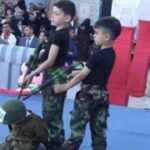
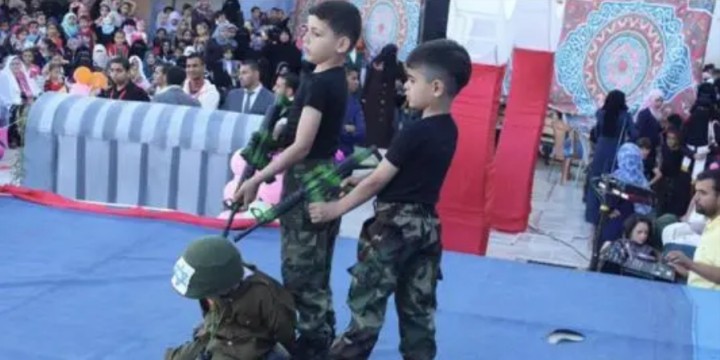
Spanish education authorities have opened an investigation into a public school in Madrid after a controversial anti-Israel student performance featuring children dressed in Hamas military-style clothing and carrying toy weapons that resembled those used by the Gaza based terror organization sparked widespread criticism, concern within the Jewish community, and calls for accountability from political leaders.
According to a report on Wednesday in The Algemeiner and the Spanish media outlet VozPópuli, the Madrid regional Ministry of Education has initiated an official inspection of a public school located in the city’s southern Puente de Vallecas district following allegations that the institution may have breached Spain’s longstanding requirements regarding political neutrality in public education.
The controversy centers on a school performance involving approximately 10-year-old students who appeared on stage wearing attire that critics said closely resembled the clothing commonly associated with members of Hamas, the Palestinian terrorist organization responsible for the October 7, 2023 attacks in Israel. Video footage of the event, widely circulated across social media platforms and highlighted in reporting referenced by The Algemeiner, shows children dressed in military-style uniforms, some wearing balaclavas and carrying imitation rifles as part of the production.
The images quickly ignited a national debate over the appropriate role of political themes in classrooms and the responsibilities of public educational institutions when addressing highly contentious international conflicts.
According to footage reviewed and described by The Algemeiner, the children participating in the production could be heard chanting slogans and dramatic lines emphasizing themes of resistance and perseverance.
Among the phrases reportedly heard during the performance were declarations such as, “With strength and courage, we will not surrender.”
Other students, some wearing Palestinian keffiyehs, recited lines including: “We must wake up,” “Resistance and freedom,” “We don’t want to cry another day,” and “Raise the scarf high, lift your voice to the wind, shout freedom, do not be afraid.”
Supporters of the performance have characterized it as an expression of solidarity with Palestinians and a student-driven artistic initiative. Critics, however, argue that the imagery employed crossed a significant line by placing children in costumes that appeared to mirror those worn by armed terrorists and by introducing highly politicized themes into a public-school setting.
The resulting backlash was swift and intense.
According to The Algemeiner report, the Madrid regional government moved quickly to examine the circumstances surrounding the event.
The Ministry of Education reportedly launched a formal inspection process to determine whether school officials violated regulations requiring political neutrality in publicly funded educational institutions.
Authorities are also said to be examining whether disciplinary measures may be warranted against individuals responsible for organizing or approving the activity.
The investigation is expected to focus on several key questions, including how the performance was conceived, who authorized it, whether parents were informed beforehand, and whether the event complied with educational guidelines governing political expression in schools.
Officials have not publicly announced any conclusions, emphasizing that the review remains ongoing.
As criticism intensified, school representatives reportedly sought to characterize the production as primarily student-driven. According to reporting referenced by The Algemeiner, the institution has attempted to distance itself from direct responsibility for the content of the performance, arguing that it originated largely as a student initiative.
That explanation has done little to calm concerns among critics, many of whom contend that public schools bear ultimate responsibility for activities conducted under their supervision. Educational experts note that schools retain a duty to ensure that classroom exercises and public performances comply with established educational standards and legal requirements.
The question of where student expression ends and institutional responsibility begins is now central to the ongoing investigation.
The controversy emerges against the backdrop of an ongoing debate in Spain regarding political activism within public educational institutions.
As The Algemeiner report noted, the Madrid regional government has repeatedly emphasized that public schools should remain free from partisan political advocacy.
In previous disputes, authorities prohibited the display of Palestinian flags on the facades of public schools, arguing that educational facilities should not serve as platforms for political campaigning or ideological messaging.
Those decisions generated fierce opposition from some activists and left-wing political organizations, which accused authorities of restricting freedom of expression.
Supporters of the restrictions countered that schools should remain focused on education rather than political mobilization.
The latest controversy appears likely to further intensify that broader national debate.
Leaders within Madrid’s Jewish community have reacted with particular alarm to the performance.
According to The Algemeiner report, community representatives have urged authorities to conduct a thorough investigation and implement safeguards designed to prevent similar incidents in the future.
Their concerns center not only on the imagery used in the production but also on the broader educational message that children may absorb when complex geopolitical conflicts are presented through highly charged symbolism.
Community leaders have argued that public education should encourage critical thinking, historical understanding, and respectful dialogue rather than what they view as politically one-sided narratives.
Several Jewish organizations have emphasized that children should not be placed at the center of ideological disputes or used as vehicles for political messaging.
The controversy comes amid broader discussions across Europe regarding rising antisemitism and increasing social tensions linked to the Israel-Hamas conflict. As The Algemeiner has reported, many European countries have experienced a significant increase in antisemitic incidents since the Hamas-led attacks of October 7, 2023, and the subsequent war in Gaza. Governments, law-enforcement agencies, and community organizations across the continent have reported increases in antisemitic vandalism, threats, harassment, and hate crimes.
Spain has not been immune from those trends. The debate surrounding the Madrid school performance has therefore resonated far beyond the immediate circumstances of the event itself, becoming part of a wider conversation about education, political activism, social cohesion, and the responsibilities of public institutions.
The incident has also intensified scrutiny of Spain’s political climate. According to The Algemeiner report, critics of Prime Minister Pedro Sánchez and members of his governing socialist coalition have accused political leaders of contributing to an environment in which anti-Israel rhetoric has become increasingly prominent in public discourse.
Supporters of the government reject those accusations and maintain that criticism of Israeli government policies should not be conflated with hostility toward Jewish people. That distinction remains at the center of many debates currently unfolding throughout Europe and beyond.
For now, attention remains focused on the Education Ministry’s inquiry. Officials have not yet announced when the investigation will conclude or whether disciplinary measures will ultimately be imposed.
The outcome could have significant implications for educational policy throughout Madrid and potentially across Spain.
Regardless of the final findings, the controversy has already sparked a nationwide discussion about the role of public schools, the limits of political expression in educational settings, and the challenges of teaching about international conflicts in an increasingly polarized environment.
As reported by The Algemeiner, what began as a school performance has evolved into a broader national debate touching on education, politics, community relations, and the responsibilities of public institutions in a democratic society.