















|
Getting your Trinity Audio player ready...
|
Trump Declares: Removing Naval Blockade of Strait of Hormuz Undermines Deal Unless “We Blow Up Iran”
By: Abe Wertenheim
In a striking escalation of rhetoric and strategic ambiguity, President Donald Trump has signaled a precarious path forward in the already volatile relationship between the United States and Iran, intertwining the prospects of diplomacy with overt threats of intensified military action. As reported and analyzed on Tuesday by Israel National News, the unfolding developments suggest a high-stakes geopolitical contest in which economic leverage, military deterrence, and psychological maneuvering converge.
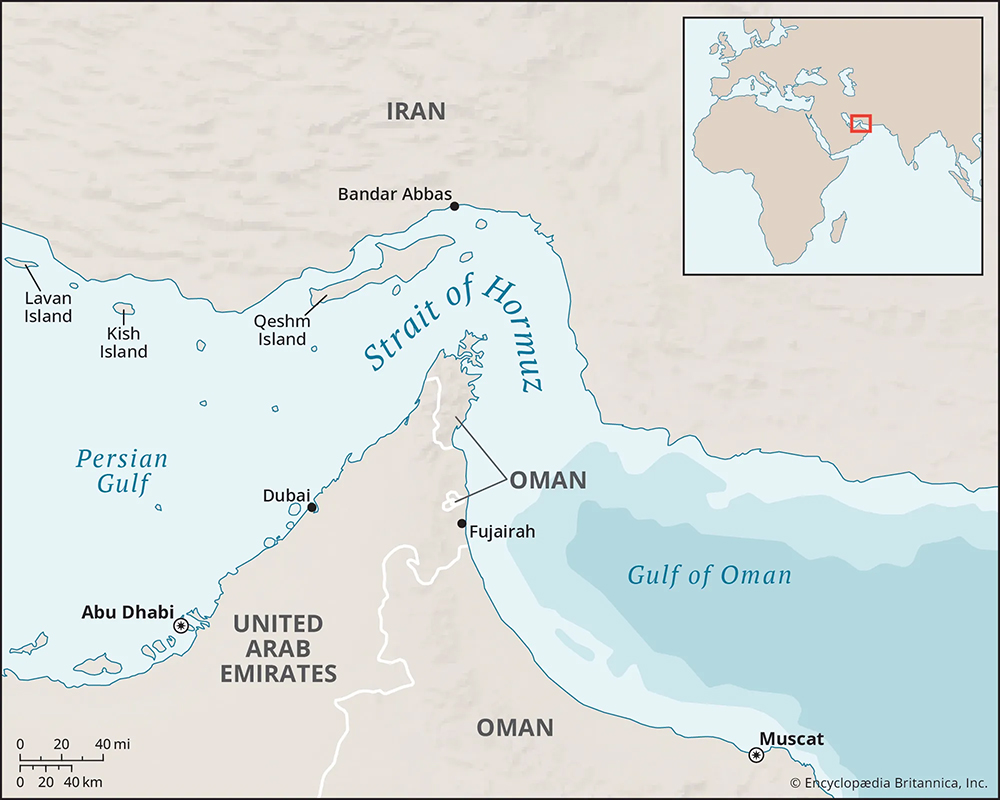
Speaking through his preferred communication platform late Tuesday evening, Trump articulated a position that appears at once contradictory and deliberate: the possibility of a diplomatic agreement with Iran, he asserted, remains contingent upon the continuation—or even escalation—of American military pressure. At the center of this strategy lies the United States naval blockade, which has effectively constrained Iran’s access to one of the world’s most critical maritime corridors, the Strait of Hormuz.
According to the Israel National News report, Trump emphasized that Iran’s public posture regarding the Strait is less an authentic policy preference and more a performative gesture aimed at preserving domestic and regional credibility. He argued that Tehran’s leadership, despite rhetorical threats to close the waterway, in fact depends heavily on its continued operation. The economic implications are profound: the Strait serves as a vital artery for Iranian oil exports, generating hundreds of millions of dollars in daily revenue.
Trump framed the blockade as a decisive instrument of economic coercion, asserting that Iran’s calls for reopening the Strait are rooted in financial necessity rather than strategic conviction. In his words, the blockade has rendered the passage effectively “closed,” depriving Iran of critical income and thereby intensifying internal pressures on its already strained governance structure. This narrative, as highlighted by Israel National News, underscores a broader American strategy of leveraging economic deprivation to compel political concessions.
Yet it is the conditionality attached to any prospective agreement that has drawn the most scrutiny. Trump suggested that lifting the blockade—thereby restoring Iran’s economic lifeline—would paradoxically undermine the possibility of a deal unless accompanied by overwhelming military action. His stark formulation implied that only the destruction of Iran’s remaining military and political infrastructure could ensure compliance, a proposition that raises profound ethical, legal, and strategic questions.
This juxtaposition of negotiation and annihilation encapsulates a doctrine of maximal pressure taken to its rhetorical extreme. It reflects a worldview in which diplomacy is not an alternative to force but rather an extension of it—a tool to be wielded in tandem with, rather than in place of, coercive measures. Analysts cited by Israel National News have noted that such an approach risks blurring the line between deterrence and provocation, potentially narrowing the already limited space for de-escalation.
Compounding the uncertainty is Trump’s announcement, made earlier the same day, that an existing ceasefire with Iran would be extended indefinitely. The stated purpose of this extension is to provide Iranian leadership with an opportunity to formulate and present a unified proposal for negotiations. However, the conditions surrounding this extension are far from conciliatory. The naval blockade, Trump made clear, will remain firmly in place, and U.S. military forces will continue to operate at a heightened state of readiness.
In his statement, Trump attributed the pause in hostilities to a combination of internal instability within Iran and external diplomatic appeals, including requests from Pakistani military and political leaders. He portrayed the Iranian government as “seriously fractured,” a characterization that aligns with longstanding narratives about divisions within the country’s ruling establishment. As reported by Israel National News, this depiction serves to justify the extension of the ceasefire as a pragmatic concession rather than a strategic retreat.
Nevertheless, the response from Iranian sources has been swift and skeptical. The state-affiliated Tasnim news agency has categorically denied that Iran requested any extension of the ceasefire, casting doubt on the veracity of Trump’s claims. Moreover, the agency has raised the possibility that the announcement itself could be a calculated deception, designed to lull Iran into a false sense of security while preparations for renewed military action proceed.
This suspicion is not confined to media outlets. According to reports cited by Israel National News, an adviser to the speaker of Iran’s parliament and a senior negotiator has characterized the ceasefire extension as a “ploy to buy time.” Such language reflects a deep-seated mistrust of American intentions, rooted in a history of fluctuating policies and abrupt strategic shifts.
The adviser’s remarks also highlight a critical dimension of the current standoff: the perception of the naval blockade as an act of war. From Tehran’s perspective, the continued restriction of its maritime commerce is tantamount to sustained bombardment, an economic siege that demands a proportional military response. This framing elevates the stakes considerably, as it transforms what might otherwise be seen as a coercive diplomatic tool into a casus belli.
The broader implications of this dynamic are profound. The Strait of Hormuz is not merely a regional concern; it is a global chokepoint through which a significant portion of the world’s energy supply flows. Any disruption to its operation has the potential to trigger cascading effects across international markets, exacerbating economic instability and heightening geopolitical tensions.
In this context, Trump’s strategy can be understood as a high-risk attempt to recalibrate the balance of power in the region. By maintaining the blockade while offering a conditional extension of the ceasefire, the United States seeks to exert maximum pressure on Iran without immediately resorting to full-scale conflict. At the same time, the explicit threat of devastating military action serves as a deterrent against Iranian retaliation.
However, as emphasized in analysis by Israel National News, such a strategy is fraught with uncertainties. The assumption that Iran will capitulate under economic and military pressure may underestimate the regime’s capacity for resilience and its willingness to endure hardship in pursuit of strategic objectives. Moreover, the risk of miscalculation—on either side—remains ever-present.
The involvement of external actors further complicates the picture. The reference to appeals from Pakistani leadership suggests that regional powers are actively seeking to prevent an escalation that could have far-reaching consequences. Yet their influence over the decision-making processes in Washington and Tehran is inherently limited, constrained by competing interests and divergent priorities.
As the situation continues to evolve, the role of information and narrative becomes increasingly significant. Competing accounts from American and Iranian sources create a landscape of ambiguity in which intentions are difficult to discern and actions are subject to multiple interpretations. In such an environment, the potential for misunderstanding is magnified, increasing the likelihood of unintended escalation.
Ultimately, the current standoff represents a critical juncture in U.S.–Iran relations. It is a moment defined by the interplay of power and diplomacy, of economic pressure and military threat, of public declarations and private calculations. Whether it will culminate in a negotiated settlement or a renewed cycle of conflict remains uncertain.
What is clear, as noted in the Israel National News report, is that the decisions made in the coming days and weeks will have consequences that extend far beyond the immediate actors involved. They will shape the strategic landscape of the Middle East, influence global economic stability, and test the limits of contemporary diplomacy in an era increasingly defined by confrontation.
In the shadow of the Strait of Hormuz, the world watches as a delicate and dangerous game unfolds—one in which the stakes could scarcely be higher, and the margin for error is perilously thin



