

































|
Getting your Trinity Audio player ready...
|
By: Fern Sidman
In a revelation that reverberates through the enduring moral and legal aftershocks of World War II, a long-lost painting looted by Nazi forces from a prominent Jewish art dealer has been discovered in the private residence of a descendant of a senior Dutch Nazi collaborator. The extraordinary case, reported in The Algemeiner on Tuesday, underscores both the persistence of unresolved Holocaust-era injustices and the complex interplay of historical memory, accountability, and restitution that continues to shape Europe’s cultural and legal landscape.
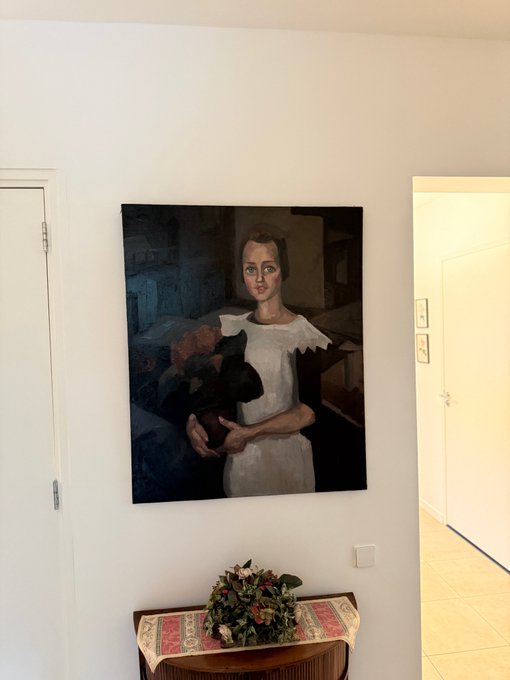
BREAKING: A painting by Toon Kelder, looted by the Nazis from the famous Jewish art dealer Goudstikker, is still hanging in the house of the granddaughter of the notorious Nazi general Hendrik Seyffardt, head of the Dutch Waffen-SS. Seyffardt was liquidated by the resistance in… pic.twitter.com/FvEopbLATE
— Arthur Brand (art detective) (@brand_arthur) May 11, 2026
At the center of this remarkable discovery is “Portrait of a Young Girl”, a work by Dutch artist Toon Kelder, originally owned by the esteemed Jewish art dealer Jacques Goudstikker. The painting was seized during the Nazi occupation of the Netherlands and subsequently disappeared into the labyrinthine world of wartime art theft and postwar obscurity. Its reemergence, decades later, within the home of the granddaughter of Hendrik Seyffardt, has reignited scrutiny of one of the most infamous chapters in cultural plunder.
The discovery was made possible through the investigative efforts of renowned Dutch art detective Arthur Brand, whose career has been marked by the recovery of numerous looted masterpieces. According to the information provided in The Algemeiner report, Brand was contacted through an intermediary by a member of the Seyffardt family who had recently become aware of both his lineage and the troubling provenance of the artwork in his possession.
“It is true that I discovered my family possesses the looted painting and does not want to return it,” the anonymous family member told the Dutch newspaper “De Telegraaf” as cited in The Algemeiner report. “I was stunned speechless. That is why I am now bringing it into the public eye. I feel deep shame about the family past and am furious about the years of silence. The painting must return to the Jewish rightful heirs.”
This striking admission reflects a broader reckoning with the moral implications of inherited artifacts whose origins are entwined with historical atrocity. The individual’s decision to come forward, despite familial resistance, has been widely interpreted as a courageous step toward rectifying a long-standing injustice.
Brand’s investigation quickly corroborated the painting’s provenance. As detailed in The Algemeiner report, the artwork still bore a label on its reverse identifying it as part of Goudstikker’s collection, alongside the number 92 carved into its frame. This seemingly innocuous detail proved pivotal. By cross-referencing archival auction records from 1940, Brand determined that an item listed under number 92 corresponded precisely to “Portrait of a Young Girl” by Toon Kelder.
The 1940 auction in question was not an ordinary commercial transaction but rather a coerced liquidation of Goudstikker’s extensive collection, orchestrated under the auspices of the Nazi regime. Following the German invasion of the Netherlands in May 1940, Goudstikker fled the country with his family, leaving behind approximately 1,400 artworks. According to the information contained in The Algemeiner report, many of these pieces were subsequently appropriated by senior Nazi officials, including Hermann Göring, who amassed one of the largest private art collections in Europe during the war.
Tragically, Goudstikker did not survive his escape. He died in an accident while fleeing Nazi-occupied territory, leaving his family to grapple with the loss not only of their patriarch but also of a cultural legacy painstakingly assembled over decades. The subsequent dispersal of his collection through forced sales and outright theft represents one of the most egregious examples of cultural plunder during the Holocaust.
The discovery of the Kelder painting in the Seyffardt family home adds a new dimension to this already complex narrative. Hendrik Seyffardt, who purchased the artwork at the 1940 auction, was a high-ranking collaborator who commanded the Dutch Waffen-SS unit. His role in facilitating Nazi objectives within the Netherlands has long been a subject of historical condemnation. That a looted Jewish artwork would resurface within his family’s possession decades later is, in many respects, emblematic of the unresolved moral debts of that era.
Despite the clarity of the painting’s provenance, legal avenues for recovery are constrained by the passage of time. As The Algemeiner report noted, Dutch authorities are unable to initiate criminal proceedings against the Seyffardt family due to the expiration of the statute of limitations. This legal limitation highlights a broader challenge in addressing historical injustices that span multiple generations.
Nevertheless, there has been a significant development in the case. According to Brand, the Seyffardt family has agreed to relinquish the painting to his team, paving the way for its eventual return to the rightful heirs of Goudstikker. This decision, while not compelled by legal obligation, represents a meaningful acknowledgment of the ethical imperative to restore looted cultural property.
A lawyer representing Goudstikker’s descendants confirmed the painting’s origins, stating unequivocally that it had been stolen from the Jewish collector and included in the 1940 auction. This confirmation further solidifies the case for restitution and underscores the importance of meticulous provenance research in resolving such disputes.
The broader historical context of Goudstikker’s collection adds further poignancy to the story. After the war, Allied forces recovered a portion of the looted artworks in Germany and returned them to the Dutch government. However, it was not until February 2006 that Goudstikker’s descendants successfully reclaimed ownership of 200 pieces from the state, following a protracted legal battle. The recovery of “Portrait of a Young Girl” thus represents another step in an ongoing process of restitution that has spanned decades.
The circumstances surrounding Seyffardt’s own demise serve as a stark reminder of the turbulent period in which these events unfolded. Assassinated by resistance fighters in The Hague in February 1943, Seyffardt was accorded a Nazi state funeral attended by high-ranking officials and marked by a wreath sent by Adolf Hitler. This juxtaposition of wartime notoriety and postwar obscurity encapsulates the complex legacy of collaboration and complicity that continues to reverberate through European history.
For Arthur Brand, the case represents both a professional triumph and a moral imperative. His work, as highlighted in The Algemeiner report, is driven not merely by the recovery of valuable artworks but by a commitment to restoring historical justice. Each recovered piece serves as a tangible link to a past that must neither be forgotten nor ignored.
The emotional resonance of the case is perhaps best captured in the words of the anonymous family member who brought the painting to light. “I feel deep shame about the family past and am furious about the years of silence,” he said. “The painting must return to the Jewish rightful heirs.”
These words echo a broader sentiment that transcends the specifics of this case. They speak to a collective responsibility to confront the legacies of injustice, to acknowledge the truths that have long been obscured, and to take meaningful steps toward redress.
The rediscovery of “Portrait of a Young Girl” stands as a powerful reminder that the echoes of history persist in unexpected ways. The painting’s journey—from a respected Jewish collection to a coerced auction, from wartime acquisition to postwar obscurity, and finally to rediscovery—encapsulates the enduring struggle for justice in the aftermath of one of history’s darkest chapters.
In the end, the return of this single artwork may not fully redress the vast scale of cultural loss inflicted during the Holocaust. Yet it represents a vital act of remembrance and restitution, affirming the principle that even after the passage of decades, the pursuit of justice remains both possible and necessary.



