




























|
Getting your Trinity Audio player ready...
|
A Banner Above Division: Ponevezh Yeshiva’s Enduring Independence Day Tradition Bridges Identity and Faith
By: Fern Sidman
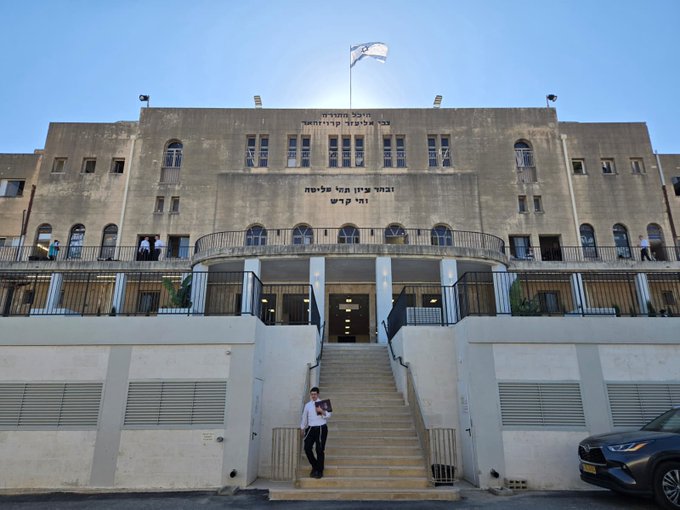
In a landscape often defined by nuanced distinctions of belief, custom, and communal identity, a singular and quietly powerful tradition continues to unfold each year in the heart of Bnei Brak. There, within one of the most esteemed centers of Torah scholarship, an act both symbolic and deeply intentional rises above the rooftops—literally and figuratively. At Ponevezh Yeshiva, the Israeli flag is raised each year on Independence Day, an enduring custom that has persisted for decades and continues to resonate far beyond the walls of the institution.
As reported on Wednesday by Jewish Breaking News, this practice stands as a striking anomaly within the chareidi world, where public observance of national holidays is often subdued or altogether absent. Yet at Ponevezh, the deliberate act of hoisting the national flag above the beis medrash serves as a visual and philosophical statement—one that invites reflection on the relationship between religious tradition and national identity.
The roots of this tradition can be traced to the founding vision of Rabbi Yosef Shlomo Kahaneman, a towering figure in the post-war reconstruction of Torah life. Known for his unwavering commitment to scholarship and community building, Rabbi Kahaneman established the yeshiva in the years following the devastation of European Jewry, with the aim of restoring a world that had been nearly extinguished.
From the earliest days of the State of Israel, he perceived its establishment not solely through the prism of political sovereignty, but as a moment imbued with profound historical and spiritual significance. In his view, the emergence of a Jewish homeland represented a form of divine providence—a development that, regardless of its complexities, contributed to the preservation and flourishing of Jewish life.
It was within this framework that Rabbi Kahaneman instituted the practice of raising the Israeli flag on Yom Ha’atzmaut. The act was intended as an expression of gratitude and recognition, acknowledging the role of the state in providing a refuge and a foundation for Jewish continuity in the modern era.
Each year, as Independence Day dawns, the yeshiva follows a precise and carefully maintained routine. The flag is raised in the morning hours, positioned prominently above the central building, where it remains visible to students, residents, and passersby alike. After approximately eight hours—typically extending into the afternoon—it is respectfully lowered, marking the conclusion of the observance.
This temporal structure is not incidental; it reflects a measured approach that balances acknowledgment with restraint. The duration of the display allows for recognition of the day’s significance without transforming it into an all-encompassing celebration. In this way, the practice embodies a nuanced equilibrium, one that aligns with the broader ethos of the institution.
The Jewish Breaking News report noted that the visual impact of the flag’s presence is both immediate and profound. Against the backdrop of Bnei Brak, a city characterized by its deep-rooted adherence to tradition and its relative distance from overt national symbolism, the sight of the Israeli flag atop a leading yeshiva is both unexpected and evocative.
The flag itself, while a simple object, carries layers of meaning that extend far beyond its physical form. In the context of Ponevezh Yeshiva, it functions as a bridge between worlds—linking the insular environment of Torah study with the broader national narrative.
For many observers, the tradition challenges prevailing assumptions about the relationship between the chareidi community and the State of Israel. It suggests that the dichotomy often drawn between religious devotion and national identity may, in certain contexts, be more permeable than commonly perceived.
This perspective is particularly significant in a society where questions of identity and affiliation are frequently the subject of debate. The practice at Ponevezh offers an alternative model, one in which acknowledgment of the state’s role coexists with an unwavering commitment to Torah values.
The continuation of this tradition over decades has elicited a range of responses, both within and beyond the chareidi community. For some, it represents a source of inspiration—a reminder that unity and shared heritage can transcend differences in outlook and practice.
For others, it prompts reflection on the evolving nature of communal identity in a rapidly changing world. The fact that such a practice has endured, even as broader societal dynamics have shifted, speaks to its resonance and relevance.
The Jewish Breaking News report highlighted the ways in which the tradition is perceived by different segments of the population. Among those who identify with the chareidi worldview, it is often seen as a unique expression of balance—an acknowledgment of reality that does not compromise foundational principles.
At the same time, for individuals outside the community, the sight of the flag at Ponevezh can serve as a powerful symbol of connection, reinforcing the idea that, despite differences, a shared sense of belonging persists.
The establishment of the State of Israel marked a turning point in Jewish history, reshaping the contours of identity, community, and collective memory. For institutions such as Ponevezh Yeshiva, founded in the aftermath of immense loss, the emergence of a sovereign state carried particular significance.
Rabbi Kahaneman’s decision to incorporate the flag-raising into the yeshiva’s annual cycle can thus be understood as part of a broader effort to situate the institution within this new historical context. By acknowledging the country in this manner, he sought to affirm a connection that, while not defined by political alignment, recognized the broader implications of its existence.
The continuation of this practice across generations underscores its enduring relevance. Successive leaders and students have maintained the tradition, ensuring that it remains a living expression of the values and perspectives that informed its inception.
Independence Day, by its very nature, invites reflection on themes of freedom, resilience, and collective identity. At Ponevezh Yeshiva, the raising of the flag serves as a focal point for such reflection, offering a moment in which the past and present converge.
The act is not accompanied by elaborate ceremonies or public fanfare. Instead, it unfolds with a quiet dignity that reflects the character of the institution. The absence of overt celebration does not diminish its significance; rather, it reinforces the contemplative nature of the observance.
The Jewish Breaking News report emphasized that this understated approach is integral to the tradition’s meaning. It allows the gesture to speak for itself, conveying a message that is both subtle and profound.
In a society marked by diversity of thought and practice, symbols that foster connection are particularly valuable. The tradition at Ponevezh Yeshiva, while rooted in a specific context, carries implications that extend beyond its immediate setting.
It suggests that acknowledgment of shared milestones need not entail uniformity of perspective. Instead, it can serve as a basis for dialogue and understanding, creating space for different voices to coexist within a broader framework of mutual respect.
This capacity to bridge divides is perhaps one of the most compelling aspects of the practice. By raising the flag, the yeshiva affirms a connection to the collective story of the Jewish people, while maintaining its distinct identity and priorities.
As the years pass and the State of Israel continues to evolve, the tradition at Ponevezh Yeshiva remains a constant—a quiet yet powerful reminder of the complex interplay between faith, history, and identity.
The annual raising of the flag, as documented by Jewish Breaking News, is more than a ritual; it is a statement. It speaks to the possibility of honoring multiple dimensions of belonging, of recognizing the significance of national milestones while remaining deeply rooted in religious tradition.
In a world often characterized by division, such gestures carry particular weight. They invite reflection, inspire dialogue, and, perhaps most importantly, remind us of the threads that bind us together.
Above the beis medrash in Bnei Brak, the flag continues to rise each year—not as a symbol of uniformity, but as a testament to the enduring strength of a people united by history, faith, and a shared future.



