






























|
Getting your Trinity Audio player ready...
|
In every generation, antisemitism has reappeared in new guises, adapting itself to prevailing cultural and political currents while retaining its ancient core of hostility toward the Jewish people. That historical reality, while tragic, is not new. What is new—and profoundly more dangerous—is the unmistakable normalization and rationalization of antisemitism now unfolding in New York and New Jersey, regions that have long stood as pillars of Jewish life in the United States.
Recent data and reporting, including detailed coverage by VIN News and corroborating accounts cited by regional sources such as New Jersey 101.5, reveal a deeply disquieting trajectory. The numbers themselves are stark, but it is their underlying meaning that demands urgent attention. The United States recorded 6,274 antisemitic incidents in 2025, a figure that, while representing a 33% decrease from the unprecedented peak of 2024, remains the third-highest total since tracking began in 1979. Yet these aggregate figures obscure a far more ominous development: the escalation of violence and the erosion of societal inhibitions against expressing hatred.
The Anti-Defamation League stated unequivocally that “2025 marked one of the most violent periods for American Jews.” That conclusion, repeatedly underscored in reporting by VIN News, is borne out by the data. Physical assaults reached a record 203 incidents, marking a 4% increase and the highest level ever documented. Even more alarming is the 39% surge in attacks involving deadly weapons, alongside the reappearance of antisemitic fatalities for the first time since 2019.
These figures are not abstract. They represent human beings targeted, assaulted, and in some cases killed because of their identity. On average, 17 antisemitic incidents occurred each day across the nation in 2025—a relentless drumbeat of hostility that has transformed what was once episodic into something disturbingly routine.
Nowhere is this phenomenon more acute than in New York and New Jersey. New York recorded 1,160 incidents, with New York City alone accounting for 860, concentrated heavily in Manhattan and Brooklyn. These are not peripheral areas; they are the heart of American Jewish communal life. Meanwhile, New Jersey has emerged as a focal point of violent antisemitism, recording 20 physical assaults in 2025—nearly 10% of the national total.
As New Jersey 101.5 reported, these incidents meet a stringent threshold: they are counted only when there is clear evidence that the perpetrator’s motivation was explicitly rooted in the victim’s Jewish identity. “To make the ADL audit, the attacker’s motivation must be based on the victim’s Jewish identity,” explained regional director Scott Richman. This is not incidental violence; it is targeted hate.
Equally troubling is the persistence of elevated incident levels following the October 7, 2023 massacre in Israel. While one might have expected a gradual reversion to baseline levels, the data suggests otherwise. New Jersey recorded 687 antisemitic incidents in 2025, a mere 4% decline from the previous year. “For the most part, the war in Gaza has ended, yet we’re seeing that incidents are not going back to anywhere near where they were pre-10/7,” Richman observed. “So, our concern is that this is a new normal.”
That phrase—“a new normal”—should serve as a clarion call. It encapsulates the central danger of the current moment. Antisemitism is no longer confined to the margins; it is increasingly embedded within the mainstream. It is expressed not only through acts of violence but through rhetoric, symbolism, and public demonstrations that are tolerated, excused, or even justified under the guise of political expression.
The events surrounding the protest outside the Park East Synagogue in Manhattan illustrate this troubling shift. What might once have been universally condemned as an act of intimidation is now frequently reframed as legitimate protest, even when it crosses the line into overt hostility toward Jewish identity. Witnesses described protesters shouting slurs and threats, attempting to block access to a house of worship. Video evidence, cited in reporting by VIN News, captured language that many observers characterized as unmistakably antisemitic.
The danger lies not only in the actions themselves but in the reactions they elicit—or fail to elicit. When such behavior is minimized, contextualized, or rationalized, it sends a powerful signal: that antisemitism is, if not acceptable, then at least tolerable. This is the normalization that must be confronted.
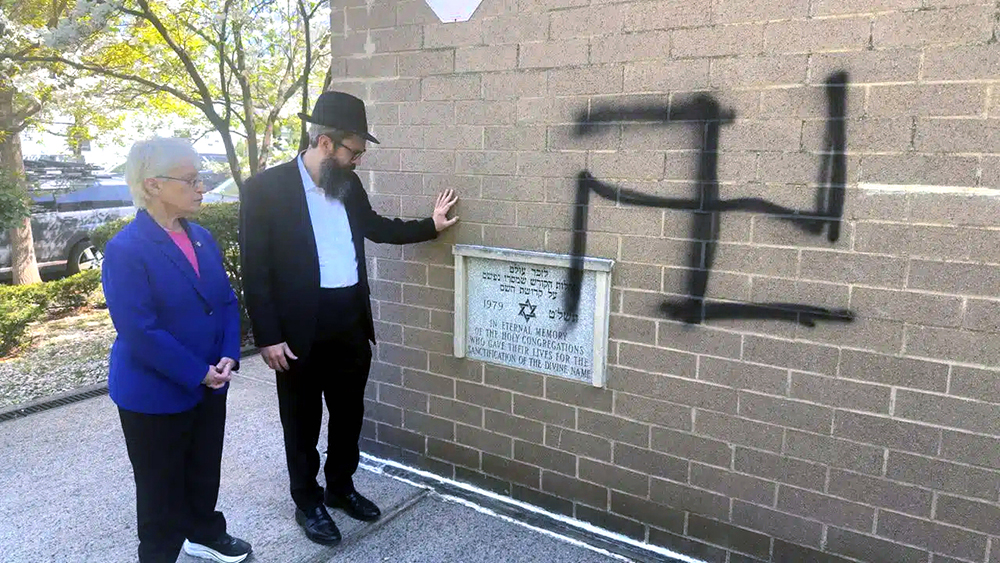
Similarly, the prevalence of vandalism and harassment—ranging from swastika graffiti to verbal abuse—contributes to a pervasive climate of fear. In New Jersey, approximately one-third of incidents are classified as vandalism, while the majority involve harassment. These acts, though less physically destructive than assaults, are no less corrosive. They erode the sense of security that is fundamental to communal life, transforming everyday spaces into potential sites of hostility.
It is essential to recognize that antisemitism has always existed. It has appeared in different forms across different eras, from medieval persecution to modern ideological hostility. What distinguishes the current moment is not its existence but its legitimization. The barriers that once constrained its expression—social norms, institutional safeguards, and moral clarity—are weakening.
This erosion is not inevitable, nor is it irreversible. It demands a collective response that transcends political, religious, and cultural divisions. The fight against antisemitism cannot be relegated to the Jewish community alone; it must be embraced as a broader societal imperative.
First, there must be an unequivocal rejection of antisemitism in all its forms. This includes not only overt acts of violence but also rhetoric and imagery that dehumanize or delegitimize Jewish identity. There can be no ambiguity, no equivocation, and no selective outrage.
Second, institutions—educational, governmental, and civic—must reaffirm their commitment to combating hate. This requires not only robust enforcement of existing laws but also proactive measures to address the cultural and informational ecosystems that enable antisemitism to flourish.
Third, there must be a renewed emphasis on education. As history has shown, ignorance is fertile ground for hatred. By fostering a deeper understanding of Jewish history, culture, and contributions, society can build resilience against the narratives that fuel antisemitism.
Finally, individuals must recognize their role in shaping the social environment. Silence in the face of hate is not neutrality; it is complicity. Each instance of antisemitism that goes unchallenged contributes to its norma


