



















|
Getting your Trinity Audio player ready...
|
By: Max Schleifer
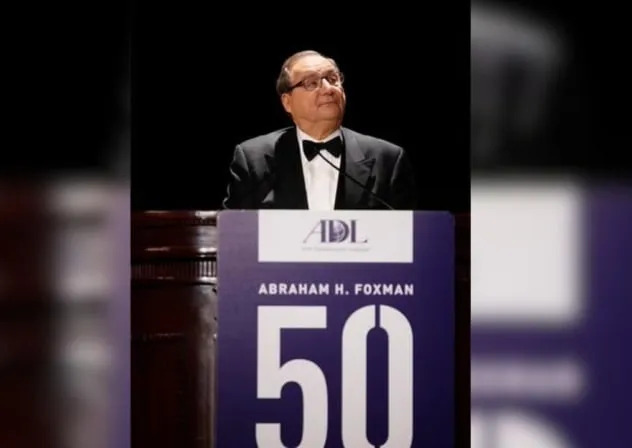
The passing of Abraham Foxman at the age of 86 marks the end of an era defined by moral clarity, intellectual rigor, and unyielding advocacy on behalf of the Jewish people and the broader fight against hatred in all its manifestations. A Holocaust survivor whose earliest days were shaped by the existential peril of Nazi persecution, Foxman would go on to spend more than 50 years at the Anti-Defamation League, ultimately emerging as one of the most influential and recognizable figures in the global struggle against antisemitism.
Foxman’s death on Sunday prompted an outpouring of tributes from colleagues, civic leaders, and institutions around the world, each underscoring the extraordinary breadth of his legacy. For many, his life story—beginning in the shadow of genocide and culminating in a distinguished career as a leading advocate for tolerance—embodied both the tragedy and resilience of the Jewish experience in the 20th and 21st centuries.
Born in the town of Baranovich at a moment when Nazi forces were tightening their grip across Eastern Europe, Foxman—then known as Fuksman—entered a world already descending into catastrophe. In a desperate effort to save their infant son, his parents entrusted him to the care of a Polish Catholic nanny, Bronislawa Kurpi, as they themselves were forced into a ghetto. Under her protection, Foxman was baptized and raised as a Catholic in Vilna for 4 years, a period that would leave an indelible imprint on his identity and worldview.
The circumstances of his survival were as extraordinary as they were precarious. While 14 members of his extended family perished in the Holocaust, Foxman’s parents survived and were eventually reunited with their son in 1944. The emotional resonance of that reunion would later be immortalized in cultural memory, including the well-known account popularized in Abie Rottenberg’s narrative “The Man From Vilna.” According to that story, the handful of Jewish survivors in Vilna, overwhelmed by the sight of a living child after years of devastation, lifted young Foxman onto their shoulders and danced with him on Simchas Torah in place of sacred scrolls—a poignant symbol of continuity amidst destruction.
Following the war, Foxman and his family emigrated to the United States, where he would begin the long journey of rebuilding a life interrupted by unimaginable trauma. He pursued his education with determination, attending the Yeshiva of Flatbush before enrolling at the City College of the City University of New York and later the New York University School of Law. It was at the conclusion of his legal studies that Foxman embarked on what would become a lifelong vocation.
In 1965, he joined the Anti-Defamation League as an assistant director of legal affairs. Over the ensuing decades, Foxman rose steadily through the organization’s ranks, demonstrating a combination of legal acumen, strategic insight, and passionate conviction that would define his tenure. In 1987, he was appointed national director, a position he would hold for 28 years until his retirement in 2015.
During that time, Foxman transformed the ADL into a formidable force in both domestic and international arenas. As noted by Jonathan Greenblatt, his successor as CEO and national director, “America and the Jewish people have lost a moral voice, a passionate advocate for the Jewish people and the state of Israel, and a remarkable leader.” Greenblatt further emphasized that “Abe Foxman was an iconic Jewish leader who embraced the ideal of an America free from antisemitism and hate and who strongly believed that these scourges could be defeated if good people opposed it.”
Foxman’s influence extended far beyond the confines of the organization he led. He became a trusted advisor to presidents, a respected interlocutor for religious leaders, and a persistent critic of intolerance wherever it appeared. His voice, as Greenblatt observed, “was heard—and listened to—by popes, presidents, and prime ministers,” a testament to the authority he commanded on the global stage.
Central to Foxman’s philosophy was a profound understanding of the power of language. He frequently articulated a principle that would guide much of his work: “The Holocaust did not begin with bricks and mortar and gas chambers, but rather, it began with words.” This insight informed the ADL’s emphasis on education and anti-bias training, initiatives that Foxman championed as essential tools in preventing the spread of hatred.
Under his leadership, the ADL confronted antisemitism in all its forms, whether emanating from the political left or right, from domestic actors or international regimes. Foxman was equally committed to defending the legitimacy and security of Israel, advocating for a vision of the state that was both Jewish and democratic. His approach was characterized by a willingness to engage in difficult conversations, challenge prevailing narratives, and hold leaders accountable for their actions.
Nicole Munchnik, chair of the ADL Board, reflected on Foxman’s multifaceted legacy in a statement that captured both his public achievements and personal qualities. “Abe Foxman helped build the modern liberal era of America,” she said. “He was recognized across the globe as a great leader and passionate advocate for tolerance, a voice of the generation rebuilding in the shadow of the Shoah, and longtime advisor to American presidents and world leaders.” She added that to those who knew him personally, “Abe was a warm friend, advisor, spirited antagonist and hugger—all over lunch.”
Munchnik also extended condolences on behalf of the organization, stating, “On behalf of the ADL Board of Directors, and our thousands of ADL volunteer leaders over decades, I extend our deepest condolences to his beloved Golda and beautiful family, who were the ultimate prizes of his life.”
Foxman’s personal story remained a touchstone throughout his career, shaping his perspective and informing his advocacy. The experience of being hidden, baptized, and raised in a different faith tradition during the Holocaust instilled in him a nuanced understanding of identity and survival. It also reinforced his commitment to ensuring that such atrocities would never be repeated.
Despite the horrors he endured, Foxman was not defined by bitterness but by a resolute belief in the possibility of progress. He maintained that antisemitism and other forms of hatred, while persistent, could be confronted and ultimately diminished through education, vigilance, and collective action. This optimism, grounded in a clear-eyed assessment of reality, became a hallmark of his leadership.
His retirement in 2015 marked the conclusion of an extraordinary chapter in the history of the ADL, but his influence continued to resonate in the organization’s ongoing work. Even after stepping down, Foxman remained an active voice in public discourse, offering commentary on issues ranging from rising antisemitism to the complexities of international relations.
The scope of his impact is perhaps best understood through the generations of leaders and advocates he inspired. Many who worked alongside him have spoken of his mentorship, his intellectual rigor, and his unwavering dedication to principle. His legacy is reflected not only in the institutional strength of the ADL but also in the broader movement for civil rights and social justice that he helped to shape.
In reflecting on Foxman’s life, it is impossible to disentangle the personal from the professional. His journey from a hidden child in wartime Europe to a global advocate for tolerance encapsulates a narrative of survival, resilience, and purpose. It is a story that resonates far beyond the Jewish community, offering lessons about the capacity of individuals to effect meaningful change in the face of adversity.
As tributes continue to pour in, one theme remains constant: the recognition that Foxman’s voice—so clear, so principled, so persistent—will be deeply missed. Yet his work endures, carried forward by those who share his commitment to a world in which hatred is neither tolerated nor ignored.
In the words of Greenblatt, “Abe Foxman spoke on the global stage with moral authority and clarity and was relentlessly dedicated to his pursuit of a world without hate.” That pursuit, shaped by the experiences of his earliest years and sustained over decades of tireless effort, stands as a testament to the enduring power of conviction.
Foxman is survived by his wife Golda, his children Michelle and Ariel, his son-in-law Brandon Cardet-Hernandez, and his grandchildren Cielo, Leila, Gideon, and Amirit. For them, as for the countless individuals whose lives he touched, his legacy is both deeply personal and profoundly public.
May his memory be for a blessing.



