
















|
Getting your Trinity Audio player ready...
|
By: Fern Sidman
In a stark and deeply consequential assessment of the modern information landscape, Israel’s Ministry of Diaspora Affairs and Combating Antisemitism has released a sweeping report identifying what it describes as the ten most influential purveyors of antisemitic rhetoric worldwide in 2025. The findings, widely cited and analyzed by The Algemeiner in a report on Thursday, illuminate a troubling convergence of digital amplification, ideological extremism, and cultural influence that has propelled anti-Jewish sentiment into the mainstream of global discourse.
At the apex of this controversial ranking stands Dan Bilzerian, a social media personality whose incendiary rhetoric and expansive online reach have, according to the report, elevated him to the position of the most influential antisemitic figure of the year. The designation reflects not merely the severity of his statements—many of which have drawn condemnation for invoking conspiratorial narratives and outright hostility toward Jews and Israel—but also the extraordinary scale of his digital platform, which spans tens of millions of followers. The Algemeiner report noted that Bilzerian’s rhetoric has frequently crossed into the realm of explicit provocation, including statements endorsing violence and dismissing antisemitism as a fabricated construct.
Bilzerian’s recent entry into American electoral politics, having filed candidacy paperwork to challenge an incumbent congressman in Florida, has further intensified scrutiny. Critics argue that his political ambitions risk legitimizing rhetoric that has long been relegated to the fringes, thereby embedding it within the formal structures of democratic society. The report underscores that influence, rather than official position, was the central metric guiding the rankings—a methodology that reflects the growing recognition that social media personalities can wield power comparable to, or even exceeding, that of traditional political actors.
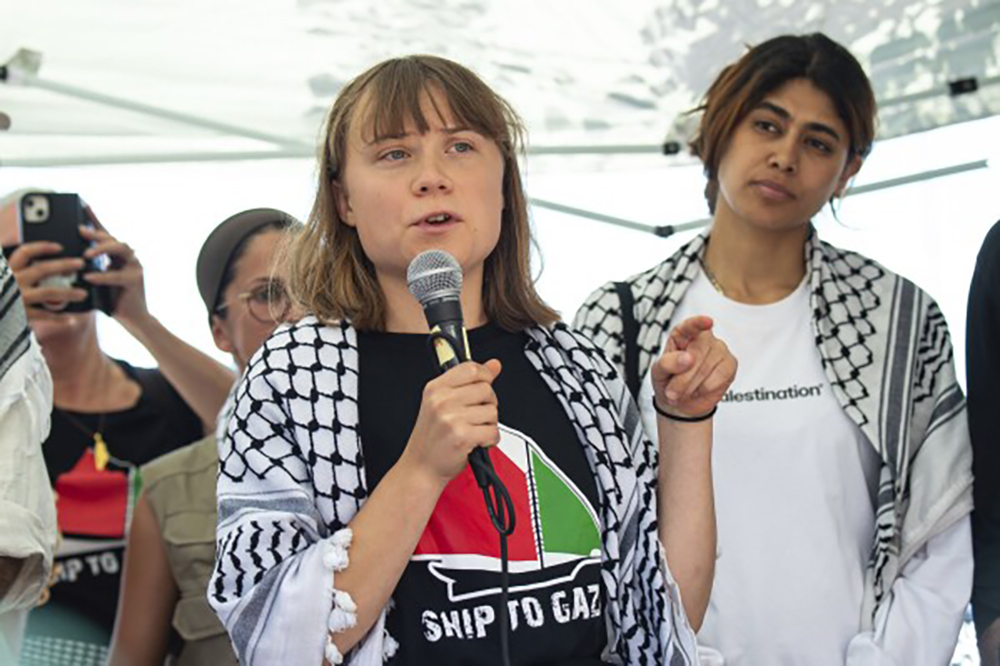
Occupying the second position is Swedish climate activist Greta Thunberg, whose inclusion has sparked considerable debate across ideological lines. According to the Ministry’s analysis, Thunberg’s repeated use of charged terminology—particularly in relation to Israel’s military operations—has contributed to narratives that, in the view of Israeli officials, blur the line between legitimate political criticism and the perpetuation of antisemitic tropes. The Algemeiner reported that the Ministry identified her rhetoric as emblematic of a broader trend in which moral language is deployed in ways that can, intentionally or otherwise, stigmatize Jewish identity by association with geopolitical conflict.
The third-ranked figure, Egyptian satirist and former television host Bassem Youssef, represents another dimension of the phenomenon: the role of cultural commentary in shaping public perceptions. Youssef’s commentary, often framed as political satire, has been scrutinized for its sharp critiques of Israel, which detractors argue sometimes veer into territory that reinforces longstanding prejudices. Similarly, American commentator Candace Owens, ranked fourth, has drawn attention for statements that critics contend echo conspiratorial narratives about Jewish influence, further illustrating the ideological diversity of those included in the report.
The list continues with Palestinian-British journalist Abdel Bari Atwan, whose editorial influence within certain media circles has been identified as a significant vector for anti-Israel sentiment. He is followed by a range of figures spanning religious leadership, online conspiracy culture, and extremist political commentary. Among them are Imam Omar Suleiman, physician and commentator Anastasia Maria Loupis, white nationalist figure Nick Fuentes, and conspiracy theorist Ian Carroll. Each, according to the Ministry’s findings, has contributed to the dissemination of narratives that either directly target Jewish communities or propagate misinformation about Israel in ways that fuel hostility.
Rounding out the top ten is media personality Tucker Carlson, whose platform and reach have rendered his commentary particularly consequential. While Carlson’s defenders characterize his positions as critiques of political power structures, the Ministry’s report, as cited by The Algemeiner, contends that his rhetoric frequently aligns with themes historically associated with antisemitic discourse. This inclusion underscores the report’s broader thesis: that antisemitism in the contemporary era is not confined to a single ideological camp but instead manifests across a wide spectrum of political and cultural contexts.
The methodology underpinning the rankings is itself a subject of considerable interest. According to the Ministry, individuals were evaluated based on a composite of factors, including the severity and frequency of their statements, the size and engagement of their audiences, and their perceived influence on public opinion. Particular emphasis was placed on digital activity, reflecting the central role of social media platforms in shaping modern discourse. The report highlights how algorithmic amplification can elevate extreme or sensational content, thereby extending its reach far beyond its original audience.
This digital dimension is critical to understanding the broader implications of the findings. As The Algemeiner has documented, the proliferation of antisemitic narratives online has coincided with a measurable increase in real-world incidents, ranging from verbal harassment to physical violence. The Ministry’s report suggests that the normalization of such rhetoric within influential digital spaces may be contributing to an environment in which prejudice is not only tolerated but, in some cases, actively encouraged.
In a separate section focusing on the United States, the report identifies additional figures whose online activity has drawn scrutiny. Among them is the widely recognized children’s content creator Ms. Rachel, whose social media posts addressing the Israeli-Palestinian conflict have been criticized by pro-Israel organizations. While her inclusion does not place her among the top global influencers, it reflects the Ministry’s concern that even ostensibly apolitical platforms can become conduits for contentious narratives. The Algemeiner report noted that this aspect of the report has sparked debate about the boundaries between advocacy, education, and the inadvertent spread of one-sided or misleading information.
The timing of the report’s release—coinciding with Holocaust Remembrance Day—imbues it with particular symbolic weight. By situating its findings within the context of historical memory, the Ministry seeks to draw a direct line between the lessons of the past and the challenges of the present. The resurgence of antisemitic rhetoric, especially in digitally mediated forms, is framed not merely as a contemporary issue but as part of a broader continuum that demands vigilance and proactive response.
Critics of the report have raised concerns about its scope and criteria, arguing that the inclusion of certain figures risks conflating legitimate political criticism with antisemitism. However, proponents contend that the distinction is not always clear-cut, particularly when criticism employs language or imagery that resonates with historical prejudices. This tension underscores the complexity of addressing antisemitism in an era characterized by rapid information exchange and diverse modes of expression.
What emerges most forcefully from the Ministry’s analysis, as reflected in coverage by The Algemeiner, is the recognition that influence in the twenty-first century is increasingly decoupled from traditional institutions. The individuals named in the report derive their power not from formal authority but from their ability to command attention, shape narratives, and mobilize audiences on a global scale. In this sense, the report serves as both a diagnostic tool and a warning, highlighting the need for new strategies to confront the evolving landscape of hate.
As governments, civil society organizations, and technology companies grapple with these challenges, the question of accountability looms large. The Ministry’s report implicitly calls for a reevaluation of how influence is measured and regulated in the digital age, as well as a renewed commitment to combat antisemitism in all its forms. Whether through policy interventions, educational initiatives, or platform governance, the imperative to address the spread of hatred remains as urgent as ever.
In the final analysis, the ranking of antisemitic influencers is less an endpoint than a starting point—a catalyst for deeper reflection on the forces shaping contemporary discourse and the responsibilities that accompany them. As The Algemeiner report underscored, the stakes extend far beyond the individuals named in the report, encompassing the broader question of how societies can safeguard truth, dignity, and mutual respect in an increasingly interconnected world.



