
























|
Getting your Trinity Audio player ready...
|
No Surprises, No Illusions: Netanyahu Signals Unwavering Resolve as US–Iran Talks Accelerate Toward Uncertain Endgame
By: Fern Sidman
Amid intensifying diplomatic maneuvering and a rapidly evolving geopolitical landscape, Benjamin Netanyahu delivered a forceful and meticulously calibrated statement at the opening of Israel’s political security cabinet meeting, addressing mounting reports that Jerusalem had been caught off guard by recent progress in negotiations between the United States and Iran. His remarks, cited in a report on Wednesday by Israel National News, sought to dispel any perception of discord between Israel and its principal ally, while simultaneously reinforcing the strategic red lines that continue to define Israeli policy.
“We are in constant contact with our friends in the United States,” Netanyahu declared, underscoring what he described as an unbroken chain of communication between Jerusalem and Washington. “I speak with President Trump almost on a daily basis. My people and his people speak on a daily basis, including today. And I will also speak with President Trump later tonight.”
The Prime Minister’s insistence on continuous coordination appeared designed to counter earlier reports suggesting that Israel had been taken by surprise by the pace and substance of diplomatic developments. According to the Israel National News report, Netanyahu moved swiftly to reject that narrative in unequivocal terms.
“We have full coordination, there are no surprises,” he stated. “We share common goals, and the most important goal is to remove the enriched material from Iran, all the enriched material, and dismantle the enrichment capabilities from Iran.”
Netanyahu’s articulation of Israel’s core objective—complete removal of enriched nuclear material and the dismantling of Iran’s enrichment infrastructure—reflects a maximalist position that has long guided Israeli security doctrine. By emphasizing the elimination of both existing stockpiles and future capabilities, the Prime Minister signaled that partial measures or temporary constraints would be insufficient.
“President Trump believes he can achieve it one way or another,” Netanyahu continued, offering a measured endorsement of Washington’s diplomatic efforts while leaving open the possibility of alternative pathways. “But we are prepared for any scenario, and this is my instruction to the IDF and our security forces.”
The phrase “prepared for any scenario,” highlighted in coverage by Israel National News, carries unmistakable implications. It suggests that while Israel remains aligned with diplomatic initiatives, it is simultaneously maintaining readiness for unilateral or coordinated military action should negotiations fail to produce outcomes deemed acceptable.
“Israel is stronger than ever, Iran and its proxies are weaker than ever,” Netanyahu added, framing the current moment as one of relative strategic advantage for Israel.
Despite Netanyahu’s assurances of seamless coordination, earlier reporting introduced an element of ambiguity into the evolving narrative. A report cited by Reuters indicated that Israeli officials had been surprised by a shift in the position of President Trump regarding negotiations with Tehran.
This apparent divergence underscores the inherent complexity of alliance dynamics, particularly when rapid diplomatic developments intersect with deeply entrenched security concerns. While Netanyahu’s public statements emphasized unity, the existence of such reports suggests that internal deliberations may be more nuanced.
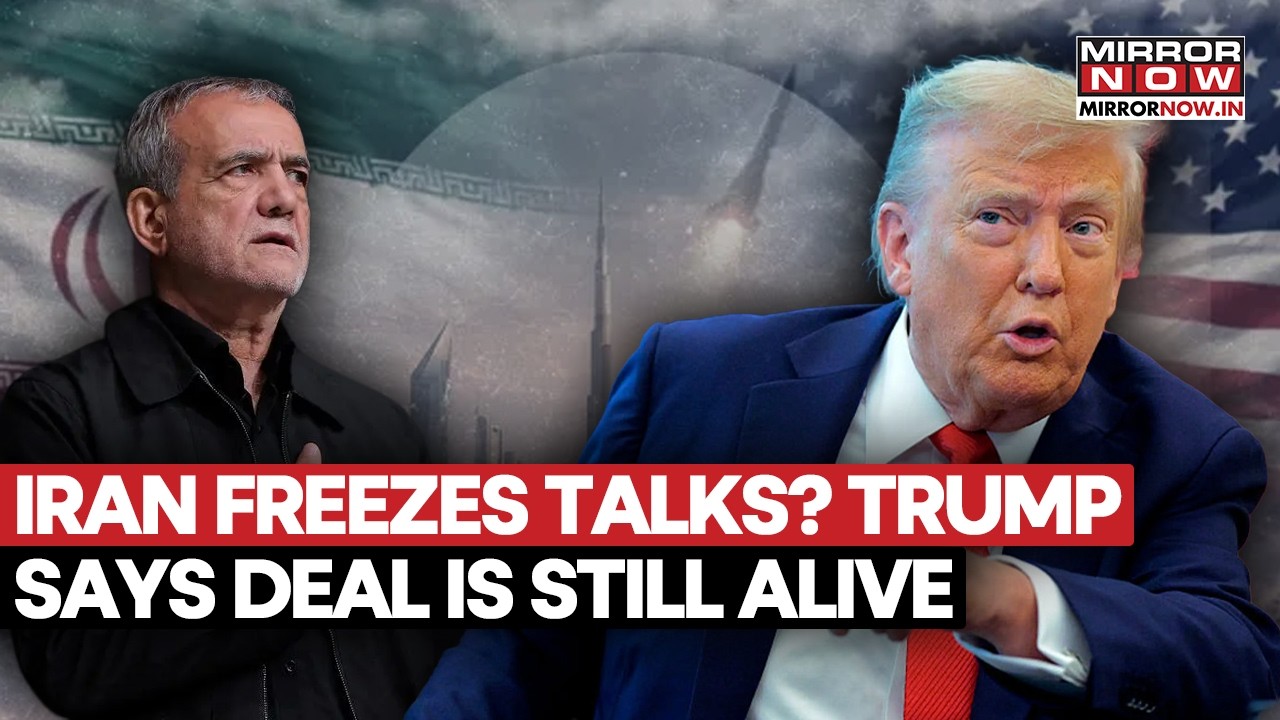
Trump himself has contributed to the sense of fluidity, signaling both optimism and caution in his public remarks. According to a report on Axios, the President indicated that a deal to bring the conflict to a close could potentially be reached before his forthcoming trip to China.
The possibility of an imminent agreement has been further reported on by Axios, which described negotiations between the United States and Iran as nearing completion of a concise, one page framework intended to halt hostilities.
According to the report, the proposed arrangement would include several key components: mutual easing of restrictions related to transit through the Strait of Hormuz, the lifting of certain sanctions by the United States, the release of frozen Iranian assets, and a commitment by Iran to a moratorium on nuclear enrichment.
Crucially, many of these provisions would be contingent upon the successful negotiation of a more comprehensive final agreement, suggesting that the current framework is intended as an interim measure rather than a definitive resolution.
The notion of a “moratorium” on enrichment, rather than a permanent cessation, is likely to be a focal point of contention. For Israeli leadership, as articulated by Netanyahu, the complete dismantlement of enrichment capabilities remains the ultimate objective.
Even as diplomatic efforts appear to gain momentum, the specter of military escalation remains ever present. In a stark warning reported by Axios, Trump issued an ultimatum to Iran, leaving little room for ambiguity.
“If they do not agree, the bombing starts, and it will be, sadly, at a much higher level and intensity than it was before,” the President stated.
This declaration introduces a dual track dynamic into the negotiations: the pursuit of a diplomatic settlement underpinned by the credible threat of force. The combination of these elements reflects a strategy aimed at maximizing leverage while preserving the option of decisive action.
At the same time, Trump tempered expectations regarding immediate breakthroughs in direct engagement. In remarks cited by The New York Post, he cautioned that it was “too soon” to discuss face to face negotiations with Iranian officials, adding that new talks in Pakistan were not imminent.
The outcome of these negotiations carries profound implications not only for the United States and Iran but for the broader Middle East. The Strait of Hormuz, a critical artery for global energy supplies, features prominently in the proposed agreement, underscoring the economic dimensions of the الأزمة—ensuring English: situation.
For Israel, the stakes are particularly acute. The prospect of an agreement that falls short of eliminating Iran’s nuclear capabilities raises fundamental questions about long term security. At the same time, the potential for military escalation introduces risks that extend far beyond the immediate theater.
Netanyahu’s emphasis on preparedness reflects an acute awareness of these dynamics. By maintaining a posture of readiness, Israel seeks to ensure that it retains the capacity to respond swiftly to any unfavorable developments.
The interplay between Israeli and American positions will be critical in shaping the trajectory of events. Netanyahu’s repeated assertions of “full coordination” suggest a deliberate effort to project unity, both to domestic audiences and to adversaries.
Yet the underlying complexities of the situation mean that differences in approach may persist beneath the surface. The United States, balancing diplomatic, economic, and strategic considerations, may prioritize flexibility in negotiations. Israel, confronting what it perceives as an existential threat, may adopt a more rigid stance.
This delicate balance will require careful management to prevent misunderstandings or miscalculations that could have far reaching consequences.
As negotiations approach what appears to be a decisive phase, the choices made by leaders in Washington, Jerusalem, and Tehran will determine the course of the conflict. The convergence of diplomatic urgency and strategic caution creates a moment of heightened tension and possibility.
For Netanyahu, the message is clear and consistent. “We share common goals,” he reiterated, while simultaneously emphasizing the non negotiable nature of Israel’s core demands.
For Trump, the path forward appears to involve a combination of negotiation and pressure, with the potential for escalation serving as a constant backdrop.
The evolving situation, as documented by Israel National News and Axios, reflects a complex interplay of diplomacy, deterrence, and strategic calculation. While the prospect of an agreement offers a glimmer of resolution, the underlying tensions and divergent objectives ensure that uncertainty remains a defining feature of the landscape.
In Netanyahu’s words, “There are no surprises,” a statement intended to convey confidence and control. Yet in a region where events can shift with startling speed, such assurances are inevitably tested.
What emerges in the coming days will not only determine the fate of the current negotiations but will also shape the strategic environment for years to come. Whether through diplomacy, confrontation, or a precarious combination of both, the path forward remains fraught with risk and consequence.



