





















|
Getting your Trinity Audio player ready...
|
By: Chaya Abecassis
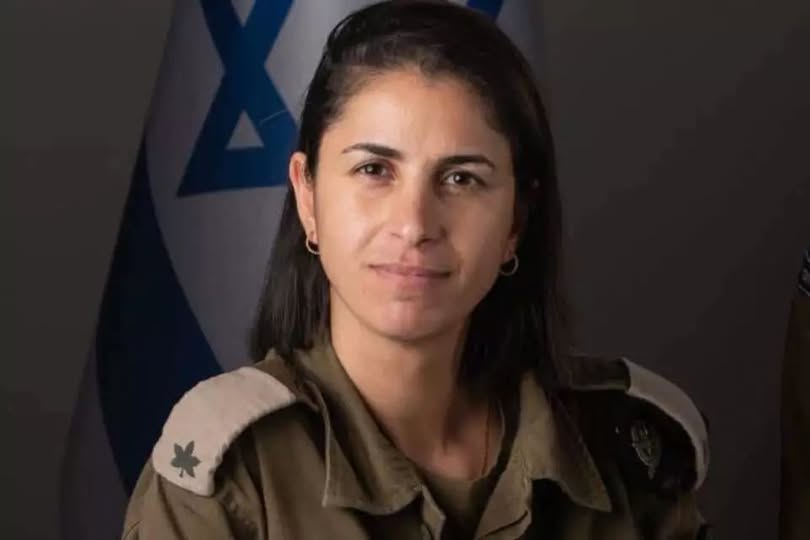
In a region so often defined by division, conflict, and entrenched narratives of separation, a singular image has emerged from the heart of Israel’s military establishment—an image that, in its quiet yet unmistakable power, challenges prevailing assumptions and underscores the country’s complex social fabric. At an air force base in southern Israel, Lieutenant Colonel Ella Waweya, a Muslim woman and the Arabic-language spokesperson for the Israel Defense Forces, stood before an advanced “Adir” aircraft and delivered a message that resonated far beyond the confines of the military sphere.
“I am standing behind an ‘Adir’ aircraft that is undermining the capabilities of the Iranian regime,” she declared with measured resolve. “We have the plan, the capabilities, and the targets—and we will continue to act with determination, precision, and strength for your security.”
Her words, delivered in the context of an escalating confrontation with Iran, were not merely a statement of military intent. They represented something far more profound: a living testament to the ethos of pluralism and inclusion that defines Israel’s armed forces and, by extension, its broader society.
The Israel Defense Forces have long been characterized not only by their operational readiness but also by their remarkable social composition. Within their ranks serve individuals from a wide array of ethnic, religious, and cultural backgrounds—Jews of diverse origins, Druze, Christians, Bedouin, and increasingly, Muslim men and women who have chosen to contribute to the defense of the state.
Lieutenant Colonel Waweya’s role is particularly significant. As the official Arabic-language spokesperson, she occupies a position that bridges linguistic and cultural divides, addressing audiences both within Israel and across the broader Middle East. Her presence in such a prominent capacity is emblematic of a system that, while not without its challenges, actively incorporates minority voices into its most visible and consequential institutions.
This inclusivity is not incidental; it is institutional. Muslim soldiers, including Bedouin trackers renowned for their specialized skills, serve alongside their Jewish counterparts in a variety of units. Women—across all communities—have increasingly assumed leadership roles, reflecting a broader commitment to gender equality within the military framework.
The image of a Muslim woman standing beside one of the most advanced aircraft in the Israeli arsenal carries a symbolism that is difficult to overstate. It conveys a message not only to adversaries but also to allies and observers: that Israel’s strength derives not solely from its technological capabilities but from the diversity and cohesion of its people.
In a region where religious identity is often weaponized as a tool of division, the integration of Muslim personnel into the Israeli military challenges reductive narratives. It demonstrates that allegiance to the state and participation in its defense are not confined to a single religious or ethnic group.
Moreover, Waweya’s speech underscores a broader principle: that the defense of Israel is a collective endeavor, encompassing citizens from all walks of life. Her words—firm, articulate, and resolute—embody a shared commitment to security that transcends individual identity.
The military serves as a microcosm of the nation itself—a space where differences are not erased but integrated into a unified purpose.
This is not to suggest an absence of tension or complexity. Like any diverse society, Israel grapples with internal challenges and competing perspectives. However, the elevation of figures such as Lieutenant Colonel Waweya illustrates a deliberate effort to foster inclusion and representation at the highest levels.
Her visibility, particularly during a period of heightened conflict, sends a powerful signal. It affirms that Israel’s defense is not the domain of a singular identity but a shared responsibility embraced by a multifaceted citizenry.
As the aircraft behind her symbolized technological superiority and strategic reach, Lieutenant Colonel Ella Waweya herself embodied something equally vital: the human dimension of national defense. Her presence, her voice, and her role within the IDF serve as a compelling reminder that strength is not measured solely in firepower but in the ability to unite diverse individuals under a common purpose.
In an era marked by polarization and mistrust, her message resonates with a clarity that transcends the immediate context of military operations. It speaks to the possibility of coexistence, the power of inclusion, and the enduring potential of a society that, even amid conflict, strives to reflect the full spectrum of its people.