























|
Getting your Trinity Audio player ready...
|
By: Fern Sidman
In the quiet Polish town of Jedwabne, where the soil itself bears witness to one of the most harrowing episodes of local complicity during the Holocaust, a new and deeply unsettling chapter in the battle over historical memory has emerged. As reported by The Jewish Telegraphic Agency (JTA), a recently erected “information center” at the site of the 1941 massacre has ignited international concern, not for its educational purpose, but for what critics describe as a brazen attempt to distort, obscure, and ultimately deny a well-documented atrocity.
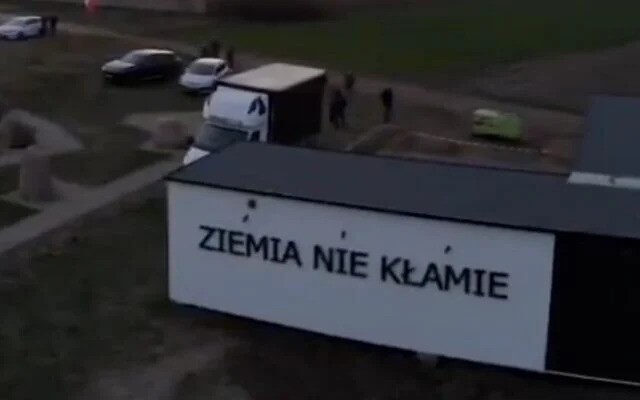
The installation—comprising two imposing shipping containers positioned prominently at the memorial site—has become an immediate focal point of controversy. Towering above the otherwise subdued landscape, the structures project a stark visual presence that appears, to many observers, less an act of commemoration than a provocation. Emblazoned on one container in bold lettering is the phrase “The earth doesn’t lie,” a slogan frequently invoked by those who advocate for the exhumation of the site in an effort to challenge established historical conclusions. According to the JTA report, this messaging aligns closely with a growing movement in Poland that seeks to recast the narrative of the Jedwabne massacre, often shifting blame away from local perpetrators.
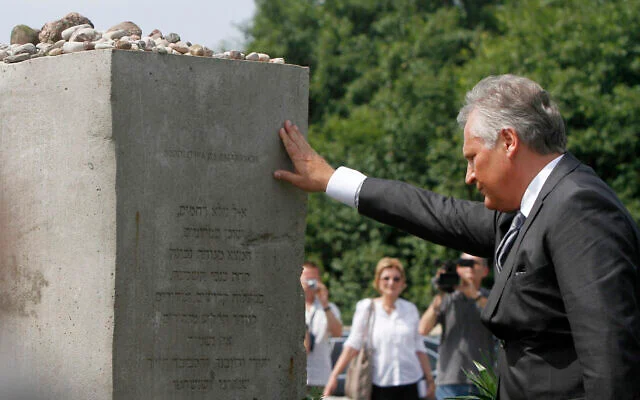
The events of July 10, 1941, in Jedwabne have long been the subject of rigorous historical inquiry. Scholars broadly agree that a significant number of the town’s Jewish residents—numbering in the hundreds—were brutally murdered by their Polish neighbors, many of whom herded victims into a barn and set it ablaze. The atrocity was not carried out in isolation but within the broader context of Nazi occupation, which created the conditions for such violence. Nevertheless, the central role of local participants has been affirmed through decades of research, judicial proceedings, and official acknowledgment.
Central to the preservation of this historical truth is the testimony of Szmul Wasersztein, one of the few survivors of the massacre. As the JTA report recounted, his 1945 deposition provided a detailed account of the events and served as a foundational document in subsequent legal actions. In 1949, twelve Polish residents were convicted for their roles in the killings, a judicial outcome that underscored the veracity of survivor testimony.
Decades later, Wasersztein’s narrative gained renewed prominence through historian Jan Tomasz Gross’s seminal work, Neighbors, published in 2000. The book catalyzed a profound and often painful national reckoning, challenging longstanding narratives that had portrayed Poles exclusively as victims of wartime brutality.
In a gesture of historical accountability, then-President Aleksander Kwasniewski issued a formal apology in 2001, acknowledging the role of Polish citizens in the massacre. The following year, an investigation conducted by Poland’s Institute of National Remembrance corroborated these findings, affirming that the killings were perpetrated by local inhabitants. These conclusions, grounded in extensive forensic and archival evidence, have since formed the basis of scholarly consensus.
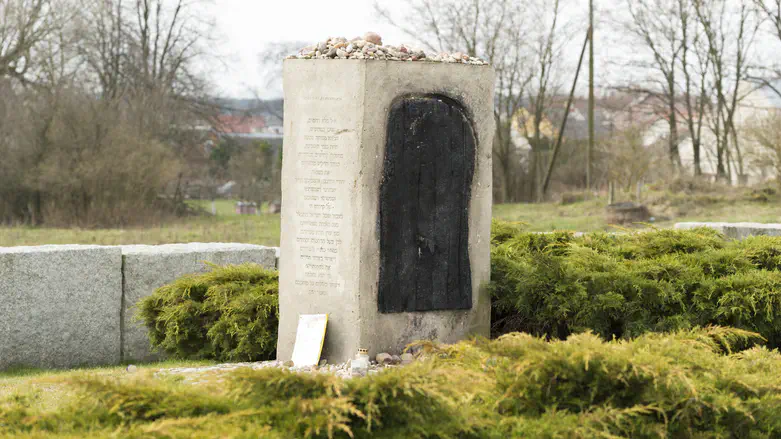
Yet, as the JTA report observed, Jedwabne has increasingly become a battleground in Poland’s contemporary political and cultural discourse. The emergence of nationalist movements has coincided with efforts to reinterpret or outright reject the established historical record. The newly installed containers, unveiled with a ribbon-cutting ceremony by activist Wojciech Sumlinski, represent the latest manifestation of this trend. Sumlinski, who has previously placed boulders at the site bearing inscriptions that deny Polish culpability, has characterized the installation as a triumph over what he terms the “Jedwabne lie.”
For descendants of the victims, such assertions are not merely offensive but profoundly injurious. Abraham Waserstein, the grandson of Szmul Wasersztein, expressed his anguish in remarks to the JTA, describing the installation as a “denial museum” that desecrates the memory of those who perished. For Waserstein and his family, the site is not an abstract historical location but a sacred remnant of a community annihilated. Their efforts to have the structures removed reflect a broader struggle to safeguard the integrity of Holocaust remembrance in the face of revisionist narratives.
The controversy is further complicated by calls from some nationalist figures to exhume the remains at Jedwabne, ostensibly to uncover evidence that would implicate German forces rather than local perpetrators. However, as the JTA report noted, a partial exhumation conducted in 2001 already yielded findings consistent with earlier conclusions, identifying Polish involvement in the killings. The process was halted out of respect for Jewish religious law, which prohibits the disturbance of the dead. For many within the Jewish community, the renewed push for exhumation is perceived not as a legitimate quest for truth but as an attempt to undermine established facts under the guise of scientific inquiry.
The installation also features messaging that frames its mission as a defense of “historical truth” in Poland’s national interest. Such language, while ostensibly neutral, carries significant ideological weight, particularly in a context where the boundaries between scholarship and political advocacy are increasingly contested. Sumlinski himself has used the platform to criticize institutions such as Warsaw’s Polin Museum of the History of Polish Jews, which is internationally recognized for its rigorous and nuanced portrayal of Jewish life in Poland. His rhetoric, as reported by the JTA, positions the new installation as a bulwark against what he perceives as external attempts to shape Poland’s historical narrative.
The tensions surrounding Jedwabne are not confined to academic debates or symbolic gestures. Annual commemorations of the massacre have frequently been marred by disruptions, including protests and acts of intimidation. In one notable incident, a far-right political figure participated in efforts to block visitors, including Poland’s chief rabbi, from leaving the memorial site. Such episodes underscore the extent to which the legacy of Jedwabne continues to polarize public opinion and inflame passions.
Journalist Anna Bikont, whose investigative work has explored the enduring impact of the massacre, has highlighted the depth of local resistance to acknowledging the historical record. As she told the JTA, denial of Polish involvement has become so entrenched that it influences electoral dynamics within the town. Her interviews with individuals connected to the events reveal a persistent reluctance to confront uncomfortable truths, often accompanied by implicit or explicit threats against those who seek to do so.
In response to these challenges, Waserstein and his family have expanded their efforts beyond legal advocacy to include educational initiatives aimed at combating Holocaust denial. Through their nonprofit organization, Shoah Truths, they seek to promote awareness, support research, and provide resources for communities grappling with similar issues. Their work also includes the translation and dissemination of Wasersztein’s memoir, ensuring that his testimony remains accessible to a broader audience.
Legal avenues have likewise been pursued. As the JTA reported, the family filed a notice of criminal activity in Poland, arguing that the installations constitute both desecration and incitement. The investigation, which remains ongoing, represents a critical test of the country’s commitment to upholding the integrity of Holocaust memory. Its outcome may have far-reaching implications, not only for Jedwabne but for similar disputes across Europe.
At its core, the controversy surrounding the Jedwabne “information center” reflects a broader and deeply consequential struggle over the meaning of history itself. In an era marked by the proliferation of misinformation and the politicization of memory, the stakes of this struggle are exceptionally high. The question is not merely how the past is remembered, but whether it is remembered truthfully at all.
As the JTA has so meticulously documented, the events unfolding in Jedwabne serve as a stark reminder that the preservation of historical truth is neither automatic nor assured. It requires vigilance, courage, and an unwavering commitment to confronting even the most painful aspects of human experience. For the descendants of those who perished, and for all who seek to honor their memory, the battle for Jedwabne is not only about the past—it is about the moral foundation upon which the future will be built.



