




























|
Getting your Trinity Audio player ready...
|
German court rulings allowing an anti-Israel encampment at Hamburg’s Moorweide Holocaust site have sparked backlash from Jewish leaders and officials, raising questions about memory, free speech, and historical responsibility.
By: Jeff Gorman & Fern Sidman
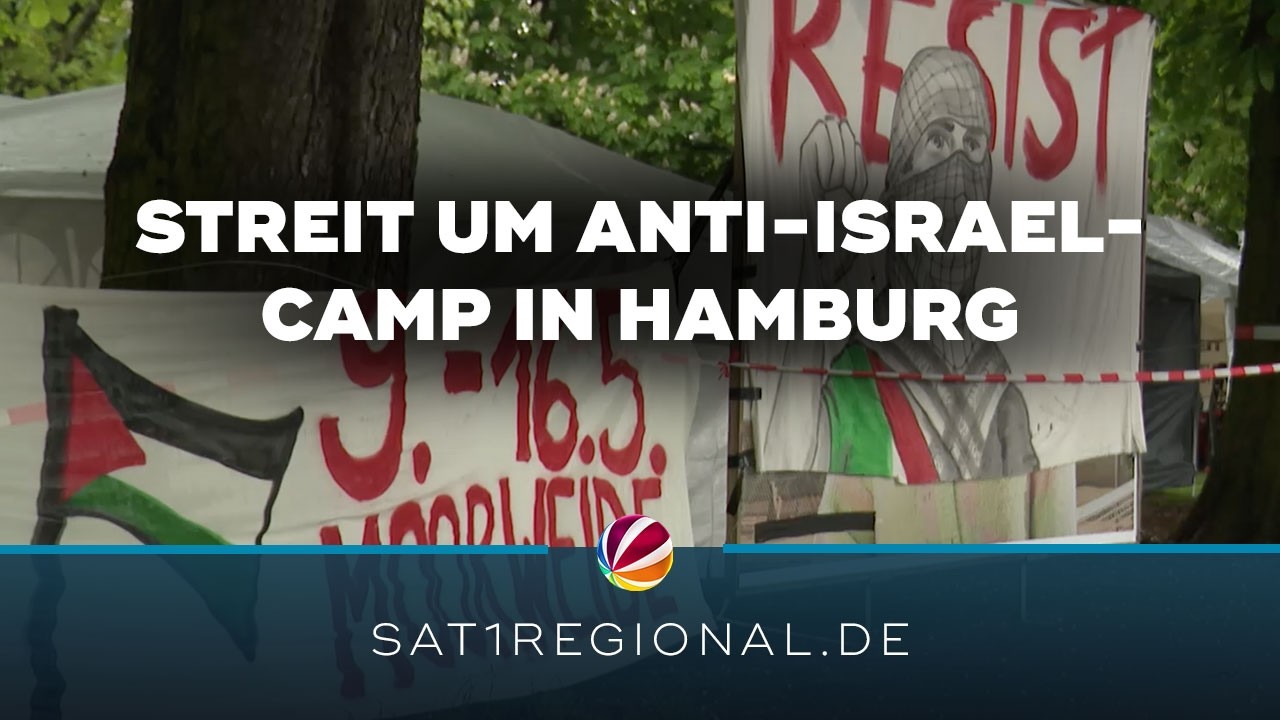
A pair of German court rulings permitting an anti-Israel protest encampment at one of Hamburg’s most historically sensitive sites has ignited widespread condemnation and intensified a national debate over the boundaries of free expression and the preservation of Holocaust memory.
As reported on Saturday by World Israel News, the Hamburg Administrative Court on May 7, followed by the Higher Administrative Court on May 8, ruled that authorities lacked sufficient legal justification to prohibit or relocate the multi-day “Bridges of Resistance” encampment at Moorweide square. The decisions have drawn sharp criticism from Jewish leaders, elected officials, and community advocates who argue that the demonstration desecrates a site intimately tied to the atrocities of the Nazi era.
Moorweide square, located near Hamburg’s Dammtor train station, occupies a somber place in history. During the Holocaust, approximately 6,000 Jews, Sinti, and Roma were assembled at the site before being deported to concentration and extermination camps. Today, a memorial stone stands as a solemn reminder of those who were forcibly uprooted and ultimately murdered.
It is this historical gravity that has made the court rulings so deeply contentious. Critics argue that allowing a politically charged protest—particularly one centered on anti-Israel messaging—risks transforming a place of remembrance into a stage for ideological confrontation.
According to the World Israel News report, the courts concluded that city officials and police had “not provided sufficient legal grounds” to restrict the encampment. In doing so, the judiciary effectively elevated constitutional protections for public assembly over concerns about the symbolic and moral significance of the site.
Organizers of the “Bridges of Resistance” encampment have made clear that their choice of location was intentional. They described Moorweide as a site that could highlight what they called “historical continuities,” linking Germany’s past with its current policies toward Israel and its role in facilitating arms shipments.
By framing their protest in this manner, activists sought to draw a direct connection between historical injustices and contemporary geopolitical dynamics. However, this argument has been met with strong resistance from Jewish leaders and scholars, who contend that such comparisons distort historical reality and trivialize the singular horror of the Holocaust.
Hamburg Chief Rabbi Shlomo Bistritzky emerged as one of the most prominent voices condemning the decision. In statements cited in the World Israel News report, he expressed deep concern about the implications of allowing a protest of this nature at Moorweide.
Rabbi Bistritzky warned that the encampment fosters what he described as a “hostile atmosphere” and undermines the dignity of Holocaust victims. For many in the Jewish community, the issue is not merely one of legal rights but of moral responsibility.
The presence of demonstrators at a site so closely associated with deportation and extermination, critics argue, represents a profound failure to honor the memory of those who suffered there.
Jewish organizations across Hamburg echoed these sentiments, issuing open letters that called on political leaders to take immediate action. As reported by World Israel News, these groups emphasized that Holocaust memorial sites must remain spaces of reflection and reverence, not venues for contemporary political activism.
In response to the controversy, Jewish community leaders have urged authorities to formally designate Moorweide as a protected memorial site. Such a designation would impose stricter limitations on public demonstrations, ensuring that the area remains dedicated to remembrance.
Advocates argue that without formal protections, historically significant locations remain vulnerable to appropriation by political movements seeking to advance their agendas.
As one community representative noted in remarks cited in the World Israel News report, the debate extends beyond legal technicalities. “The issue is not merely legal but moral,” the representative said, emphasizing that how a society treats its historical sites reflects its broader values.
The Hamburg decisions stand in stark contrast to a separate ruling in Weimar involving the Buchenwald concentration camp memorial. In that case, a court upheld a police ban on an anti-Israel protest, determining that such demonstrations would violate the dignity of Holocaust victims.
The divergence between the two rulings has exposed inconsistencies in how German courts are applying legal standards to protests at historically significant sites.
As World Israel News has reported, the contrasting outcomes have fueled a broader national debate about the criteria used to balance free speech with historical sensitivity. While the Buchenwald decision established a clear boundary, the Hamburg rulings appear to adopt a more permissive approach.
At the core of the controversy lies a fundamental tension between two principles: the right to free assembly and the obligation to preserve the dignity of historical memory.
Germany’s postwar legal framework places a strong emphasis on protecting democratic freedoms, including the right to protest. However, critics argue that these freedoms must be carefully balanced against the need to honor sites associated with the Holocaust.
In the case of Moorweide, the courts determined that the legal threshold for restricting the encampment had not been met. Yet many observers contend that this narrow legal interpretation fails to account for the broader ethical considerations at stake.
The question, therefore, is not simply whether the protest is lawful, but whether it is appropriate.
The Moorweide controversy reflects a larger and increasingly complex conversation within Germany about how to reconcile its historical legacy with contemporary political realities.
In recent years, protests related to the Israeli-Palestinian conflict have become more frequent and more polarized, often intersecting with debates about antisemitism and national identity.
As World Israel News has highlighted, the Hamburg rulings illustrate the challenges faced by a society striving to uphold democratic principles while remaining mindful of its past.
For many critics, the decision to allow the encampment raises troubling questions about the potential for historical sites to be repurposed in ways that diminish their significance.
Despite the backlash, the “Bridges of Resistance” encampment remains in place at Moorweide, serving as a visible and contentious symbol of the unresolved tensions surrounding the issue.
Supporters of the protest view the court rulings as a victory for free expression and the right to challenge government policies. Opponents, however, see them as a troubling erosion of the respect owed to Holocaust memorial sites.
As documented in the World Israel News report, calls for legislative and administrative action continue to grow, with community leaders urging authorities to establish clearer guidelines for the use of historically significant locations.
The Hamburg court decisions have placed Germany at a critical juncture, forcing a national reckoning with the delicate balance between honoring the past and navigating the present.
For many in the Jewish community, the issue is clear. Sites like Moorweide are not merely public spaces; they are sacred ground, imbued with the memory of lives lost and histories shattered.
Allowing such spaces to become arenas for political protest, critics argue, risks diluting their significance and undermining the lessons they are meant to convey.
As the debate continues, the events in Hamburg serve as a stark reminder that the legacy of the Holocaust is not confined to history. It endures in the choices societies make—about how they remember, how they speak, and how they protect the sanctity of the past in an increasingly contentious present.



