





























|
Getting your Trinity Audio player ready...
|
Real estate investor Jacob Tauber faces $119M in liabilities, multiple bankruptcies, and foreclosure actions across Newark, New York, and Chicago, according to The Real Deal.
By: Andrew Carlson
A once-ambitious real estate expansion stretching across New Jersey, New York, and Chicago has deteriorated into a sweeping financial and legal crisis for Monsey-based investor Jacob Tauber, whose portfolio is now entangled in a dense web of foreclosures, lawsuits, and bankruptcy proceedings. As reported on Wednesday by The Real Deal, the unraveling of Tauber’s holdings illustrates the inherent dangers of aggressive leverage, complex partnerships, and insufficient operational oversight in volatile urban real estate markets.
Tauber, who rapidly built a commercial property portfolio in Newark between 2018 and 2019 before pivoting to Chicago investments, has filed for Chapter 7 bankruptcy twice within the past year. According to filings cited by The Real Deal, his liabilities have ballooned to $119,000,000, driven largely by unsecured debts, legal judgments, and foreclosure-related obligations tied to his earlier acquisitions.
The ascent of Jacob Tauber in the real estate sector was marked by speed and ambition. As detailed by The Real Deal, he acquired more than two dozen office and mixed-use properties in Newark over a compressed timeline, targeting small commercial buildings with retail components and redevelopment potential.
However, the pace of acquisition soon gave way to financial strain. By 2019 and 2020, Tauber had begun defaulting on multiple mortgage obligations, triggering a cascade of legal actions that would ultimately destabilize his portfolio.
One of the most consequential developments involved an $11,000,000 construction loan obtained to redevelop two commercial properties on Broad Street in downtown Newark. The project was never completed. Following a judicial sale that failed to satisfy the outstanding debt, a court ordered Tauber to pay an additional $8,000,000 to the lender—a liability that remains unresolved.
The Real Deal report emphasized that these early setbacks marked a turning point, as lenders moved decisively to recover losses and additional properties began slipping into distress.
Tauber’s most recent bankruptcy filing offers a stark portrait of his financial condition. According to documents cited by The Real Deal, he reported monthly income of $25,000 and personal assets valued at approximately $3,000,000—figures dwarfed by his $119,000,000 in liabilities.
The filing also revealed personal financial concessions, including the forfeiture of a $32,000 Piaget watch. Additionally, his father, Eli Tauber, covered $27,500 in legal fees, underscoring the extent of familial financial involvement in the unfolding crisis.
While bankruptcy proceedings have temporarily halted foreclosure actions on many of Tauber’s properties in Airmont, New York, and Newark, New Jersey, The Real Deal report noted that these protections do not extend to a separate and increasingly troubled portfolio in Chicago.
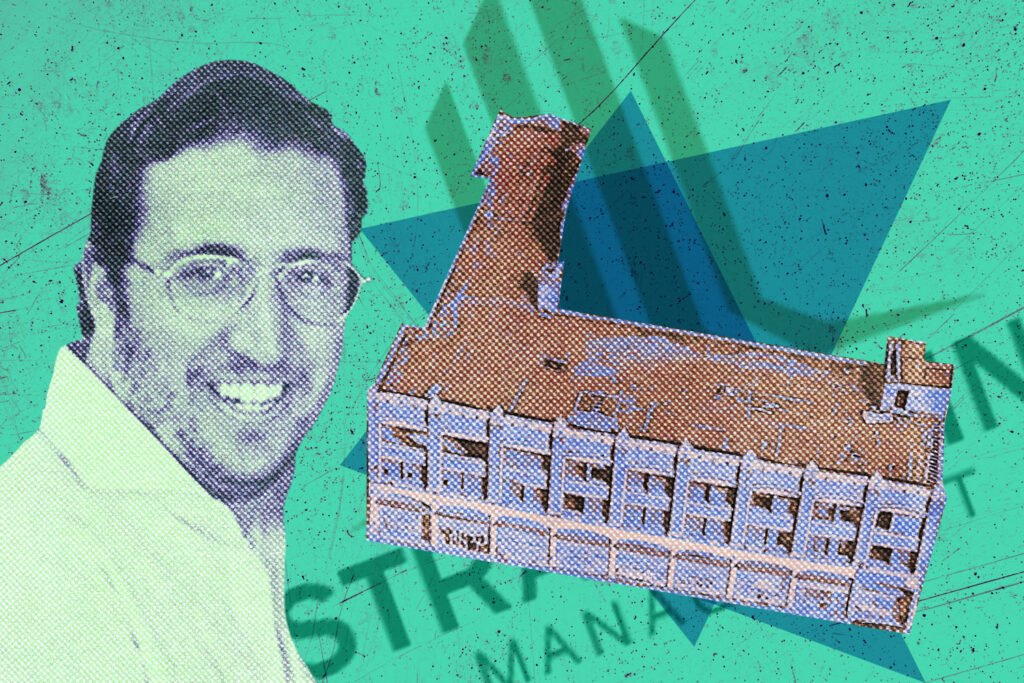
The situation in Chicago presents a distinct and escalating challenge. Although Jacob Tauber’s name does not formally appear on many property records, sources cited by The Real Deal point to his involvement in a network of multifamily buildings on the city’s South Side.
These properties are primarily tied to his father, Eli Tauber, and attorney-investor Mark Nussbaum through their company, Straightline Management. The scale of financial distress is significant: lenders have filed at least 33 foreclosure complaints against entities controlled or managed by Eli Tauber and Nussbaum, totaling more than $27,000,000 in allegedly defaulted mortgage debt.
The Real Deal report described the situation as a “tidal wave” of legal action, reflecting both financial instability and operational breakdowns. As capital reserves diminished, necessary property maintenance reportedly went unfunded, leaving tenants in deteriorating living conditions.
City code violation records cited by The Real Deal indicate that residents were forced to endure unsafe and substandard environments, adding a human dimension to what might otherwise appear as a purely financial crisis.
Compounding the complexity of the situation is Tauber’s association with Mark Nussbaum, a figure whose legal troubles have drawn widespread attention. As reported by The Real Deal, Nussbaum has been charged by the Manhattan District Attorney’s office with allegedly stealing at least $15,000,000 from his law firm’s escrow accounts. He has pleaded not guilty.
In a separate civil matter, Nussbaum disclosed that he diverted more than $330,000,000 in escrow funds—an admission that has intensified scrutiny of his financial practices and business dealings.
While neither Jacob Tauber nor Eli Tauber has been accused of criminal wrongdoing, their professional association with Nussbaum has raised questions about governance, oversight, and the structure of their joint investments.
Nussbaum himself acknowledged in legal filings that he does not fully know the current status of certain Chicago properties, stating that some assets connected to his partnerships with the younger Tauber had been “sold or transferred.”
Tauber’s financial distress is mirrored by a growing number of legal disputes. According to The Real Deal, he is currently involved in 12 civil lawsuits, reflecting conflicts with lenders, partners, and other stakeholders.
One of the most significant cases involves a 2022 lawsuit filed by Tauber against Brooklyn-based lender Yosef Brezel. Tauber alleged that Brezel improperly pursued a $25,000,000 foreclosure action against several Newark properties. Despite his claims, a court entered a $37,000,000 judgment against Tauber, which remains unpaid.
The accumulation of such judgments has further strained his financial position. Court records cited by The Real Deal indicate that several lenders have sought to lift the automatic stays imposed by bankruptcy proceedings in order to proceed with foreclosure actions.
At least one such motion has already been granted, allowing a lender to move forward with foreclosure on one of Tauber’s remaining assets.
The unraveling of Tauber’s real estate holdings highlights the vulnerabilities of highly leveraged investment strategies, particularly when combined with rapid expansion and complex ownership structures.
The Real Deal report emphasized that the crisis spans multiple states, with interconnected financial and legal challenges complicating efforts to stabilize or restructure assets. The divergence between properties protected by bankruptcy and those exposed to foreclosure illustrates the fragmented nature of the portfolio.
Equally significant is the issue of operational management. As funding for maintenance and repairs declined, tenant conditions deteriorated, leading to regulatory scrutiny and additional legal exposure.
This breakdown in property management not only accelerated financial losses but also contributed to reputational damage, further complicating any potential recovery efforts.
Despite the scale and visibility of the crisis, key individuals involved have remained largely silent. According to The Real Deal report, Jacob Tauber and his legal representatives did not respond to requests for comment. Attorneys representing Mark Nussbaum similarly declined to provide statements.
This absence of public communication has left critical questions unanswered, particularly regarding the future of the affected properties and the prospects for resolution through bankruptcy proceedings or asset liquidation.
The future of Jacob Tauber’s real estate holdings remains highly uncertain. While bankruptcy proceedings may offer temporary protection from creditors, the magnitude of his liabilities suggests that significant asset liquidation is likely unavoidable.
In Chicago, where properties are tied to his father and business partners, outcomes will depend on separate legal processes and the willingness of lenders to negotiate restructuring agreements.
For tenants residing in distressed properties, the consequences are immediate and tangible. Foreclosure proceedings and ownership transitions often bring instability, raising concerns about maintenance, safety, and long-term housing security.
Ultimately, the collapse of Jacob Tauber’s real estate empire serves as a cautionary example of the risks associated with rapid expansion, excessive leverage, and inadequate oversight.
As The Real Deal report documented, the convergence of financial mismanagement, legal entanglements, and deteriorating property conditions has created a crisis that extends beyond a single investor, affecting tenants, lenders, and entire communities.
In an industry where rapid growth can yield substantial rewards, the Tauber case underscores the importance of sustainability and disciplined management. With $119,000,000 in liabilities, dozens of foreclosure actions, and legal battles spanning multiple jurisdictions, the trajectory is unmistakable.



