


























|
Getting your Trinity Audio player ready...
|
Flames of Hatred, Fortress of Resolve: London’s Jewish Community Confronts Rising Antisemitic Terror
By: Fern Sidman
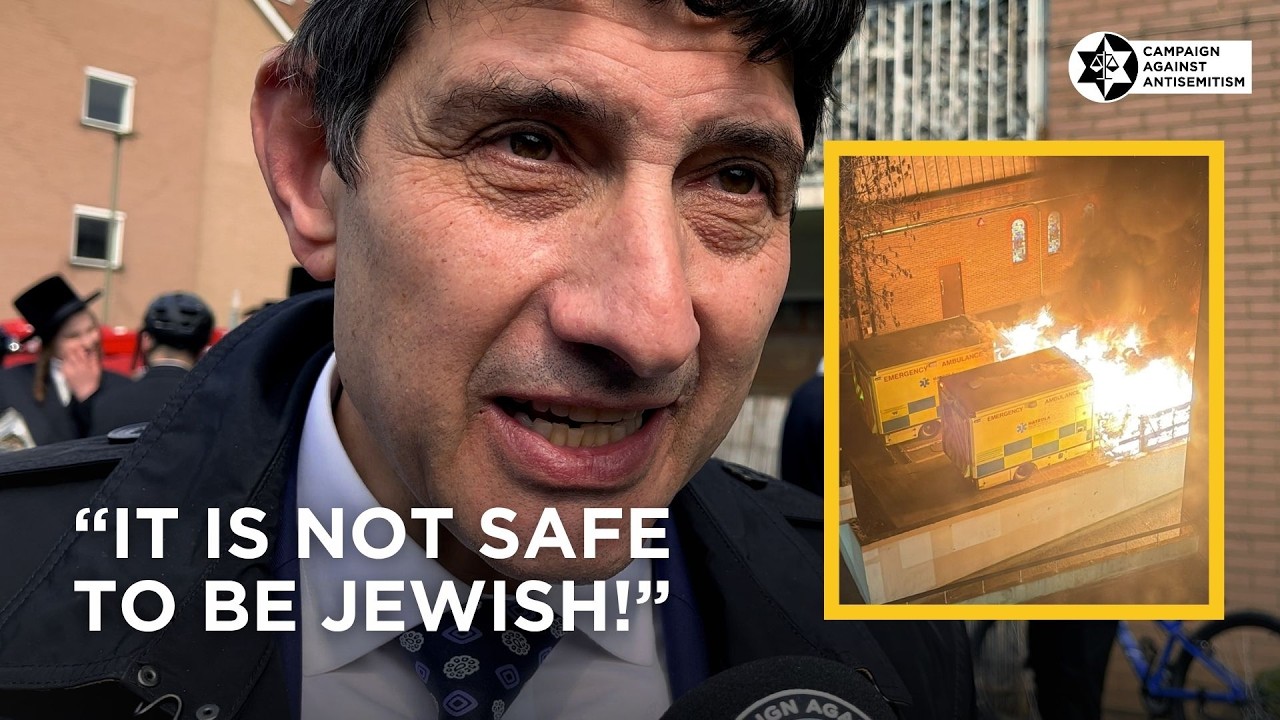
In the quiet residential enclave of Golders Green—long regarded as one of London’s most vibrant and deeply rooted Jewish communities—the charred remains of four emergency response vehicles now stand as a grim testament to a troubling and intensifying reality. The targeted arson attack on Hatzalah ambulances has not only destroyed vital lifesaving equipment but has also ignited a profound sense of unease among British Jewry, who find themselves navigating an increasingly volatile social landscape.
As reported on Monday by The Algemeiner, the incident has reverberated far beyond the immediate physical damage, striking at the psychological core of a community already grappling with sustained levels of antisemitism. Phil Rosenberg, president of the Board of Deputies of British Jews, articulated the prevailing sentiment with stark clarity: the community is “very anxious,” yet determined to remain vigilant and resilient in the face of mounting threats.
The arson attack, which unfolded in the heart of London’s Jewish population center, represents a particularly insidious form of violence. Hatzalah, a volunteer emergency medical service, is not merely an institution but a lifeline—its vehicles dispatched in moments of crisis to deliver urgent care. The deliberate targeting of such an entity underscores the malicious intent behind the act, transforming it from vandalism into a symbolic assault on communal welfare.
According to The Algemeiner report, this attack is not an isolated occurrence but part of a broader pattern of hostility that has escalated over recent years. Rosenberg referenced a series of incidents, including a deadly assault at a synagogue in Manchester, to illustrate the cumulative effect of sustained antisemitic aggression. “We’ve had two-and-a-half years of very high levels of antisemitism,” he noted, situating the Golders Green attack within a continuum of violence that has reshaped the daily realities of Jewish life in the United Kingdom.
For London’s approximately 150,000 Jewish residents, this climate of insecurity has necessitated a profound recalibration of communal priorities. Activities once centered on cultural celebration, charitable engagement, and religious observance are increasingly overshadowed by considerations of safety and preparedness.
Perhaps the most striking illustration of this shift lies in the community’s evolving approach to security. As Rosenberg recounted in remarks highlighted by The Algemeiner, communications within synagogues and communal organizations now frequently focus on emergency readiness rather than spiritual or social programming.
“On the way here, I was looking at my messages,” he explained. “Instead of discussing the services we provide or the outreach we do, the conversation was about kits designed to stop bleeding or respond to a chemical attack.”
These specialized kits, distributed with the assistance of a £28.4 million government grant to the Community Security Trust, represent a sobering adaptation to contemporary threats. Designed to mitigate the immediate consequences of violent incidents, they equip community members with the tools to respond to scenarios that, until recently, would have seemed unthinkable.
Yet the very necessity of such measures underscores a deeper tragedy. “It’s sad that it’s needed,” Rosenberg acknowledged, emphasizing that the ultimate goal must be prevention rather than perpetual preparedness. The normalization of emergency protocols within everyday communal life reflects a society in which the specter of violence has become an inescapable consideration.
In the aftermath of the attack, the British government moved swiftly to provide replacement vehicles for the destroyed Hatzalah fleet—a gesture that Rosenberg described as both significant and commendable. As detailed in The Algemeiner report, this rapid response demonstrated a recognition of the essential role played by Jewish communal institutions and the urgency of restoring their operational capacity.
However, Rosenberg’s assessment of the broader governmental response remains measured. While acknowledging positive steps, he characterized the overall approach as “mixed,” suggesting that more comprehensive action is required to address the underlying drivers of antisemitism.
Among the measures advocated by community leaders is the formal proscription of Iran’s Islamic Revolutionary Guard Corps, an organization widely regarded as a key architect of global antisemitic and anti-Western extremism. Such a designation, Rosenberg argues, would represent a decisive step in confronting the transnational dimensions of the threat.
Equally pressing is the need to address the proliferation of hate speech and extremist content on social media platforms. As The Algemeiner has reported, the digital sphere has become a fertile ground for the dissemination of antisemitic narratives, amplifying their reach and accelerating their impact.
Beyond the immediate concerns of security and policy lies a more profound and disquieting phenomenon: the erosion of social cohesion. Rosenberg warned of a society increasingly “pulled apart” by the growth of extremism, a dynamic that extends beyond antisemitism to encompass a broader spectrum of divisive ideologies.
This fragmentation poses a significant challenge not only to the Jewish community but to the fabric of British society as a whole. The normalization of hostility toward any group undermines the principles of pluralism and mutual respect that are essential to a stable and inclusive democracy.
In this context, the Jewish community’s experience serves as both a warning and a call to action. The targeting of Jewish institutions, while deeply distressing, is indicative of a wider trend that, if left unchecked, threatens to destabilize the social order.
Despite these challenges, Rosenberg’s remarks convey a sense of enduring resilience. “It is nonetheless a very resilient and proud community,” he affirmed, emphasizing the determination to “push back and build back stronger.” This resilience is not merely rhetorical; it is manifested in the community’s proactive engagement with security measures, its advocacy for policy reforms, and its commitment to maintaining cultural and religious vitality.
The rapid restoration of the Hatzalah fleet, facilitated by government support, stands as a tangible example of this resilience. It reflects a refusal to allow acts of hatred to disrupt essential services or to erode the community’s capacity to care for its members.
At the same time, resilience does not equate to complacency. The acknowledgment of vulnerability, coupled with a commitment to preparedness, represents a pragmatic approach to navigating an uncertain environment.
The implications of the Golders Green attack extend far beyond the confines of the Jewish community. They raise fundamental questions about the responsibilities of government, the role of civil society, and the capacity of democratic institutions to confront and contain extremism.
As The Algemeiner report highlighted, the rise in antisemitic incidents is not an isolated phenomenon but part of a broader pattern of intolerance that demands a coordinated and sustained response.
Rosenberg’s call for unity—“to come together, among all communities, to push back against hatred in all its forms”—resonates as both a moral imperative and a practical necessity. The marginalization of extremists requires not only law enforcement action but also a collective reaffirmation of shared values.
The charred vehicles in Golders Green serve as a stark reminder of the challenges confronting London’s Jewish community. Yet they also symbolize a broader struggle—one that encompasses issues of security, identity, and social cohesion.
As the community navigates this complex landscape, it does so with a combination of vigilance and resolve, supported by both internal solidarity and external assistance. The road ahead is fraught with uncertainty, but it is also marked by the enduring strength of a community determined to persevere.
In the final analysis, the response to this moment will shape not only the future of British Jewry but the character of British society itself. Whether the flames of hatred are allowed to spread or are extinguished through collective action will determine the trajectory of a nation at a crossroads.



