


























|
Getting your Trinity Audio player ready...
|
By: Abe Wertenheim & Fern Sidman
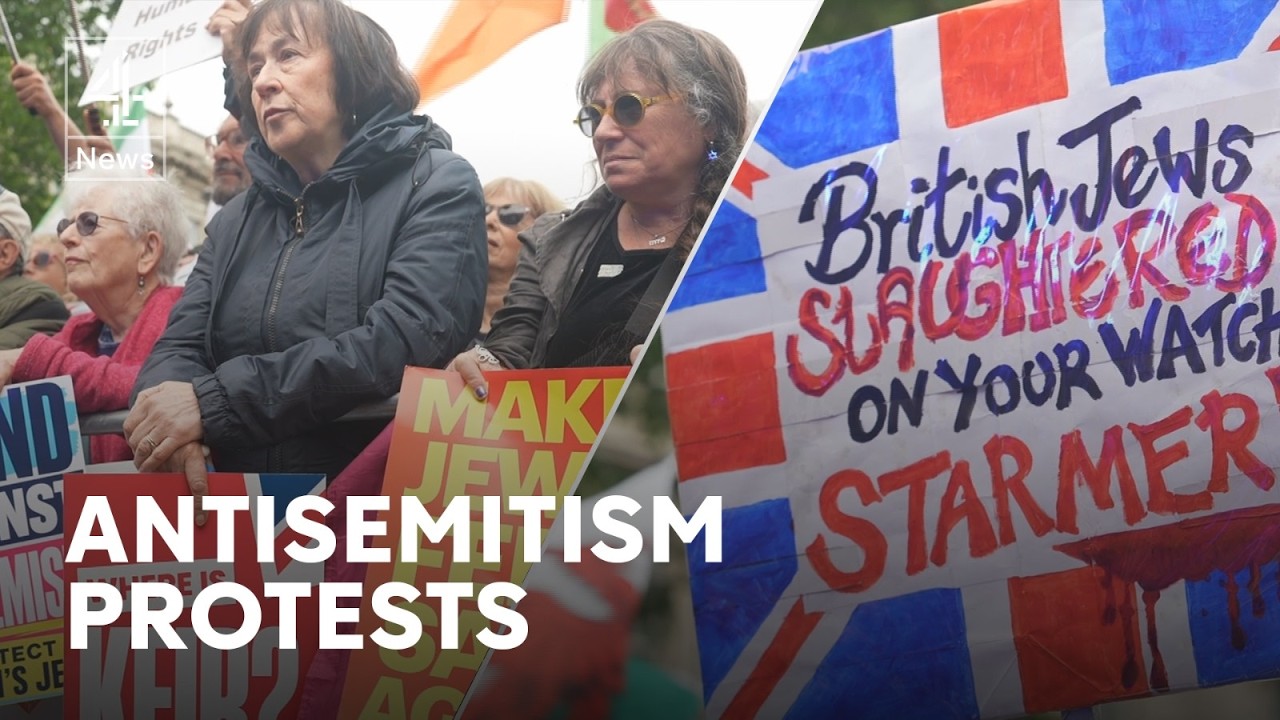
In a sweeping and emotionally charged demonstration that underscored both unity and urgency, approximately 20,000 members of Britain’s Jewish community, joined by allies from across the political, religious, and civic spectrum, gathered opposite Downing Street on Sunday at 1 p.m. for the “Standing Strong” rally against antisemitism. The event, framed under the resonant slogan “Britain stands with British Jews,” represented one of the most significant public mobilizations in recent memory confronting the intensifying climate of anti-Jewish hostility across the United Kingdom.
As reported by The Jerusalem Post on Sunday, the rally was not merely symbolic; it served as a collective declaration that British Jews—long accustomed to regarding their country as a bastion of tolerance—are now confronting a reality that many speakers described as profoundly destabilizing and historically alarming. Organizers urged participation not only from Jewish communities, but from all who reject antisemitism and extremism in its many forms, framing the gathering as a broader defense of democratic values and civil society.
The coalition behind the rally reflected the institutional breadth of British Jewry and its allies. Organizations including the Board of Deputies of British Jews, the Jewish Leadership Council, the Campaign Against Antisemitism, StandWithUs UK, Maccabi GB, the Union of Jewish Students, the National Holocaust Museum, Masorti Judaism, Progressive Judaism, the Jewish National Fund, Stop the Hate, and the Office of the Chief Rabbi united in a rare display of communal cohesion. According to the information provided in The Jerusalem Post report, this level of coordination across ideological and denominational lines marked a striking departure from past patterns in which divergent factions often convened separate demonstrations.
One of the most notable and unexpected dimensions of the rally was the prominent participation of anti-regime Iranian demonstrators. Many waved Iranian flags and chanted slogans such as “Long Live Israel, Long Live Iran,” signaling a convergence of opposition to extremism that transcended national and ethnic boundaries. A participant cited by The Jerusalem Post estimated that roughly 25% of attendees were Iranian dissidents, a statistic that lent the gathering a distinctly international dimension and highlighted the global resonance of the issues at stake.
Security arrangements for the event were extensive. The Metropolitan Police confirmed to The Jerusalem Post that a comprehensive operational plan had been implemented, including a robust law enforcement presence to ensure public safety and to respond to any potential disruptions. Notably, authorities reported that no counterprotests occurred, a detail that distinguished the rally from other recent demonstrations on contentious geopolitical issues.
At the heart of the gathering were a series of speeches delivered by leading figures in religious, political, and civic life, each articulating a shared concern that antisemitism has reached a critical juncture in British society. UK Chief Rabbi Ephraim Mirvis delivered one of the most forceful and widely cited addresses, warning unequivocally that “poisonous antisemitism has become normalized in the UK.”
“It is unacceptable that our communities can only function behind high fences and with security guards,” Rabbi Mirvis declared, as quoted in The Jerusalem Post report. “It is unacceptable that social media platforms continue to spew out Jew hatred with impunity. It is unacceptable that Iran is inspiring violence against British citizens on British soil.”
Rabbi Mirvis went further, calling for decisive governmental action, including the expulsion of Iran’s ambassador and the formal proscription of the Islamic Revolutionary Guard Corps. These demands were echoed by numerous speakers, reflecting a growing consensus that the sources of contemporary antisemitism—whether domestic or international—must be confronted with both moral clarity and legislative resolve.
Political leaders from across the ideological spectrum also took the stage, underscoring the cross-party nature of concern over rising antisemitism. The leader of the Conservatives in the House of Commons, Kemi Badenoch, emphasized the imperative of confronting extremism directly. “We have to call out hate when we see it,” she stated. “There are many different pockets of antisemitism in this country, but I am most worried about the growth of extremism and terror around the world. There are many who are afraid to call it what it is.”
Addressing the crowd, Badenoch added, “I stand with you. Millions stand with you. Britain has been a sanctuary for Jewish people, and it must always be a sanctuary for Jewish people,” a sentiment that resonated deeply with attendees concerned about the erosion of that historic refuge.
Leader of the Liberal Democrats Ed Davey echoed these concerns while pressing for more substantive governmental intervention. “Words are not enough. You’ve heard them too often,” he said. “We need action from the government. We need to make sure that the police approach is zero tolerance towards hate and harassment of the Jewish community.”
The theme of inadequate leadership was addressed with particular bluntness by Richard Tice, the deputy leader of the Reform UK, who lamented what he described as a systemic failure to confront antisemitism with sufficient urgency. “We’re sick and tired of warm words from waffly politicians,” he declared. “The absence of leadership has allowed antisemitism to flourish.”
In remarks to The Jerusalem Post following the rally, Tice reflected on both the symbolic and emotional impact of the gathering. “It was an incredible sight seeing lots and lots of Union Jack flags and Israeli flags being flown together,” he said. “It symbolizes everything about the Jewish community in the UK and their British values. Every time, it sends a patriotic shiver up my spine.”
Yet Tice also acknowledged the sobering context in which the rally took place. “We’re all sad that we have to congregate at these events as opposed to more fun, friendly events,” he observed. “But I do think we are at a serious staging post in the horrific surge in antisemitism.”
He further criticized what he characterized as political constraints within the governing establishment. “I think they have a huge conflict: they’re being torn electorally from pillar to post,” he said. “The leadership of the government wants to do the right thing, but the harsh truth is, in my calculation, give or take 50% of Labour MPs are intrinsically antisemitic, and that gives the leadership a major, major problem.”
Tice also addressed the growing crisis on university campuses, emphasizing the need for tangible consequences. “Sometimes only a serious sanction is a proper deterrent,” he said. “For the universities, the thing that they are very focused on is money. If they’re not going to do the right thing… that needs to cost them a lot of money.”
The rally’s political undertones were further underscored by the absence of British Prime Minister Keir Starmer and other senior government figures, a development noted by The Jerusalem Post and widely discussed among participants. For many attendees, this absence reinforced perceptions of insufficient governmental engagement with the crisis.
Beyond the political discourse, the rally was marked by a profound sense of communal solidarity. Jonathan Romain, convenor of Progressive Judaism’s Beit Din, described the event as “a very powerful expression of Jewish solidarity.”
“It was both inward-facing and outward-facing,” he told The Jerusalem Post. “Inward in that it was about us and standing together and showing that we are hurting, but also outward looking, in the message to wider society that, yes, we are hurting, but we will not be intimidated, and we can just stand strong.”
Romain also highlighted the extraordinary diversity of the gathering. “You had people there from Orthodox to secular… people wearing kippot, to those with tattoos… people with wheelchairs and people with prams,” he said. “There was a complete sort of panorama of British Jewry.”
This unity, he noted, was particularly significant given the historical tendency for different segments of the community to organize separately. “This one, however, represented Jews from all walks of life,” he observed, as reported by The Jerusalem Post.
Yet beneath the pride and solidarity lay a palpable sense of alarm. “This is a country we were born in, this is a country that used to be a beacon of tolerance,” Romain said. “Suddenly, we find ourselves in this situation.”
Institutional voices echoed this concern with striking clarity. The Board of Deputies of British Jews issued a statement emphasizing the gravity of the moment. “The Jewish community is facing one of the most challenging periods in recent memory. Antisemitism is out of control in Britain,” the organization declared, as cited by The Jerusalem Post.
“This is a rally about Britain,” the statement continued. “About what it now feels like to be a Jewish child walking to school in this country. To wear a kippah on the Tube. To be on security at a synagogue. To be the only Jewish family on the road.”
The Campaign Against Antisemitism delivered an equally forceful message. “Britain must face down extremists to save itself and its Jews,” the organization stated. “This cross-communal rally brings together those who stand with British Jews to express our collective anger… and to demand real action from the government.”
As the crowd gradually dispersed, the resonance of the rally’s message lingered with unmistakable intensity. The convergence of voices—from religious leaders and political figures to grassroots participants and international allies—reflected a shared recognition that the current moment represents a critical inflection point.
The events described by The Jerusalem Post suggest that the struggle against antisemitism in Britain has entered a new and more urgent phase. Whether the demands articulated on Sunday will translate into concrete policy measures remains uncertain. Yet the scale, unity, and moral clarity of the demonstration have ensured that the issue will remain at the forefront of national discourse.
In the final analysis, the “Standing Strong” rally was not merely a protest; it was a declaration—one that affirmed the resilience of British Jewry, the necessity of collective action, and the enduring imperative to confront hatred wherever it emerges.



