

























|
Getting your Trinity Audio player ready...
|
Hochul Proposes New Tax on NYC Owners of Second Homes Valued Above $5M
By: Andrew Carlson
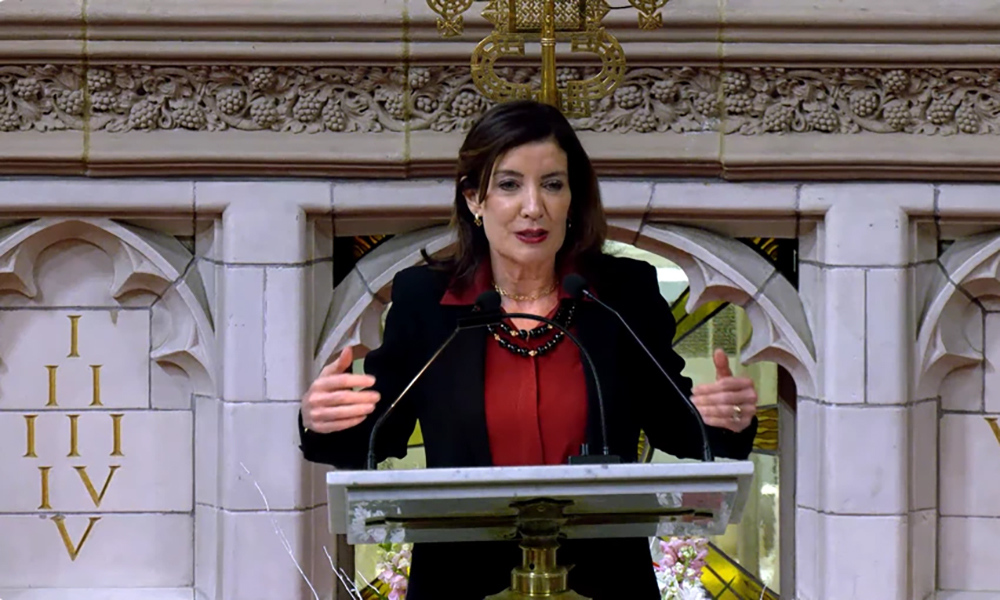
In a move that has intensified an already fraught debate over taxation, economic vitality, and the future trajectory of New York City, Governor Kathy Hochul has advanced a proposal to impose a new annual surcharge on high-value second homes—an initiative that has drawn both support and sharp criticism as fiscal pressures mount across the state.
As detailed in a report on Tuesday in the New York Post, the proposed measure—commonly referred to as a “pied-à-terre tax”—would target individuals who own secondary residences in New York City valued at $5 million or more. The policy is explicitly aimed at the uppermost tier of property owners, those who maintain luxury apartments in Manhattan and other boroughs while residing primarily elsewhere. Under the framework currently under consideration, the surcharge would escalate for properties exceeding $15 million and again for those valued above $25 million, creating a tiered structure designed to capture increasing levels of wealth.
Governor Hochul has framed the proposal as both a matter of fairness and a pragmatic response to the state’s evolving fiscal landscape. “If you can afford a multimillion-dollar second home in New York City, you can afford to join its residents in supporting the greatest city in the world,” she stated, invoking a rationale that seeks to align financial contribution with the privileges of ownership in one of the world’s most desirable urban environments. Her argument reflects a broader effort to distribute the burden of public financing in a manner that prioritizes those with the greatest capacity to pay.
Yet the proposal emerges at a moment of considerable economic and political complexity. New York State faces the prospect of significant federal reductions in Medicaid funding, a development that threatens to exacerbate existing budgetary constraints. Simultaneously, New York City’s political leadership, under Mayor Zohran Mamdani, has called for substantial fiscal intervention from Albany, seeking a multibillion-dollar infusion to address a widening budget gap. According to the New York Post report, Mamdani has proposed an array of tax increases, including higher levies on corporations and individuals earning more than $1 million annually, signaling a more aggressive approach to revenue generation.
The convergence of these initiatives has created a charged environment in which competing visions of economic policy are being advanced with increasing urgency. Hochul’s pied-à-terre tax, while more narrowly targeted than the broader proposals championed by the mayor, nevertheless represents a significant departure from traditional approaches to property taxation in the city. It raises fundamental questions about the role of luxury real estate in the urban economy and the extent to which it should be leveraged as a source of public revenue.
Critics of the proposal have been quick to articulate their concerns, emphasizing the potential for unintended consequences. The New York Post reported that the Real Estate Board of New York, a prominent industry organization, has issued a forceful critique, warning that the tax could undermine property values and dampen investment. Its president, James Whelan, argued that the measure would weaken the broader economic ecosystem, extending its impact far beyond the relatively small cohort of property owners directly affected.
The logic underpinning this critique is rooted in the interconnected nature of the real estate market. High-value properties, while representing a niche segment, often serve as indicators of overall market health. A policy that diminishes their attractiveness could, in theory, ripple outward, influencing pricing dynamics, development incentives, and the perception of New York as a favorable destination for capital. In this context, the pied-à-terre tax is viewed not merely as a targeted levy but as a signal that may alter investor behavior.
Moreover, skeptics question the revenue-generating potential of the proposal. While it is estimated to affect approximately 13,000 properties, the precise financial yield remains uncertain. Drawing on a model implemented in Rhode Island, the tax introduces a degree of experimentation into a system that has traditionally relied on more established mechanisms. As New York Post report noted, the absence of clear projections has fueled debate about whether the anticipated benefits will materialize in practice.
Supporters, however, contend that the measure addresses a longstanding inequity within the city’s tax structure. Second homes, particularly those left vacant for significant portions of the year, contribute less to the day-to-day vibrancy of neighborhoods while still benefiting from municipal services and infrastructure. By imposing an additional levy, proponents argue, the city can ensure that these properties make a more equitable contribution to the public good.
This perspective aligns with broader discussions about housing availability and urban density. New York City continues to grapple with a shortage of affordable housing, a challenge that has been exacerbated by rising costs and limited supply. While the pied-à-terre tax is not explicitly designed as a housing policy, its implications intersect with these concerns, raising questions about how best to balance the interests of different constituencies within the city.
The political dimensions of the debate are equally significant. Governor Hochul’s approach reflects a measured stance, one that seeks to generate additional revenue without embracing the more expansive tax increases advocated by some within the state’s leadership. By contrast, Mayor Mamdani’s proposals represent a more assertive reconfiguration of the tax landscape, encompassing a broader array of economic actors. The tension between these approaches underscores the diversity of perspectives within New York’s political ecosystem, as leaders navigate the competing demands of fiscal responsibility and economic growth.
At the same time, the broader national context cannot be ignored. Cities across the United States are confronting similar challenges, as shifting economic conditions and evolving policy priorities reshape the fiscal landscape. In this regard, New York’s deliberations may serve as a bellwether, offering insights into how major urban centers respond to the pressures of the present moment.
The role of public perception also looms large. Luxury real estate has long occupied a symbolic place within the city’s imagination, representing both opportunity and inequality. Policies that target this sector inevitably resonate beyond their immediate financial impact, influencing narratives about fairness, prosperity, and the distribution of wealth. As such, the pied-à-terre tax carries a significance that extends beyond its technical details, embodying broader questions about the identity and direction of New York City.
As the proposal moves through the legislative process, its ultimate fate remains uncertain. Lawmakers will need to weigh the competing arguments, assess the potential consequences, and determine whether the measure aligns with the state’s long-term objectives. In doing so, they will confront a series of complex trade-offs, balancing the need for revenue against the imperative of maintaining a dynamic and competitive economic environment.
The New York Post highlighted the multifaceted nature of this debate, capturing the interplay of economic analysis, political strategy, and public sentiment that defines the issue. It is a debate that reflects the broader challenges facing New York as it seeks to navigate a period of transition and uncertainty.
In the final analysis, Governor Hochul’s proposal represents more than a discrete policy initiative; it is a reflection of the evolving relationship between government, wealth, and urban life.



