

























|
Getting your Trinity Audio player ready...
|
By: Jeff Gorman
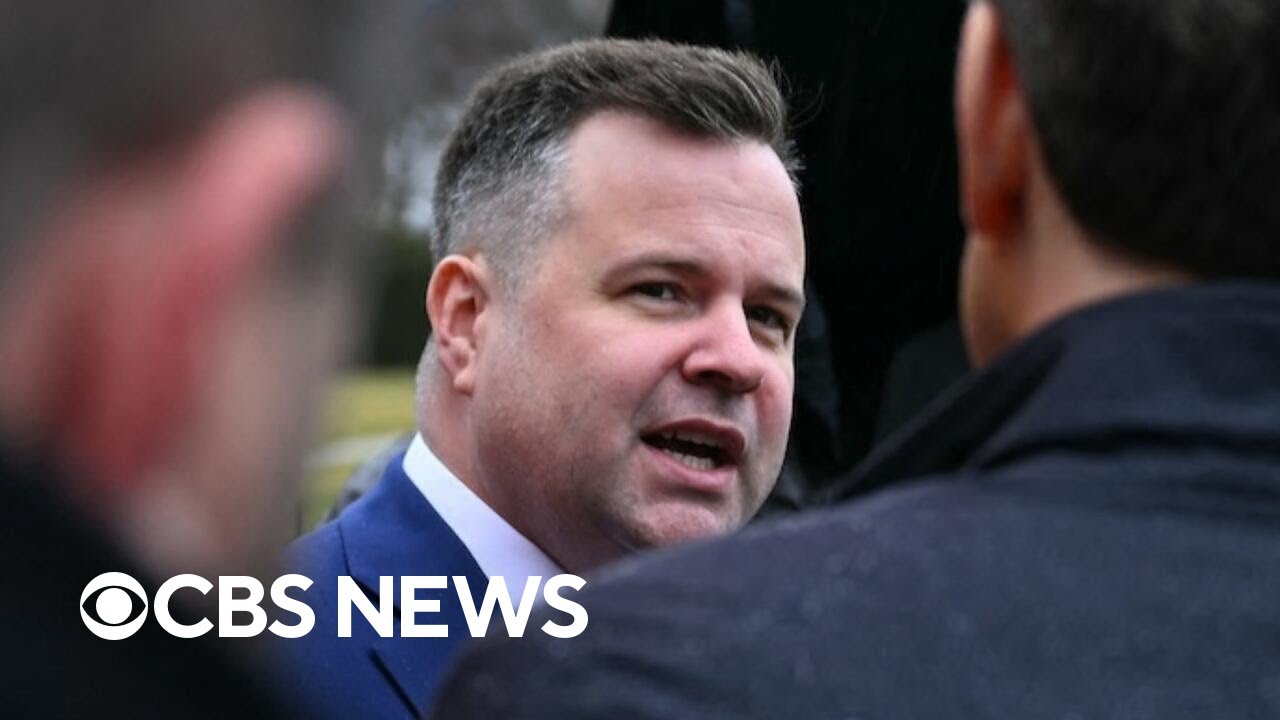
A disturbing confrontation at Cornell University has intensified national scrutiny over the deteriorating climate on American campuses, where debates over the Israel–Palestine conflict have increasingly spilled into acts of confrontation, intimidation, and alleged harassment. At the center of the latest controversy is Cornell’s president, Michael Kotlikoff, who has publicly accused a group of radical student activists of surrounding his vehicle, verbally abusing him, and effectively preventing him from leaving a campus event.
The episode, which was reported on by The New York Post on Tuesday, unfolded following a structured debate series intended to foster civil discourse, and has reignited broader concerns about the erosion of academic norms, the boundaries of protest, and the safety of university leadership in an increasingly volatile environment.
The incident occurred last Thursday evening after a debate hosted by the Cornell Political Union, an organization historically dedicated to promoting open and vigorous intellectual exchange. The event, co-sponsored by a diverse array of campus groups including Cornell Progressives, Cornellians for Israel, and Students for Justice in Palestine, was described by university officials as a model of respectful engagement.
According to The New York Post report, President Kotlikoff himself characterized the forum as “vigorous and civil,” underscoring that it exemplified the type of discourse that universities are meant to cultivate. Yet the atmosphere shifted dramatically once the event concluded.
As Kotlikoff attempted to depart the venue, a group of students began following him across campus, filming the encounter and shouting questions. What began as a continuation of debate quickly devolved into a confrontation that the university president would later describe in stark and unequivocal terms.
In a formal statement widely circulated and quoted by The New York Post, Kotlikoff detailed the sequence of events that led to the confrontation in the parking lot. He explained that after initially engaging with the students and responding to several questions, he informed them that he would not continue the interaction and requested that they cease recording.
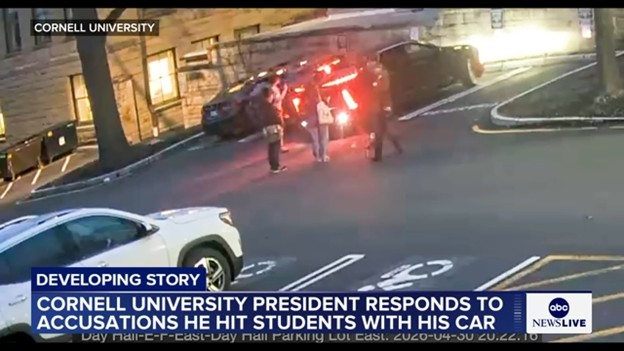
The group, however, did not comply. Instead, they followed him to his vehicle, where the situation escalated further. According to Kotlikoff, the students surrounded the car, banged on its windows, and physically obstructed its movement.
“These individuals followed me from the event space and across campus, while loudly shouting questions and recording on their phones,” he stated. “After answering a few questions, I let them know that I was not planning to engage further, and asked them to stop recording.”
He continued, “They continued to follow me to my car and then surrounded the car, banging on the windows, blocking the car, and shouting.”
Kotlikoff’s account portrays a scenario in which he was effectively trapped, forced to wait for an opportunity to safely maneuver his vehicle out of the parking space. He emphasized that he relied on his car’s safety systems, including a rear pedestrian alert and automatic braking mechanism, to exit without causing harm.
While Kotlikoff’s description of the incident has been echoed in The New York Post, student activists involved in the confrontation have offered a sharply divergent account. Several individuals claimed that the president’s actions endangered them, with at least one alleging that his foot was run over during the incident.
A student organization, Students for a Democratic Cornell, took to social media to challenge Kotlikoff’s narrative, asserting that the president responded to student inquiries with what they described as reckless behavior. In a post accompanying video footage, the group accused him of striking students with his vehicle.
“When we tried to discuss campus speech policies, he hit us with his car,” the organization claimed, framing the episode as evidence of what they characterize as an increasingly repressive administrative approach to student activism.
These competing narratives have complicated efforts to establish a definitive account of the events, highlighting the broader challenge of interpreting incidents that unfold in highly charged environments and are documented through partial and often selective recordings.
The confrontation at Cornell does not exist in isolation. Rather, it reflects a broader pattern of escalating tensions on university campuses across the United States, where debates over international conflicts have become flashpoints for domestic discord.
As extensively reported by The New York Post, many institutions have struggled to balance the principles of free expression with the need to ensure safety and prevent harassment. The Cornell incident underscores the difficulty of maintaining this equilibrium when activism crosses into behavior that university officials characterize as intimidation.
Kotlikoff himself drew a clear distinction between legitimate protest and the actions he experienced. “The behavior I experienced last night is not a protest,” he stated. “It is harassment and intimidation, with the direct motive of silencing speech. It has no place in an academic community, no place in a democracy, and can have no place at Cornell.”
His remarks reflect a growing concern among university leaders that the boundaries of acceptable conduct are being eroded, with potentially far-reaching consequences for academic freedom and institutional integrity.
The incident also unfolds against the backdrop of heightened federal scrutiny. According to The New York Post report, the Trump administration previously suspended more than one billion dollars in federal funding to Cornell as part of an investigation into alleged civil rights violations, including the handling of antisemitism on campus.
The government’s intervention signaled a willingness to impose significant financial consequences on institutions deemed to have failed in their obligations to protect students and staff. Officials warned that further action, including potential law enforcement measures, could follow if deficiencies were identified.
In November, Cornell reached an agreement with federal authorities to restore a substantial portion of that funding. The terms included a payment exceeding thirty million dollars and a commitment to invest an equivalent amount in agricultural and research programs, areas in which the university has long excelled.
Yet the latest incident raises questions about whether those measures have been sufficient to address the underlying issues.
The rapid dissemination of video footage has played a central role in shaping public perception of the incident. Clips shared online show Kotlikoff’s vehicle maneuvering amid a crowd of students, providing visual evidence that has been interpreted in conflicting ways by different audiences.
As The New York Post report noted, such footage can both illuminate and obscure, offering a snapshot of events without necessarily capturing their full context. In an era where social media often serves as the primary lens through which incidents are viewed, the challenge of discerning truth from partial narratives has become increasingly acute.
For Kotlikoff, who assumed the presidency in March 2025, the incident represents a significant test of leadership. Navigating the complexities of campus politics, student activism, and external scrutiny requires a delicate balance of firmness and engagement.
His decision to publicly condemn the actions of the students involved signals a willingness to draw clear boundaries, even at the risk of further controversy. At the same time, the response of student groups suggests that tensions between administration and activists remain deeply entrenched.
The events at Cornell University serve as a microcosm of the broader challenges facing higher education in a time of heightened polarization. As documented in detail by The New York Post, the incident encapsulates the competing demands of free expression, safety, and institutional accountability.
At its core, the controversy raises fundamental questions about the nature of protest, the responsibilities of leadership, and the limits of acceptable behavior within academic communities. The answers to these questions will not only shape the future of Cornell but also influence the trajectory of universities across the nation.
In the aftermath of the confrontation, one reality is unmistakable: the campus, once envisioned as a sanctuary for reasoned debate, has become an arena of contention where the principles it seeks to uphold are being tested as never before.



