


























|
Getting your Trinity Audio player ready...
|
On and Off the Court: Israeli NBA Star Deni Avdija Confronts Rising Tide of Jew Hatred as Teammates Speak Out
By: Andrew Carlson
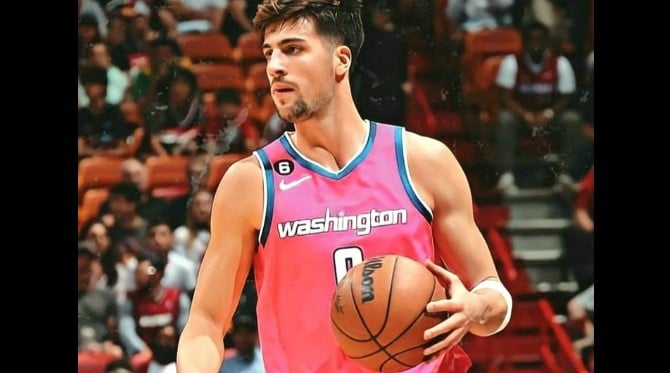
In an era when professional athletes are increasingly thrust into the vortex of geopolitical discourse, the experience of Israeli NBA star Deni Avdija has become emblematic of a broader and deeply troubling phenomenon: the politicization of identity in global sports. The Portland Trail Blazers forward, widely recognized for his exceptional talent and historic achievements as the first Israeli to attain All-Star status in the National Basketball Association, has found himself the target of persistent hostility—not for his performance on the court, but for his nationality and willingness to express pride in it.
Recent remarks by Michael Porter Jr., now with the Brooklyn Nets, have brought renewed attention to this issue. Speaking candidly during a live online broadcast, Porter expressed astonishment at the vitriol directed toward his fellow player, raising pointed questions about the motivations underlying such animosity. As reported on Tuesday by The Algemeiner, the exchange has ignited a broader conversation about the intersection of sports, identity, and the alarming normalization of hostility toward Israeli and Jewish figures in public life.
The discussion unfolded during a live stream hosted by a prominent online personality, where Porter casually referenced Avdija’s playing style, noting his ability to draw fouls and reach the free-throw line with notable frequency. What might have remained a routine commentary on basketball quickly took a more serious turn when the host observed that Avdija receives “a lot of hate” online.
According to coverage by The Algemeiner, Porter’s immediate reaction was one of genuine confusion. Seeking to understand the basis for such criticism, he asked whether the hostility was connected to Avdija’s Jewish identity. When informed that this was indeed the case, Porter responded with incredulity.
“It’s so weird,” he remarked, questioning why an athlete should be criticized for representing his country. His comments, while informal, encapsulated a sentiment that has resonated widely: the notion that pride in one’s heritage should not be a source of controversy, let alone hostility.
For Avdija, the issue is neither abstract nor peripheral. As a highly visible representative of Israel in one of the world’s most prominent sports leagues, he occupies a position that carries both honor and scrutiny. His achievements—culminating in his historic All-Star selection and his role in leading the Trail Blazers to a playoff appearance—have elevated his profile, but they have also intensified the attention directed toward him.
As detailed in The Algemeiner report, Avdija has been candid about the challenges he faces. In an interview earlier this year, he described the frustration of seeing his athletic accomplishments overshadowed by political commentary.
“I obviously stand for my country, because that’s where I’m from. It’s frustrating to see all the hate,” he said. His words reflect a broader struggle experienced by athletes whose identities become entangled with contentious global issues.
Avdija’s appeal is striking in its simplicity: a desire to be judged on his merits as a basketball player rather than on his nationality or the political interpretations imposed upon it. Yet, as his experience demonstrates, this aspiration is increasingly difficult to realize in a climate where social media amplifies both visibility and vulnerability.
The digital landscape has fundamentally altered the dynamics of public engagement, enabling athletes to connect directly with fans while also exposing them to unfiltered criticism. In Avdija’s case, this has manifested in a steady stream of hostile messages that frequently conflate his identity with broader political grievances.
According to The Algemeiner report, such reactions are not isolated incidents but part of a wider pattern of online behavior that targets individuals associated with Israel. The anonymity and immediacy of social media platforms have created an environment in which hostility can proliferate with minimal accountability.
This phenomenon raises important questions about the responsibilities of platforms, the role of fans, and the broader cultural forces that shape online discourse. While criticism is an inherent aspect of professional sports, the nature and intensity of the attacks directed at Avdija suggest a departure from conventional boundaries.
Porter’s defense of Avdija represents a notable instance of solidarity within the NBA, a league that has often positioned itself as a platform for social awareness and advocacy. His willingness to address the issue publicly underscores the importance of peer support in confronting discrimination.
As highlighted in The Algemeiner report, such expressions of support can play a critical role in challenging harmful narratives and fostering a more inclusive environment. By questioning the rationale behind the criticism, Porter not only defended his colleague but also invited a broader audience to reconsider the assumptions underlying their reactions.
Avdija’s accomplishments on the court are undeniable. His trajectory—from a promising young talent in Israel to a key contributor in the NBA—reflects both individual dedication and the growing globalization of the sport. His recent milestones, including becoming the first Israeli to win an NBA playoff game, have cemented his status as a trailblazer.
Yet, as The Algemeiner report emphasized, these achievements have not shielded him from criticism. Instead, they have often been accompanied by an intensification of scrutiny, as his visibility amplifies both admiration and animosity.
The paradox is striking: success, which should serve as a unifying force, instead becomes a catalyst for division when filtered through the lens of identity politics.
Beyond the headlines and statistics lies a deeply human story. Avdija’s remarks reveal the emotional toll of navigating a public environment in which personal identity is subject to constant evaluation and critique.
“All the extra stuff around it? It’s just unnecessary,” he observed, capturing the sense of exhaustion that accompanies sustained exposure to hostility. His words resonate with a broader audience, reflecting the challenges faced by individuals whose professional achievements are overshadowed by factors beyond their control.
As The Algemeiner report noted, this dynamic is not unique to Avdija but is indicative of a wider trend affecting athletes and public figures across various domains.
The controversy surrounding Avdija’s experience invites a deeper examination of the cultural forces at play. It raises fundamental questions about the extent to which sports can serve as a neutral arena in an increasingly polarized world.
Historically, athletics have been celebrated as a unifying force, transcending boundaries of nationality, religion, and ideology. Yet, the current climate suggests that these ideals are being tested, as external conflicts permeate the realm of sports.
The unfolding narrative surrounding Deni Avdija serves as both a cautionary tale and a call to action. It highlights the need for a renewed commitment to the principles of fairness, respect, and perspective—values that are essential not only in sports but in society as a whole.
As articulated through the voices of Avdija and his supporters, including Michael Porter Jr., the message is clear: athletes should be judged on their performance, not their identity. The persistence of hostility in this context represents a departure from that ideal, one that demands thoughtful reflection and meaningful response.
In the final analysis, the story of Deni Avdija is not merely about basketball. It is about the enduring struggle to reconcile identity and achievement in a world where the two are too often conflated—and the imperative to ensure that respect prevails over division.


