




























|
Getting your Trinity Audio player ready...
|
By: Mendel Braun
Mimouna is one of the most joyous celebrations on the Moroccan Jewish calendar. In Israel, it is akin to a national holiday, seen as a symbol of Moroccan Jewish heritage.
Yet its origins are mysterious. While the genesis of many Jewish customs can be largely reconstructed from historical sources, this is not the case with Mimouna. Although practiced for generations among the Jews of North Africa, its origin remains largely ambiguous.
What Is Mimouna?
Mimouna, or “Noche de Mimouna” in Moroccan Ladino, is a one-day post-Passover holiday marked by exuberant celebration, mystical rituals, traditional foods, ceremonial dress, and socializing with friends, family, and neighbors.
The holiday originated in the Maghreb region of North Africa, encompassing present-day Morocco, Algeria, Tunisia, and Libya, with celebrations also reported as far as Syria.1 When the displaced Maghrebian community settled in new places across France, Canada, South America, and later Israel, they brought the tradition with them.2
The celebration begins immediately after Passover, typically with an elaborate, lavish feast shared with guests, acquaintances, and friends.
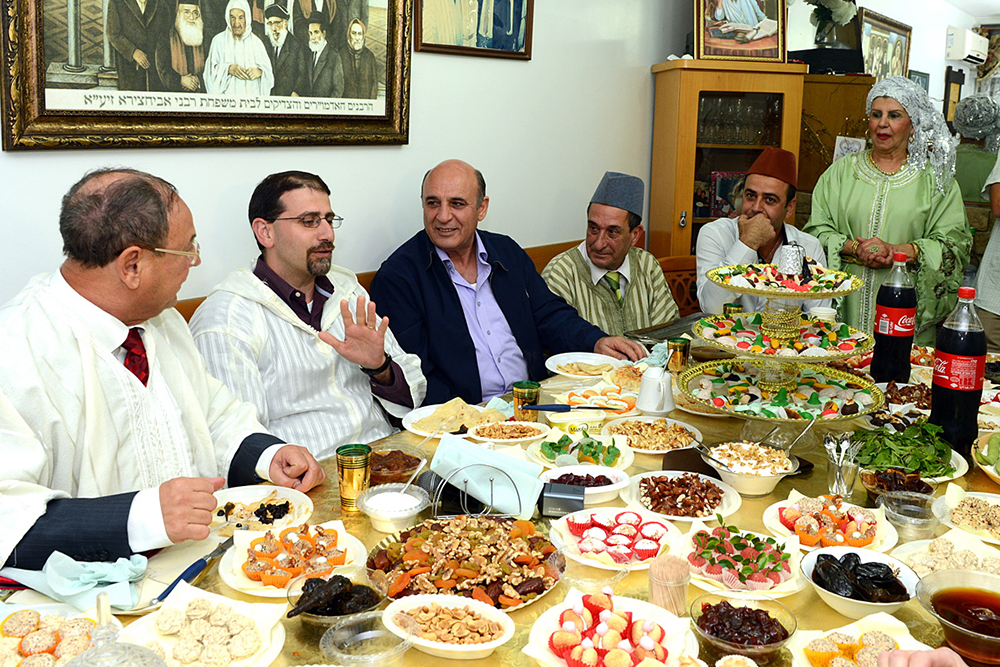
The doors of the home remain open throughout the night, inviting everyone to enter, enjoy words of Torah, sing, dance, exchange traditional good wishes, and sample the sweet treats laid out on the tables.
The following morning was traditionally spent outdoors in gardens, groves, and orchards, and participating in mystical rituals near water sources. Today, families typically visit parks and nature reserves or hold outdoor barbecues, with large public gatherings of Torah-learning featuring community leaders and dignitaries.
The Origins of Mimouna
The first recorded accounts of Mimouna emerged in mid-18th-century Morocco.3
The most common reason given for the post-Passover feast is to celebrate being able to eat chametz again after being restricted throughout the holiday.
Goodwill
Among Moroccan (and some other) Jewish communities, it was customary to avoid eating in others’ homes throughout the holiday.
The open-house Mimouna celebrations were a way for people to emphasize that their absence from others’ homes over Passover was not out of dislike or animosity, but simply a desire to observe Passover’s unique dietary restrictions meticulously.
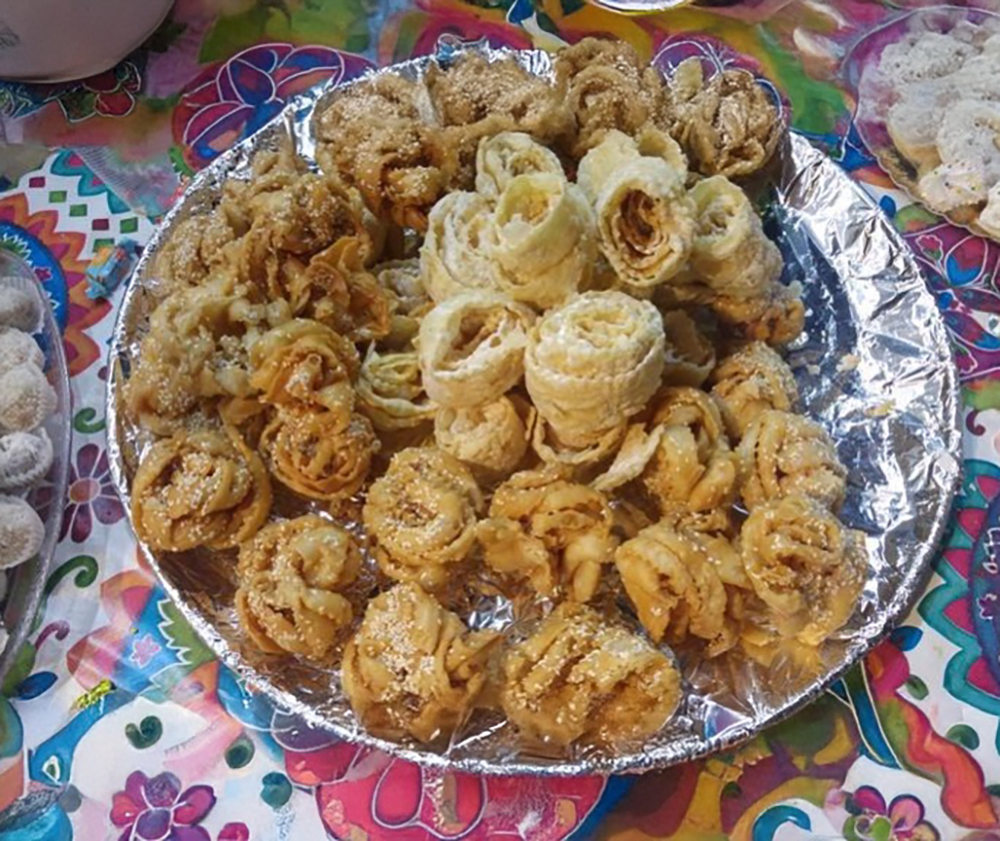
Jews in Morocco celebrated Mimouna alongside their Arab neighbors. As many Jewish homes had no flour on hand at Passover’s conclusion, Muslim neighbors would often supply the ingredients for the celebration, many bringing along gifts as well.4 In return, they were treated to mouth-watering moufleta and an invitation to stay and join the festivities.5
Anticipation of Bounty
The Mishnah teaches that the fate of the year’s crops is determined during the month of Nisan,6 so Mimouna was also viewed as a celebration of spring and an expression of hope for a successful harvest.
As such, Mimouna typically features foods symbolizing abundance and fertility, and homes are decorated with wheat stalks and greens of all kinds. In Morocco, Muslims often allowed Jews to use their gardens and vineyards, believing it would bring rain and blessings.
Adding to the Holiday
Adding an extra day to a holiday through eating and drinking is equivalent to bringing an offering to G‑d, teaches the Talmud.7 Many believe that this day, known as Isru Chag, is the origin of the Mimouna custom; just as we enter the holiday with joy, we leave it with joy.
Reuniting With Tefillin
Yet another tradition records the holiday as a celebration over the resumption of wearing tefillin, after not having had the opportunity to don them for the duration of Passover.8
Thanking G‑d
Finally, there is a tradition recorded from the city of Agadir in southern Morocco which offers an entirely different reason for the holiday’s origins. Rabbi Moshe Amar, a learned kabbalist known among Arabs as a celebrated poet, received a Heavenly vision warning him that the Jews of Agadir were in danger.
Returning to the city, he found that a decree had been issued to arrest the community’s leaders. He hastened to the Pasha where he was received with great honor and succeeded in having the decree cancelled. Since the miracle occurred on Passover eve, Rabbi Moshe established a special celebration at the close of the holiday, calling it Mimouna: a feast of faith and trust in G‑d for saving them from all trouble.9
What Does Mimouna Mean?
The etymology of Mimouna has been widely debated by historians and scholars alike.
Maimon
The name Mimouna is most commonly attributed to Maimonides’ father, Rabbi Maimon ben Yosef, “Mimouna” being the Arabic feminine form of the name Maimon.
Maimon was a famed Jewish scholar in Fez, Morocco, and an important figure in Moroccan Jewish life, having written and worked extensively on Muslim-Jewish relations.10 It was largely through his influence that the Muslim community joined their Jewish neighbors in the Mimouna celebrations.
According to tradition, he passed away around this time (circa 1170), and since public yahrzeits are not observed during the month of Nisan, the joyous festivities of Mimouna at the close of Passover serve as a fitting tribute.
Others believe that Mimouna celebrates Maimonides himself, whose birthday falls on the day preceding Passover.
Another tradition explains that the holiday’s roots lie in warding off the evil forces and spirits known as Maimon, with the celebration originally referred to as “Leil al-Maimon” — the night of Maimon.11 The kabbalistic work Sefer HaKaneh notes that the day following Passover is especially susceptible to the evil eye, and accordingly, a festive meal is held to ward off bad fortune.12
Wealth and Faith
Another common theory is that the name is derived from either the Arabic word ma’amoun, meaning “wealth,”13 or “luck,”14 or that it is an Arabicized version of the Hebrew word emuna, “belief.” Alternatively, it is a blend of the Hebrew emuna and the Arabic ana, “I believe.”
The final days of Passover celebrate the day the Jewish people placed their full trust15 in G‑d and crossed the Red Sea, while their Egyptian pursuers drowned and their gold and jewelry washed ashore, enriching the Jewish people.16
Thus the Mimouna celebration may either be a celebration of the good fortune and wealth their ancestors encountered, or a nod to the powerful faith they demonstrated.17
Indeed, the Mimouna celebrations are strongly associated with themes of wealth and faith. Gold and jewelry often decorate the table, with families even decorating the food itself, such as golden rings hidden in a bowl of flour, suggesting hoped-for wealth and blessings.
Bread
The word may also be related to manna, the heavenly food G‑d provided following the Exodus. Additionally, the Arabic word for food or provisions is mona, which some18 believe may allude to the bread permitted at the conclusion of Passover.19
Longing
The name Mimouna may also commemorate Tamentit (or Tameimona), an ancient Jewish city in the Saharan oasis region that was destroyed in 1492 when a local Muslim cleric incited a massacre against its Jewish community. Survivors fled to Morocco, where the holiday became an expression of their longing to return—both to their lost city and ultimately to Jerusalem.20
Redemption
Perhaps most meaningfully, Mimouna is to be associated with hope and belief in the Future Redemption and the coming of Moshiach. 21
Once Passover has ended and the month of Nisan, associated with redemption,22 begins drawing to a close, Moroccan Jews added an extra day of celebration to express their continued belief that even if redemption is delayed, it will eventually come.
Moroccan Jewish businessman Yehuda Ben-Susan recounts that when he approached the Rebbe at the close of Passover at a time his daughter was struggling with speech and memory loss, the Rebbe blessed his daughter with a complete recovery and encouraged him to strengthen his faith, noting that, “Today is the Mimouna holiday by Moroccan Jews. It is a festival of faith.” 23
Customs of Mimouna
From Morocco and Algeria in the west to Iraq and Syria in the east, Mimouna was celebrated across hundreds of widely dispersed communities. Over time, the specific rituals and customs of each city varied widely, and many have been lost entirely. What follows is a partial list.
The ceremony generally began with Havdalah, preceded by the recitation of several verses from the Tanach, especially from the Book of Proverbs, as well as the Mishnah.
After Havdalah, the meal would commence with words of Torah, singing, and dancing.
In some communities, the celebrations began in the afternoon, before Passover formally ended, with the congregation taking to the fields to recite Birkat Ilanot, the blessing over blossoming fruit trees. In other communities, the celebration began with the evening prayers in the synagogue, held with much pomp and singing, followed by dancing and a torch-lit procession through the streets.
Participants would carry their rabbi high in the air until they reached his home, where a major celebration was held before everyone headed off to their individual homes.24
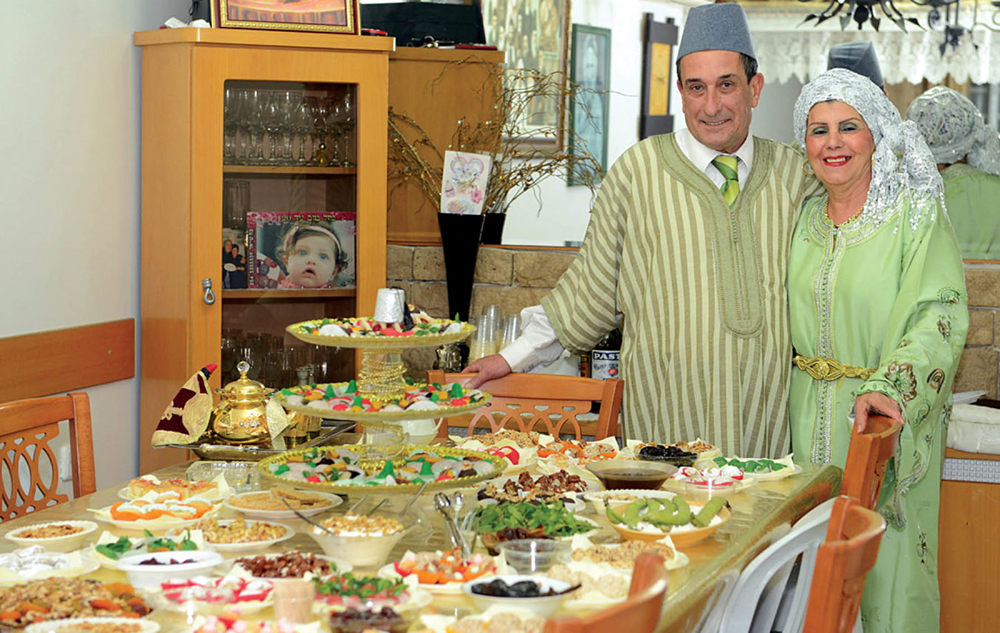
Today, the hosts of the Mimouna meal wear festive traditional Moroccan clothing. Women wear decorated ceremonial kaftans and men don a jellabiya (long robe), a fez, and pantouf house shoes.
Colored candles light the home and the floors are draped with ornate carpets and mats.
The tables are adorned with green branches and flowers, laden with bowls of dairy foods and an array of sweet treats, many made from ingredients permitted during Passover, such as dates, peanuts, almonds, and sugar. Zaben (white almond nougat), marozia (fried raisins with nuts), and mazun (fruit jam) also feature prominently.
Plates of flour, often topped with gold coins, oil, or beans, decorate the table, and live fish are often present due to their association with protection and fertility.
To this day, the culinary highlight of the Mimouna meal is mufleta, a type of pancake closely resembling mallawach, made from a mixture of flour, honey, and butter, and prepared fresh just before serving.
While the dough is prepared, family members collect coins and sing special Hebrew liturgy. The hostess would often dip the coins into the dough, blessing the household with much success and blessing.
The Jews of Marrakesh had a unique custom of their own. They would prepare some of the dishes with wine saved from Elijah’s Cup and the Four Cups, and would sing songs expressing their longing for Moshiach.25
It was also customary to formalize marriage matches during the festival, while already-engaged bridegrooms would send precious ornaments to their future brides and dine with their future in-laws.
The night is known to be a time when the gates of Heaven open, and it is thus auspicious to pray for livelihood and wealth, with people traditionally blessing one another with wishes for prosperity and success.
Hosts bless guests upon their arrival with the traditional Judeo-Arabic greeting “Tirbehu Utis’adu,” “May you succeed and prosper.”
Families would bring their young children to visit the homes of rabbis, who would sprinkle a few drops of milk on the guests’ heads26 and recite verses of Torah, while others would sprinkle flour with their hands or offer a date filled with butter or walnuts. In other communities, they would visit the rabbis at shul shortly before the end of the holiday.
It was also customary to visit the homes of the Kohanim, who would bless their guests with the Priestly blessing three times,27 and it was common to give gifts to the needy.
At dawn, Moroccan Jews would go out to nearby water sources and either immerse themselves or pour water over their feet, reminiscent of the miracle of the Splitting of the Sea. Afterwards, some would throw a stone, pebble, or even bones into the water, while in other communities, women would strike the water seven times and recite prayers.
This closely resembles the Tashlich ceremony held on the first day of Rosh Hashanah, in which garments are shaken out toward the water while reciting the verse: “And You shall cast all their sins into the depths of the sea,”28 symbolizing casting away evil into the water.
Following the morning prayers, some congregations would escort their rabbis to the fields, groves, and orchards to witness the blossoming of spring, while in the afternoon the women and children would sit in the fields, eat delicacies, and sing and dance.29
Perhaps the most defining theme of Mimouna is the celebration of life itself, along with the values of hospitality, generosity, and faith—the open-door policy and house-hopping connecting strangers and friends alike.
Footnotes
- Chaim Zeev Hirschberg, A History of the Jews in North Africa, Vol. 1 (Leiden: Brill, 1974).
- Haim Zafrani, Two Thousand Years of Jewish Life in Morocco, p. 245.
- According to Eliyahu Refael Martzianu in his book Chag HaMimouna (pg. 17), parts of the holiday can be traced back to Rav Nissim Gaon, the 10th-century Tunisian sage who recorded the custom of drinking milk at the conclusion of Passover as a sign of sustenance and blessing for the coming year.
- Chaim Zeev Hirschberg, Zechor L’Avraham, chapter on Mimouna and Isru Chag Pesach; Rabbi David Ovadia, Kehilat Tzfro, vol. 3, p. 96.
- These gifts were considered a gesture of gratitude in return for the Passover delicacies their Jewish neighbors had shared with them throughout the holiday, which the Arabs had come to love. (Rabbi David Ovadia, Kehilat Tzfro, vol. 3, p. 96, 145-146)
- Rosh Hashanah 1:2.
- Sukkah 45b.
- Rabbi Avraham Davda, L’ilan Reiach B’mimouna, p. 26.
- Had HaMizrach, Year 9, Issue 22-32, p. 91, Kantroviz.
- Netivot Hamarav, Minhagei Pesach, Rabbi Yosef ben Naim–Noheg



