




























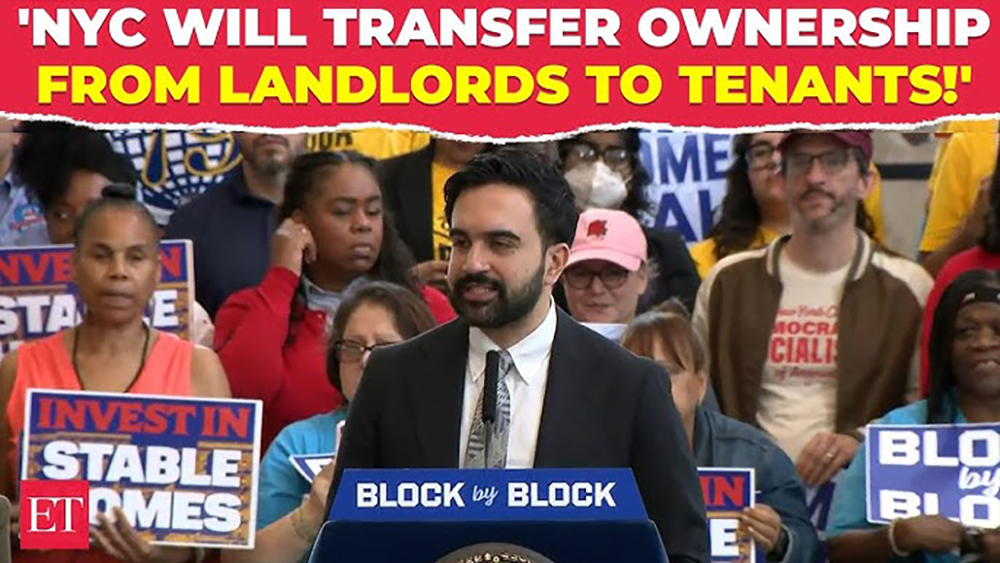
New York City stands on the precipice of a potentially transformative and deeply destabilizing political experiment, one that could fundamentally alter the nature of property rights, civic governance, and political power not merely within the five boroughs, but across the United States. If Mayor Zohran Mamdani succeeds in implementing the ideological framework increasingly championed by his Democratic Socialists of America allies and activist infrastructure, the consequences may reverberate far beyond the city limits, reshaping the relationship between government authority, private ownership, and partisan political machinery for generations.
The warning signs are no longer subtle. They are overt, coordinated, and increasingly institutionalized.
At the center of this looming conflict lies an emerging political doctrine that presents itself publicly as a crusade for “housing justice,” while critics argue it is, in reality, an aggressive strategy to consolidate economic and political power through systematic pressure campaigns against private property owners. Under this vision, city agencies, activist networks, nonprofit entities, and ideological organizers would operate in concert, creating a pressure apparatus capable of overwhelming landlords through legal attrition, regulatory suffocation, and public intimidation.
The first stage of the process is already conceptually visible.
Activist organizations aligned with the Democratic Socialists of America, including high-profile organizers associated with figures such as Cea Weaver, would likely receive not merely rhetorical encouragement from City Hall, but full institutional reinforcement. Tenant activism would no longer exist primarily as an independent civic phenomenon; instead, it could evolve into an integrated extension of municipal political power.
Under such a structure, virtually every housing dispute could become weaponized.
Minor maintenance complaints, bureaucratic oversights, delayed repairs, paperwork discrepancies, or routine property management disputes could be escalated into full-scale political confrontations. Buildings would become ideological battlegrounds. Landlords would increasingly be portrayed not as housing providers operating within a difficult regulatory environment, but as enemies of “the people,” symbols of alleged systemic oppression to be publicly humiliated and politically destroyed.
The implications of this transformation cannot be overstated.
Once activism becomes fused with municipal enforcement authority, the machinery of city government itself risks becoming an instrument not of neutral administration, but of selective ideological enforcement. The Department of Buildings, housing inspectors, regulatory agencies, and municipal enforcement divisions could become tools of political leverage rather than impartial guardians of public safety.
Under such conditions, violations would inevitably multiply.
No major property portfolio in New York City is entirely free from technical infractions. The city’s labyrinthine of housing regulations, construction codes, inspection mandates, and compliance requirements are so vast and often contradictory that nearly every property owner remains perpetually vulnerable to citations. Historically, those systems functioned imperfectly but within generally recognizable legal boundaries.
The concern now being voiced by critics is that those same systems could be transformed into engines of political coercion.
A landlord facing endless waves of complaints, mounting fines, activist demonstrations, organized rent strikes, hostile media campaigns, and relentless regulatory enforcement may eventually find ordinary property management economically impossible. The cumulative effect would not simply be financial pressure; it would be psychological and reputational warfare.
And that, many observers argue, is precisely the point.
Because the ultimate objective may not merely be punishment. It may be acquisition.
Under the ideological framework increasingly associated with segments of the Democratic Socialists of America, distressed or seized properties would not necessarily revert to direct municipal ownership. Instead, many fear they would be transferred into the hands of politically aligned nonprofit entities operating under the banner of “community control,” “housing justice,” or “tenant empowerment.”
This distinction is critically important.
If the city itself directly absorbed failing properties, one could at least argue that the objective was misguided public administration. But the emerging model appears far more politically sophisticated and far more consequential.
The nonprofit industrial complex already exerts enormous influence throughout New York City politics. These organizations receive grants, donations, contracts, and government partnerships that provide both financial resources and political reach. Yet their current power would pale in comparison to what could emerge if they were suddenly entrusted with vast portfolios of New York real estate.
Such an outcome would create something unprecedented: a politically interconnected network of activist-controlled entities possessing billions upon billions of dollars in hard assets.
The scale of such a transformation is staggering to contemplate.
New York real estate remains among the most valuable property markets on Earth. Control over even a fraction of distressed or seized housing stock would instantly generate extraordinary economic leverage. Entire neighborhoods could gradually fall under the operational influence of ideologically aligned nonprofit organizations whose leadership structures are deeply intertwined with activist politics.
That would not merely alter housing policy. It would reshape political power itself.
Property ownership has always conferred influence. Control over housing means influence over employment networks, contracting, public messaging, organizing infrastructure, donor relationships, legal advocacy, tenant mobilization, and electoral machinery. If politically aligned nonprofits became the dominant custodians of massive housing portfolios, they would possess unparalleled capacity to shape elections, policy agendas, and activist movements nationwide.
This is why critics increasingly describe the issue not as a local housing dispute, but as a long-term institutional strategy.
Under this model, New York City would become the financial and organizational nucleus of a vastly expanded activist apparatus capable of exporting its political methodology across America. Organizers trained within the city’s nonprofit ecosystem could be deployed nationwide to support ideologically aligned candidates and movements. Housing assets would provide stable revenue streams and enormous patronage opportunities.
The implications would extend far beyond municipal governance.
One need only examine the language increasingly used by prominent ideological figures to understand the broader atmosphere surrounding these debates. Rhetoric demonizing landlords as exploiters, oppressors, or enemies of the working class has become disturbingly normalized in some activist circles. In more radical corners of political discourse, inflammatory language openly romanticizing confrontation and social vengeance has proliferated with alarming frequency.
Such rhetoric is not harmless.
When public officials and activist leaders encourage a political culture that frames entire categories of citizens as morally illegitimate, the social consequences become dangerous. Property owners cease being viewed as participants in civil society and instead become targets of ideological struggle.
That is a profoundly destabilizing path for any democracy.
What makes the situation particularly troubling is that New York already possesses a real and catastrophic housing crisis demanding serious solutions. The city’s public housing infrastructure, particularly the long-troubled NYCHA system, remains plagued by staggering maintenance failures, deteriorating conditions, bureaucratic dysfunction, and chronic financial distress.
Yet rather than focusing political energy on repairing those failures, ideological activists increasingly appear obsessed with constructing new mechanisms of confrontation and seizure.
That disconnect raises unavoidable questions about motive.
If the objective were genuinely improving housing quality, policymakers would prioritize pragmatic reforms, accelerated construction, streamlined permitting, targeted affordability measures, and rehabilitation of existing public housing stock. Instead, much of the current rhetoric centers overwhelmingly on identifying villains, escalating conflict, and consolidating institutional control.
That is not governance. It is ideological mobilization.


