



























|
Getting your Trinity Audio player ready...
|
By: Fern Sidman
In an era defined by information saturation and rapid digital dissemination, the intersection of data, perception, and political narrative has become increasingly fraught. A recently circulated graphic detailing the top foreign lobbying expenditures in the United States offers a revealing, if often misunderstood, window into this dynamic. The figures themselves are relatively straightforward: countries such as the Marshall Islands, Japan, Saudi Arabia, and Turkey lead in reported lobbying expenditures for 2024, with spending ranging from roughly $24.8 million at the top to approximately $5.5 million among the top ten. Notably absent from this list is Israel—a country that, despite its omission, remains the subject of disproportionate public scrutiny and persistent debate regarding its influence in American political life.
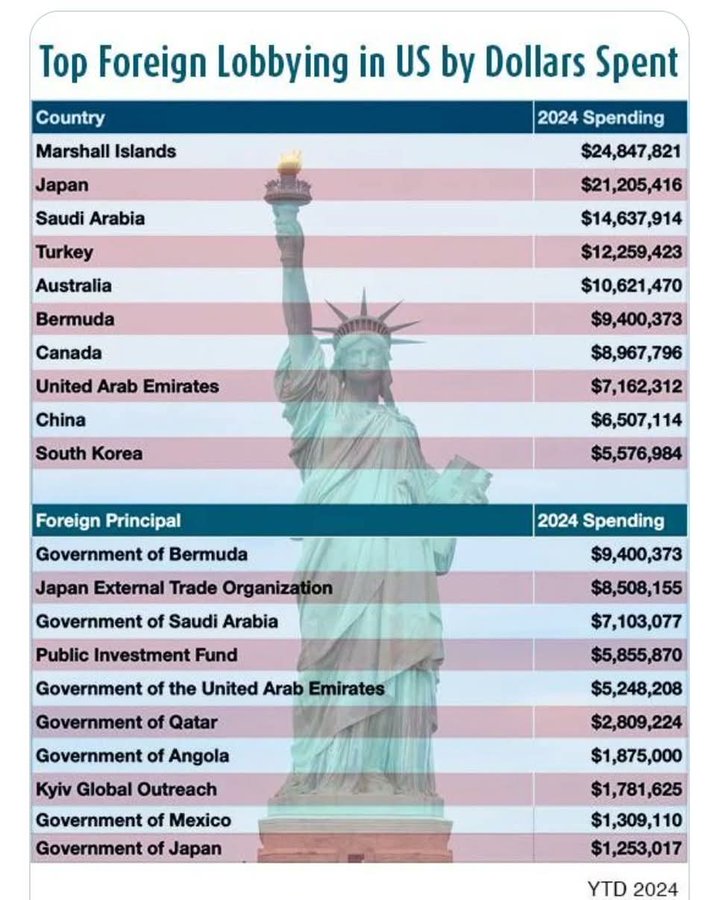
The data, when examined objectively, presents a clear hierarchy of foreign lobbying activity. The Marshall Islands, a small Pacific nation, tops the list with nearly $25 million in reported expenditures. Japan follows with over $21 million, while Saudi Arabia and Turkey report spending of approximately $14.6 million and $12.2 million, respectively. Other nations—including Australia, Bermuda, Canada, the United Arab Emirates, China, and South Korea—round out the top ten, each contributing substantial sums to influence policy, trade relations, or diplomatic priorities within the United States.
Further granularity emerges when examining the “foreign principal” breakdown. Entities such as the Government of Bermuda, the Japan External Trade Organization, and the Government of Saudi Arabia are among the leading spenders, alongside sovereign wealth funds and state-backed institutions. These figures underscore a fundamental reality: foreign lobbying in the United States is both widespread and multifaceted, encompassing economic, strategic, and diplomatic interests across a broad spectrum of nations.
Yet, despite this empirical landscape, public discourse often gravitates toward a singular focus on Israel. This phenomenon raises an important question: why does a country not even listed among the top lobbying spenders command such outsized attention?
Part of the answer lies in the nature of modern information ecosystems. Digital platforms, driven by algorithms that reward engagement, tend to amplify content that is emotionally charged, controversial, or polarizing. In this environment, narratives surrounding Israel—particularly those tied to geopolitical conflict—are uniquely susceptible to distortion. Simplified or sensationalized claims can spread rapidly, often detached from factual context, creating a feedback loop in which perception diverges sharply from reality.
The graphic in question, while ostensibly a neutral presentation of data, has itself become a vehicle for competing interpretations. Some observers point to Israel’s absence as evidence that widely held assumptions about its influence are overstated. Others, however, attempt to reinterpret or dismiss the data altogether, suggesting that influence operates through less visible channels. In both cases, the discussion frequently drifts away from the empirical evidence and into the realm of conjecture.
This tendency is not merely academic; it has tangible consequences. The persistent focus on Israel, often disproportionate to its measurable lobbying activity, can contribute to the proliferation of misleading narratives. These narratives, in turn, risk reinforcing stereotypes or fostering unwarranted suspicion. In extreme cases, they may intersect with broader patterns of antisemitism, where critiques of state policy become entangled with generalized hostility toward Jewish individuals or communities.
It is important to distinguish between legitimate policy debate and the propagation of unfounded claims. Democratic societies depend on robust discourse, including critical examination of foreign policy and international relationships. However, such discourse must be grounded in accurate information and a willingness to engage with complexity. The data presented in the lobbying graphic does not preclude scrutiny of any nation’s actions, but it does challenge the notion that Israel occupies a uniquely dominant position in this specific domain.
Another factor contributing to the disproportionate attention is the symbolic role Israel plays in global politics. As a focal point of longstanding regional tensions, the country often becomes a proxy for broader ideological debates. Issues such as security, human rights, and international law are frequently projected onto the Israeli context, amplifying its visibility far beyond what raw data on lobbying expenditures would suggest.
Moreover, the historical and cultural dimensions of the Israeli-Palestinian conflict lend themselves to deeply entrenched narratives. These narratives, shaped by decades of reporting, advocacy, and political rhetoric, can be resistant to revision even in the face of new information. As a result, data that contradicts prevailing assumptions may struggle to gain traction, while narratives that align with existing beliefs are more readily accepted.
The role of media—both traditional and digital—cannot be overlooked in this process. Selective coverage, framing choices, and editorial priorities all influence how information is perceived. When combined with the rapid spread of unverified content on social media, these factors can create an environment in which certain topics receive sustained attention regardless of their empirical weight.
It is also worth considering the broader context of foreign lobbying itself. The practice is a well-established component of international relations, governed by legal frameworks such as the Foreign Agents Registration Act. Countries engage in lobbying to advance a wide range of interests, from trade agreements to security cooperation. The presence of multiple nations with higher reported expenditures than Israel suggests that influence is neither monolithic nor confined to a single actor.
Against this backdrop, the fixation on Israel appears less a reflection of its actual lobbying footprint and more a product of narrative construction. This does not imply that all criticism is unwarranted, but it does highlight the need for a more nuanced and evidence-based approach to public discourse.
Ultimately, the graphic serves as a reminder of the importance of grounding discussions in verifiable data. It challenges observers to reassess assumptions and to consider the broader landscape of foreign influence in the United States. At the same time, it underscores the risks associated with the selective interpretation of information—a practice that can distort understanding and fuel unnecessary division.
In a world where information is both abundant and contested, the ability to critically evaluate data is more essential than ever. The case of foreign lobbying expenditures illustrates how easily perception can diverge from reality, particularly when narratives are shaped by factors beyond the data itself. For policymakers, analysts, and the public alike, the task is to navigate this complexity with rigor and integrity, ensuring that conclusions are informed by evidence rather than conjecture.
As debates continue, the challenge will be to foster a discourse that is both critical and constructive—one that acknowledges the multifaceted nature of international relations while resisting the allure of simplistic explanations. Only then can the conversation move beyond disproportionate focus and toward a more comprehensive understanding of the forces that shape global engagement.



