































|
Getting your Trinity Audio player ready...
|
By: Yisroel David
A sweeping new demographic analysis examining the future of global Jewish communities has concluded that Israel could become home to the majority of the world’s Jewish population within the next decade, a historic transformation that scholars describe as one of the most consequential developments in modern Jewish history. The study, cited by Tazpit Press Service (TPS) paints a portrait of a rapidly evolving Jewish world shaped by divergent birth rates, shifting migration patterns, rising antisemitism, and profound ideological and cultural changes that are likely to redefine Jewish life over the coming century.
The report, authored by renowned demographer Professor Sergio DellaPergola and published by the London-based Institute for Jewish Policy Research, presents a far-reaching examination of the demographic forces reshaping Jewish communities across Israel, North America, and Europe. DellaPergola, professor emeritus and former chairman of the Hebrew University’s Harman Research Institute of Contemporary Jewry, argues that while the Jewish People will endure far into the future, the composition, geographic center, and cultural identity of global Jewry may look dramatically different from anything previously experienced.
“If there is still a world in 2126, there will be a Jewish People,” DellaPergola wrote in the report cited by TPS. “It will be a Jewish People very different from the current one, in a world even more unrecognizable than the one we live in today.”
The report estimates the current global Jewish population at approximately 15.8 million people, a figure notably smaller than the population of the Netherlands. Yet despite its relatively modest numerical size, the Jewish People continue to occupy what DellaPergola described as an “exorbitant” place in global political, cultural, and ideological discourse.
Nearly half of the world’s Jews presently reside in Israel. However, according to the study cited by TPS, existing demographic trajectories suggest that Israel could surpass the symbolic threshold of housing a majority of world Jewry as early as 2035. Such a milestone would represent a profound historic shift, effectively completing a demographic transformation that began with the establishment of the modern State of Israel in 1948.
DellaPergola reportedly characterized the development as “epochal,” underscoring its significance not merely in statistical terms but as a defining civilizational realignment for the Jewish People after centuries in which Jewish life was overwhelmingly centered in diaspora communities.
The report attributes this emerging demographic dominance primarily to dramatically different fertility patterns between Israel and Jewish communities elsewhere in the world. While Jewish populations in the United States and Europe are increasingly ageing and experiencing stagnation or decline, Israel continues to sustain one of the highest birth rates among developed nations.
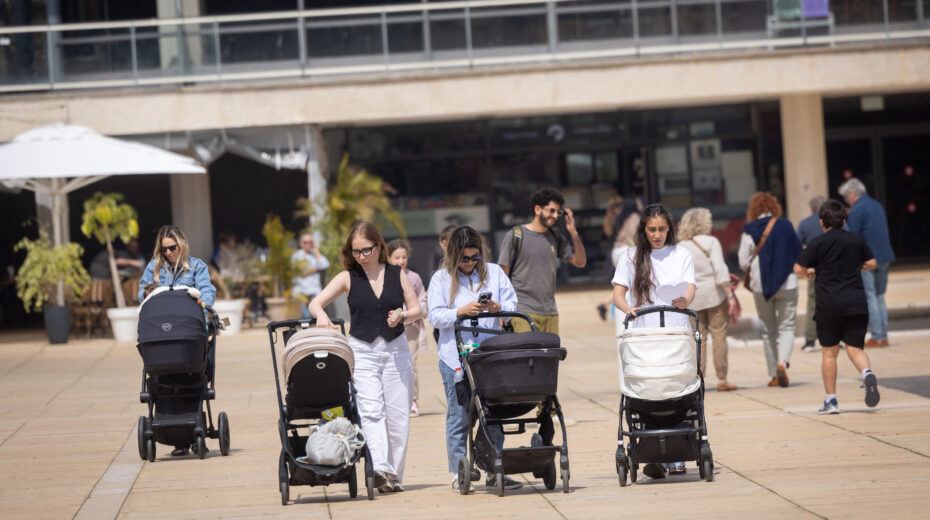
According to the findings highlighted in the TPS report, even Israel’s secular population maintains fertility levels substantially above those seen across Europe and North America. Families in Tel Aviv, often regarded as one of the country’s most secular urban centers, reportedly average more children than families in virtually any major European city.
At the same time, the report identifies growing intermarriage rates in the United States as a central factor contributing to demographic contraction within diaspora communities. Intermarriage, which DellaPergola noted was almost negligible among American Jews roughly a century ago, has now surpassed 60% by 2020.
The study argues that this trend has weakened the intergenerational transmission of Jewish identity in many non-Orthodox households, accelerating assimilation and contributing to long-term demographic decline.
In contrast, Israel’s demographic expansion is being fueled heavily by its Orthodox and ultra-Orthodox sectors, particularly the Haredi population. According to the report cited by TPS, Haredim currently constitute approximately 15% of Israel’s Jewish population, but their exceptionally high birth rates could dramatically alter the country’s demographic balance in the decades ahead.
Haredi families reportedly average between 6 and 7 children, compared with slightly more than 2 among secular Israelis. As a result, DellaPergola projects that the Haredi share of Israel’s population could climb to approximately 30% by 2050.
The report, however, emphasizes that this demographic success also carries substantial economic and strategic implications for the Jewish state. DellaPergola warns that persistently low workforce participation rates among Haredi men, coupled with relatively limited military service participation, could create mounting fiscal and national security pressures if existing trends continue unchecked.
According to the analysis cited by TPS, these dynamics may ultimately force Israel to confront difficult questions about balancing religious tradition, economic productivity, military readiness, and social cohesion within an increasingly diverse society.
The report also devotes considerable attention to migration patterns reshaping both Israel and the broader Jewish diaspora in the aftermath of the Hamas-led massacre in southern Israel on Oct. 7, 2023. In the wake of the attack and the prolonged regional conflict that followed, Israel experienced an unusual demographic phenomenon: a temporary negative migration balance in which more people departed the country than arrived.
At the same time, however, the study notes that rising antisemitism across Europe and North America has simultaneously prompted growing numbers of Jews to contemplate relocation to Israel. The result, DellaPergola explains, is a complicated psychological and demographic tension within global Jewish communities.
According to the report cited by TPS, many Jews today feel caught between opposing emotional and practical forces — an escalating desire to leave environments perceived as increasingly hostile, paired with uncertainty about where long-term security and stability can truly be found.
DellaPergola reportedly summarized the dilemma by describing “a strong desire to leave, but without being able to truly decide where.”
The report argues that antisemitism itself has evolved significantly in recent decades. While outright physical violence against Jews remains a serious concern, contemporary antisemitism increasingly manifests through social exclusion, ideological delegitimization, public intimidation, and challenges to both Jewish identity and the legitimacy of the State of Israel.
According to the study highlighted in the TPS report, this transformation has created a climate in which many Jews experience persistent insecurity even in countries historically considered safe havens for Jewish life.
The report suggests that younger generations of Jews in Europe and North America are increasingly grappling with questions surrounding identity preservation, communal continuity, and the sustainability of Jewish institutions amid rising polarization and social fragmentation.
Jonathan Boyd, executive director of the Institute for Jewish Policy Research, emphasized that the report was designed to counteract what he described as excessive communal fixation on immediate crises at the expense of long-term demographic realities.
“There’s a tendency in Jewish communal life to focus on the crisis of the day,” Boyd said in remarks cited by TPS. “But if you base your understanding of the future on short-term shocks, you risk missing the bigger picture entirely.”
That “bigger picture,” according to the report, points toward a future in which Israel assumes an even more dominant role not only politically and militarily, but demographically, culturally, and spiritually within global Jewish civilization.
The implications of such a transformation are enormous. For centuries, the center of Jewish life shifted repeatedly due to exile, persecution, migration, and political upheaval — from the ancient Land of Israel to Babylon, from Spain to Eastern Europe, and eventually to the United States. Now, the study suggests, the pendulum may once again be swinging decisively toward Israel.
According to the TPS report, DellaPergola’s analysis ultimately portrays a Jewish future defined by resilience and adaptation, even amid uncertainty and profound transformation. While the Jewish People may remain numerically small relative to the broader global population, the report argues that their demographic evolution will continue carrying immense geopolitical, cultural, and historical significance.
The study concludes that the coming century is likely to witness the emergence of a Jewish world increasingly concentrated in Israel, more religiously polarized, more demographically driven by Orthodox communities, and more profoundly shaped by the intersection of identity, security, migration, and global political instability.
Whether viewed as a warning, a prediction, or a historic milestone, the findings outlined in the report cited by TPS underscore that the future of world Jewry is entering a period of historic transition whose consequences may reverberate for generations to come.