













|
Getting your Trinity Audio player ready...
|
By: Ariella Haviv
In a development that speaks volumes about the prevailing climate of anxiety and resolve within New York City’s Jewish community, a growing number of residents are turning toward firearms training and legal gun ownership as a means of personal protection. The trend, documented in detail in a November 15, 2025 report by The New York Post, reflects what many describe as a profound shift in mindset—one driven by escalating antisemitic incidents, eroding confidence in public safety, and an increasingly volatile political atmosphere.
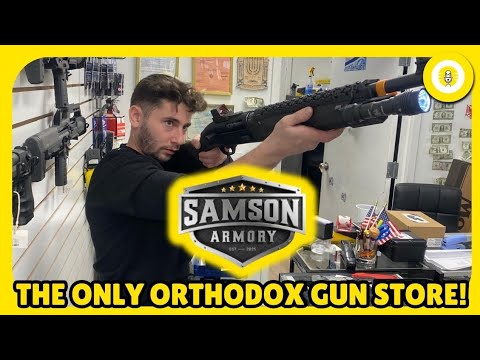
At the epicenter of this movement stands a modest yet symbolically potent establishment in Marine Park, Brooklyn: Samson’s Armory. Founded by 30-year-old entrepreneur Michael Bergida, the shop has rapidly become both a commercial success and a communal hub for those seeking to reconcile faith, identity, and self-defense in an era marked by uncertainty.
Bergida’s choice of name is deliberate. Drawing inspiration from the Biblical figure Samson—a symbol of strength and defiance—the armory embodies a philosophy that is as much about psychological empowerment as it is about physical preparedness. “We’re probably the only gun store to have a minyan,” Bergida remarked, referencing the traditional Jewish quorum for prayer, a detail that underscores the unique cultural synthesis taking place within his establishment.
According to the New York Post report, Bergida’s clientele spans a remarkably broad demographic spectrum. “I’m arming everyone from fearful zaydes to terrified rabbis,” he said, capturing in a single phrase the generational breadth of the phenomenon. The image is striking: elderly men, religious leaders, professionals, and young families converging in pursuit of a shared objective—the capacity to defend themselves in a world they increasingly perceive as hostile.
Bergida’s assessment of the broader environment is unambiguous. “Chaos” is how he describes the current state of affairs, attributing much of the unease to what he characterizes as a deterioration in public safety and civic order. “The NYPD is all retiring—we have to fight for ourselves. People are freaking out,” he said, as quoted in the New York Post report. His language, while stark, resonates with a segment of the population that feels exposed and underserved.
The sentiment is echoed in a phrase that has become something of a rallying cry within certain circles: “We have to let everyone know—don’t mess with the Jews.” Bergida framed this not as a call to aggression, but as a declaration of deterrence rooted in historical memory. “Never again,” he added, invoking a phrase that has long served as a moral and existential cornerstone for Jewish communities worldwide.
The surge in interest is not confined to a single storefront. Across the city, firearms instructors and training facilities report a marked increase in demand, particularly in the aftermath of the election of Mayor Zohran Mamdani. The New York Post report details how, in the immediate wake of the election, instructors were inundated with inquiries from individuals seeking guidance on obtaining concealed carry permits and completing mandatory training.
Among those witnessing this influx firsthand is veteran instructor Lance Dashefsky, who has spent decades teaching gun safety in New York. “It’s getting busy because of him,” Dashefsky said, referring to Mamdani, in remarks cited by the New York Post. His observation is supported by empirical data: concealed carry permit applications rose 14%, from 620 in June to 706 in August, according to NYPD figures referenced in the same report.
Dashefsky’s classes, which include 16 hours of classroom instruction and 2 hours of live-fire training as mandated by state law, have taken on a distinctly communal character. “I always ask people in class why they want a gun,” he explained. “And now the answer is Mamdani.” The simplicity of the response belies the complexity of the motivations underlying it, which encompass not only political concerns but also broader anxieties about safety and identity.
The regulatory framework governing firearm ownership in New York City remains among the most stringent in the nation. Applicants must undergo a rigorous vetting process that can take between 6 months and 12 months to complete, a timeline that has done little to dampen enthusiasm. If anything, the protracted process appears to have intensified the sense of urgency among prospective gun owners.
Another prominent voice in this evolving landscape is Ross Den, a Brooklyn-based trainer who has observed a decisive shift among those who were previously ambivalent about gun ownership. “Anyone who was ever on the fence about getting a concealed carry weapon is no longer,” Den stated, according to the New York Post report.
Den’s clientele includes a diverse array of professionals—doctors, lawyers, tradespeople, and clergy—many of whom share a common concern about the vulnerability of communal spaces. “There are plenty of rabbis who carry—shul is where the greatest threat is,” he said. His remarks highlight a sobering reality: houses of worship, once perceived as sanctuaries, are now viewed by some as potential targets.
Under current regulations, carrying a firearm within a synagogue is permissible if the individual is designated as a security volunteer by the institution. This provision has facilitated the emergence of informal security networks within certain congregations, further blurring the line between civilian and communal defense.
The motivations driving this trend are multifaceted, but they are unified by a pervasive sense of unease. The New York Post report situates this phenomenon within the broader context of rising antisemitism, noting that incidents have increased both in frequency and intensity in recent years. For many, the decision to arm themselves is less about ideology than about necessity.
This perspective is poignantly articulated by an Israeli-born mother of four, who spoke to the New York Post. “We are Jewish and we will protect ourselves—even if the mayor despises us,” she said. Her words encapsulate a sentiment that is at once defiant and deeply personal. “We will have a say in our protection and not have to rely on others.”
The political dimension of the issue cannot be ignored. Mayor Mamdani’s past statements and affiliations have drawn scrutiny from critics who argue that his rhetoric has contributed to an environment of polarization. According to the New York Post report, Mamdani, founder of his college Students for Justice in Palestine chapter and supporter of the antisemitic Boycott, Divest, Sanction movement, outrageously pronounced that “when the boot of the NYPD is on your neck, it’s been laced by the IDF” as an assemblyman in 2023.
The Muslim radical socialist also refused to recognize Israel’s right to exist as a Jewish state and vowed to arrest the Israeli PM on his next visit to the Big Apple.
Election data cited in the New York Post report reveals that heavily Orthodox neighborhoods such as Borough Park and Crown Heights voted overwhelmingly for former Governor Andrew Cuomo, with support levels of 88% and 75% respectively. These figures suggest a significant divergence between the political preferences of these communities and the broader electoral outcome.
The implications of this divide extend beyond the ballot box. They are manifesting in tangible behavioral changes, including the decision by many to pursue firearm ownership. For Bergida and others, this is not merely a response to current conditions but a long-term commitment. “We ain’t fleeing—we’re here to stay,” he declared. “We’re not victims anymore.”
His statement encapsulates the ethos underpinning the movement: a refusal to retreat in the face of adversity, coupled with a determination to assert agency in matters of personal and communal security. It is a posture that draws upon historical memory while adapting to contemporary realities.
Yet the trend also raises complex questions about the future of urban life in New York. The increasing normalization of civilian armament, even within a highly regulated framework, signals a shift in the social contract between citizens and the state. It reflects a recalibration of expectations regarding the role of law enforcement and the extent to which individuals must take responsibility for their own safety.
For some observers, this development is cause for concern, suggesting a potential erosion of trust in public institutions. For others, it represents a pragmatic adaptation to a changing environment. What is clear is that the phenomenon is not isolated; it is part of a broader national conversation about security, identity, and the limits of government protection.
The New York Post report provides a compelling snapshot of this moment, capturing both the immediacy of the concerns and the depth of the responses they have elicited. Through the voices of individuals like Bergida, Dashefsky, Den, and the Israeli mother, the report offers a window into a community grappling with profound challenges and making consequential choices.
As New York continues to navigate an era marked by heightened tensions and evolving threats, the decisions being made today will have lasting ramifications. Whether the turn toward armed self-defense proves to be a temporary response or a more enduring transformation remains to be seen.
What is certain, however, is that for many Jewish New Yorkers, the phrase “Never again” has taken on a renewed and deeply practical meaning—one that is being expressed not only in words, but in actions.




1 Comment
Dr. Holly Priestley
May 13, 2026Hubby volunteers as a range safety officer in AZ. He wears an Israeli/US pin on his bullet-proof vest so many Jewish patrons speak to him. In the 8+ years he has volunteered, since Oct 7th, he has seen a large increase in Jewish patrons.