

















|
Getting your Trinity Audio player ready...
|
By: Abe Wertenheim
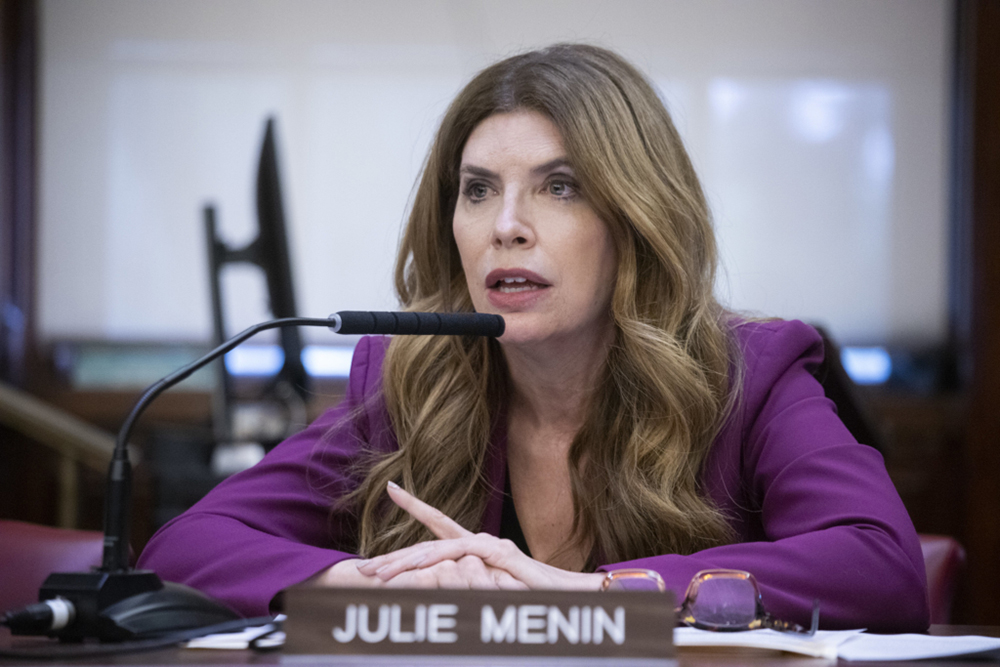
A consequential legislative standoff is unfolding within the corridors of New York City governance, as City Council Speaker Julie Menin and her colleagues deliberate whether to override Mayor Zohran Mamdani’s veto of a controversial “buffer zone” bill designed to regulate protests near educational institutions. The measure, formally known as Int. 175-B, has become a focal point of broader tensions surrounding public safety, constitutional rights, and the limits of protest activity—particularly in the wake of recent demonstrations targeting Jewish institutions across the city.
According to a report on Thursday by The Jewish News Syndicate (JNS) discussions within the City Council remain ongoing, with no definitive timeline established for a potential override vote. The procedural uncertainty reflects both the complexity of the issue and the delicate political calculus required to secure the supermajority necessary to reverse the mayor’s decision.
“Speaker Menin is engaging in conversations with council colleagues about Int. 175-B, and that member-driven process will determine next steps,” Jack Lobel, Menin’s deputy press secretary, told JNS, firmly rejecting earlier reports that a vote had been scheduled for May 14. His statement underscores the fluid nature of the deliberations, as council members weigh competing priorities and constituencies.
The legislation at the heart of the dispute was initially passed by a 30–19 margin on April 24, falling short of the 34 votes required to override a mayoral veto in the 51-member council. Mayor Mamdani subsequently exercised his veto authority, citing concerns over both the breadth of the bill’s language and its potential implications for constitutionally protected rights.
In his veto message, the mayor argued that the bill’s definition of “educational institutions” was overly expansive, raising the possibility that its enforcement could encroach upon fundamental freedoms of speech and assembly. “The definition is overly broad,” Mamdani warned, suggesting that the measure could inadvertently restrict lawful protest activity in ways that might not withstand judicial scrutiny.
The proposed legislation would mandate that the New York Police Department develop and implement comprehensive plans to manage protests occurring in proximity to schools and other educational facilities. As JNS has reported, the initiative forms part of a broader legislative package advanced by Speaker Menin in response to a series of high-profile demonstrations, including anti-Israel protests that have taken place outside synagogues and Jewish communal institutions.
Supporters of the bill contend that such measures are essential to ensuring the safety and accessibility of educational environments, particularly in an era marked by heightened tensions and increasingly confrontational protest tactics. They argue that the establishment of designated buffer zones would provide a necessary safeguard against intimidation, obstruction, and potential violence, without categorically prohibiting protest activity.
Yet critics have framed the proposal in starkly different terms, portraying it as an attempt to curtail dissent and marginalize specific political movements. Opposition to Int. 175-B has intensified markedly in the weeks following the mayor’s veto, with a diverse coalition of labor organizations and activist groups mobilizing to influence the council’s next steps.
A coalition of 13 labor unions has formally urged council members to uphold Mamdani’s veto, emphasizing concerns about the potential erosion of workers’ rights to organize and demonstrate. Simultaneously, the New York City chapter of the Democratic Socialists of America has launched a coordinated campaign encouraging its members to lobby council representatives in favor of sustaining the veto.
In a statement cited in the JNS report, the organization characterized the bill as “a clear attempt to silence the Palestinian solidarity movement,” reflecting a broader critique that situates the legislation within the context of ongoing debates over Israel and Palestinian advocacy in public spaces.
This framing has, in turn, heightened the political stakes of the impending decision, transforming what might otherwise be a technical policy debate into a referendum on the boundaries of permissible protest and the responsibilities of municipal government in managing deeply polarizing issues.
For Speaker Menin, the challenge lies in navigating these competing pressures while maintaining momentum for a legislative agenda rooted in public safety concerns. Her office has consistently emphasized the importance of protecting vulnerable communities from disruptive and potentially threatening demonstrations, particularly those that occur in close proximity to educational settings.
As the JNS report noted, the buffer zone proposal was conceived in direct response to incidents in which protests outside synagogues and Jewish institutions escalated into confrontational and, at times, volatile encounters. Proponents argue that the bill represents a measured and targeted response to these developments, designed to balance the right to protest with the imperative of ensuring secure and unobstructed access to schools and communal facilities.
The mayor’s decision to allow a related measure concerning houses of worship to become law—albeit without his signature—adds a further layer of complexity to the situation. That bill, which passed with a veto-proof majority, similarly requires the NYPD to develop strategies for managing protests near religious institutions, suggesting that consensus may be more attainable in certain contexts than in others.
The divergence between the two measures raises important questions about the criteria used to define protected spaces and the extent to which different types of institutions warrant distinct regulatory approaches. It also highlights the nuanced interplay between legislative intent and executive oversight, as policymakers grapple with the challenge of crafting laws that are both effective and constitutionally sound.
From a procedural standpoint, the path to an override remains uncertain. Under council rules, achieving the requisite 34 votes will require not only persuading undecided members but also potentially securing defections from those who initially opposed the bill. Given the current 30–19 vote tally, proponents must bridge a gap of at least 4 votes—a task that will likely necessitate intensive negotiation and strategic compromise.
The absence of a scheduled vote suggests that council leadership is acutely aware of these challenges and is proceeding with caution. As Lobel’s remarks to JNS indicate, the process remains “member-driven,” with individual council members playing a decisive role in determining the outcome.
Beyond the immediate legislative dynamics, the controversy surrounding Int. 175-B reflects broader societal tensions that extend far beyond the confines of City Hall. The intersection of protest activity, public safety, and political expression has become an increasingly contested terrain, particularly in a city as diverse and dynamic as New York.
In this context, the debate over buffer zones can be seen as part of a larger conversation about how democratic societies navigate the competing imperatives of security and freedom—how they protect the rights of individuals to express dissent while also safeguarding the well-being of communities that may be affected by that expression.
As JNS has emphasized in its coverage, the stakes of this debate are not merely theoretical. They have tangible implications for the daily lives of students, educators, and community members, as well as for the broader fabric of civic engagement in the city.
For now, the future of Int. 175-B remains unresolved, its fate contingent upon the outcome of ongoing discussions within the City Council. Whether lawmakers ultimately choose to override the mayor’s veto or uphold it, their decision will carry significant ramifications—not only for the specific provisions of the bill, but also for the principles that underpin the city’s approach to governance in an era of heightened polarization.
As the deliberations continue, one thing is clear: the question of how to balance the right to protest with the need for public order is unlikely to be settled definitively by a single piece of legislation. Rather, it will remain an evolving challenge, one that demands both vigilance and nuance from those entrusted with the responsibility of shaping public policy.
In the words conveyed through the JNS report, the process now rests squarely in the hands of council members themselves—a “member-driven” journey that will ultimately determine whether the city charts a course toward stricter regulation or reaffirms a more expansive interpretation of protest rights.



