













|
Getting your Trinity Audio player ready...
|
Hochul Signs Landmark Buffer Zone Legislation as Jewish Leaders Gather at Met Council’s Legislative Breakfast
Governor Establishes 50-Foot Protective Perimeters Around Houses of Worship, Citing Need to Safeguard Religious Freedom and Public Safety
By: Justin Winograd
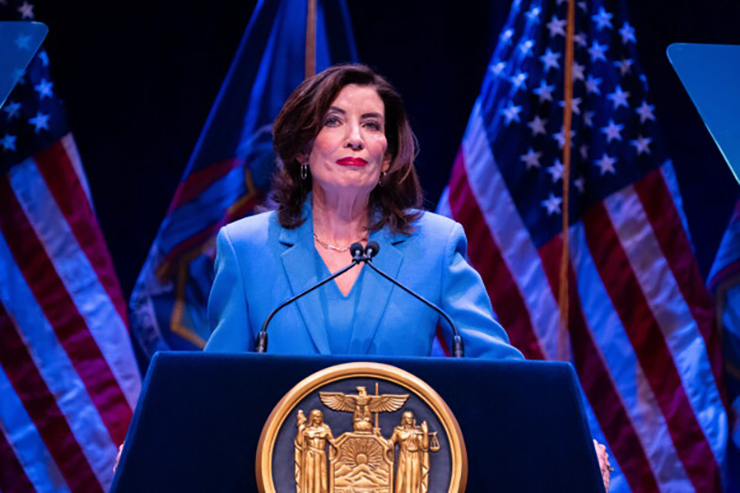
In a move hailed by supporters as a significant step toward strengthening protections for religious communities amid a climate of rising concerns about harassment and intimidation, Governor Kathy Hochul signed landmark legislation on Sunday establishing protective buffer zones around houses of worship and other religious institutions throughout New York State.
The signing ceremony took place before an influential audience of elected officials, religious leaders, community advocates, and nonprofit executives gathered at Manhattan’s historic Cipriani 42nd Street for Met Council’s annual legislative breakfast, an event that preceded New York City’s annual Israel Day Parade and underscored growing efforts to address security concerns facing faith-based communities.
According to a report on Sunday at VIN News, the legislation creates 50-foot security perimeters around houses of worship and religious institutions where protests and demonstrations that interfere with access are prohibited. Advocates of the measure argue that the law is designed to ensure that individuals can enter and leave religious institutions without fear of intimidation, harassment, or disruption.
The legislation arrives at a time when many religious communities, particularly Jewish institutions, have expressed increasing concern about security challenges and the broader rise in antisemitic incidents both in New York and across the nation.
Governor Hochul used the occasion to emphasize what she described as a fundamental principle of American society: the right of every individual to practice his or her faith without fear.
“Everyone should be able to walk into their place of worship without fear of harassment or intimidation,” Hochul declared during the bill-signing ceremony, according to the VIN News report.
Her remarks resonated with many in attendance, particularly leaders from religious communities who have spent recent years advocating for enhanced security measures.
The governor framed the legislation not as a political initiative but as a public safety measure intended to preserve both religious liberty and civil order.
Supporters contend that the law establishes an important balance between the constitutional right to protest and the equally fundamental right of individuals to worship freely without interference.
In the governor’s view, protecting access to religious institutions is an essential responsibility of government and a critical component of maintaining social cohesion in an increasingly polarized environment.
The signing took place during one of the most prominent annual gatherings of civic and community leadership in New York.
As was reported by VIN News, more than 600 elected officials, government representatives, clergy members, nonprofit executives, and community stakeholders attended Met Council’s annual legislative breakfast.
The event served both as a policy forum and as a celebration of the organization’s extensive social service work throughout New York State.
Met Council has long been recognized as one of the nation’s largest Jewish social service organizations, providing a broad range of assistance programs to vulnerable populations.
Its services extend far beyond the Jewish community and include food distribution initiatives, senior citizen programs, emergency assistance, housing support, anti-poverty efforts, and social welfare services that collectively reach hundreds of thousands of New Yorkers.
According to figures cited in the VIN News report, the organization currently serves more than 350,000 residents through an extensive network of community programs.
The annual breakfast has become a major venue for discussions regarding public policy, community needs, and government partnerships aimed at improving the quality of life for New Yorkers.
Among the most notable speakers at the event was David G. Greenfield, the Chief Executive Officer of Met Council and a prominent advocate on behalf of New York’s Jewish community.
Greenfield delivered particularly strong praise for Governor Hochul’s record, arguing that her administration has demonstrated an unprecedented commitment to protecting Jewish New Yorkers during a period marked by heightened concerns regarding antisemitism and security.
Greenfield stated that no governor in New York’s history has done more to protect Jewish residents than Hochul.
The remarks reflected a broader sentiment among many attendees who view the governor’s actions on issues affecting religious communities as both substantive and consistent.
Supporters pointed to a series of initiatives undertaken by her administration involving security funding, hate crime prevention efforts, educational programs, and partnerships with community organizations.
For many leaders in attendance, the newly signed buffer zone legislation represented another chapter in what they described as a sustained effort to strengthen protections for vulnerable communities.
The passage of the legislation comes amid growing concern regarding incidents targeting houses of worship across the United States.
Many religious leaders have reported increasing anxiety among congregants who worry about protests, demonstrations, and security threats occurring near religious facilities.
While advocates stress that peaceful protest remains a protected constitutional right, they argue that there is an important distinction between lawful expression and conduct that creates fear or obstructs access to places of worship.
Supporters contend that the newly established buffer zones help clarify that distinction.
The law seeks to ensure that worshippers can enter and exit religious institutions without being confronted by demonstrators positioned immediately outside entrances or access points.
Proponents maintain that the legislation is especially important in an era marked by elevated tensions surrounding political, religious, and international issues.
For many Jewish institutions, these concerns have become particularly acute following the surge in antisemitic incidents reported nationwide in recent years.
Throughout the breakfast gathering, discussions extended beyond the specific legislation and touched upon broader issues affecting communities throughout New York.
Participants addressed concerns involving public safety, poverty, social services, food insecurity, and support for vulnerable populations.
Met Council’s leadership emphasized that the organization’s mission extends beyond emergency assistance and includes long-term efforts to strengthen communities through partnerships with government agencies and civic organizations.
The event highlighted the increasingly interconnected relationship between nonprofit organizations and public policymakers in addressing complex social challenges.
Speakers repeatedly stressed that effective public policy requires collaboration among elected officials, community leaders, religious institutions, and service providers.
The buffer zone legislation was frequently cited as an example of such collaboration.
The gathering also provided an opportunity to spotlight Met Council’s substantial impact throughout New York.
For decades, the organization has played a central role in combating poverty and supporting individuals facing economic hardship.
Its extensive network of food pantries, social service programs, senior assistance initiatives, and emergency support services has made it one of the most influential nonprofit organizations in the state. VIN News reported that the organization currently reaches more than 350,000 New Yorkers through its various programs.
That expansive reach has allowed Met Council to serve as both a provider of direct services and a powerful advocate for public policies affecting vulnerable populations.
The annual legislative breakfast serves as a platform for advancing those policy discussions while bringing together decision-makers from multiple sectors.
As attendees departed Cipriani 42nd Street and many proceeded to participate in New York City’s annual Israel Day Parade, the significance of the legislation remained a dominant topic of conversation.
Supporters expressed optimism that the measure would provide meaningful protections for religious institutions and reinforce the principle that every individual has the right to worship without fear.
Governor Hochul’s signing of the legislation was widely viewed as a symbolic and practical affirmation of that principle.
By establishing protective zones around houses of worship, New York has joined a growing number of jurisdictions seeking to address concerns about safety while preserving constitutional freedoms.
For advocates, the law represents more than a procedural change. It stands as a declaration that religious liberty, public safety, and human dignity remain values worthy of vigorous protection.
As New York continues to confront evolving social and security challenges, supporters hope the legislation will serve as a model for ensuring that houses of worship remain places of peace, reflection, and communal strength rather than venues vulnerable to intimidation and disruption.
In that sense, Sunday’s signing ceremony was not merely a legislative event. It was a public affirmation of the enduring importance of religious freedom and the collective responsibility to safeguard it for future generations.



