
















|
Getting your Trinity Audio player ready...
|
By: Tzirel Rosenblatt
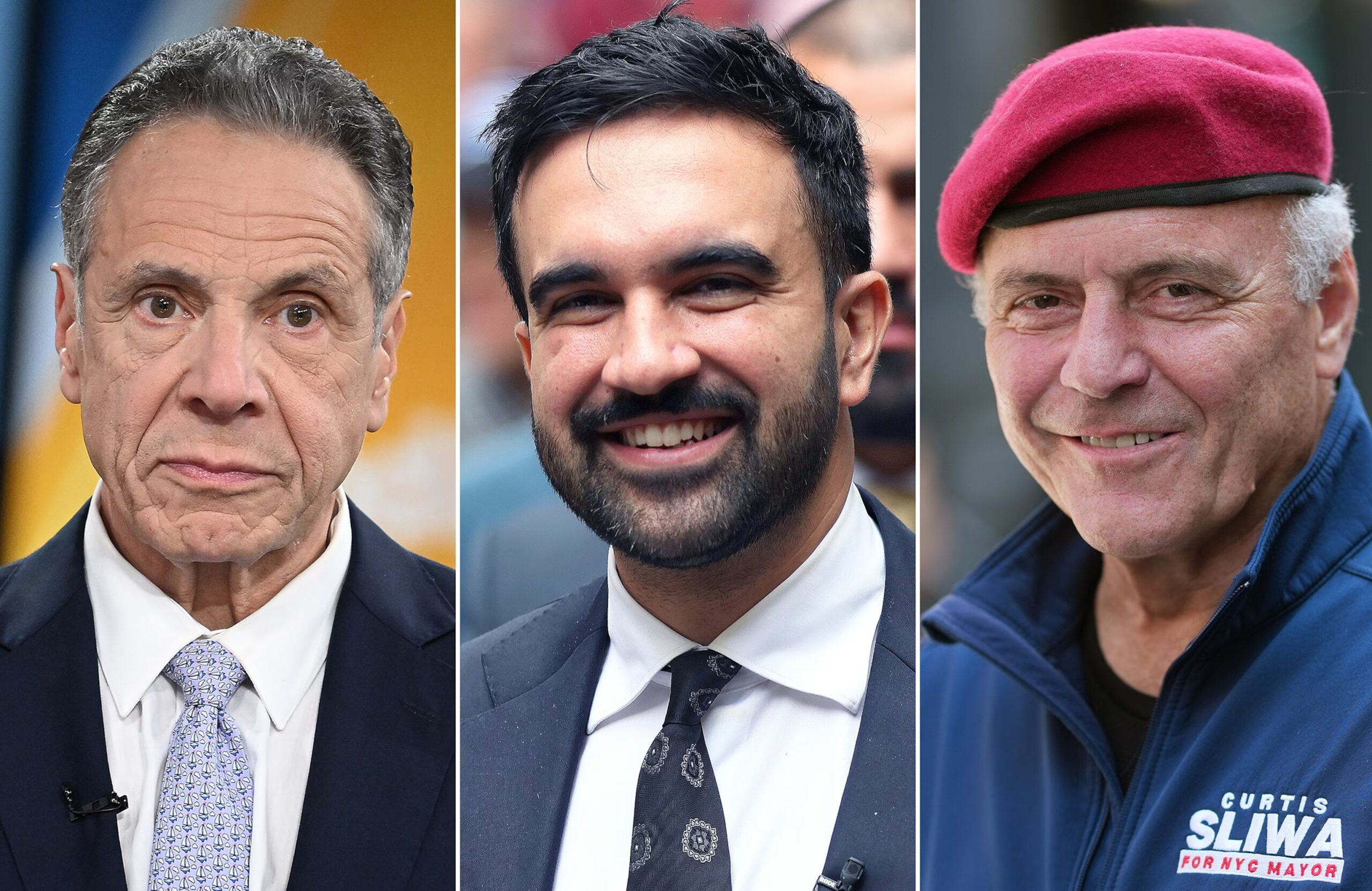
The results of New York City’s 2025 mayoral election have underscored a stark generational divide that speaks volumes about the city’s shifting political identity. According to a CBS News Exit Poll released on November 4, 2025, the race between Zohran Mamdani, Andrew Cuomo, and Curtis Sliwa fractured sharply along age lines, revealing a city where political ideology appears increasingly dictated by generational worldview rather than geography or class.
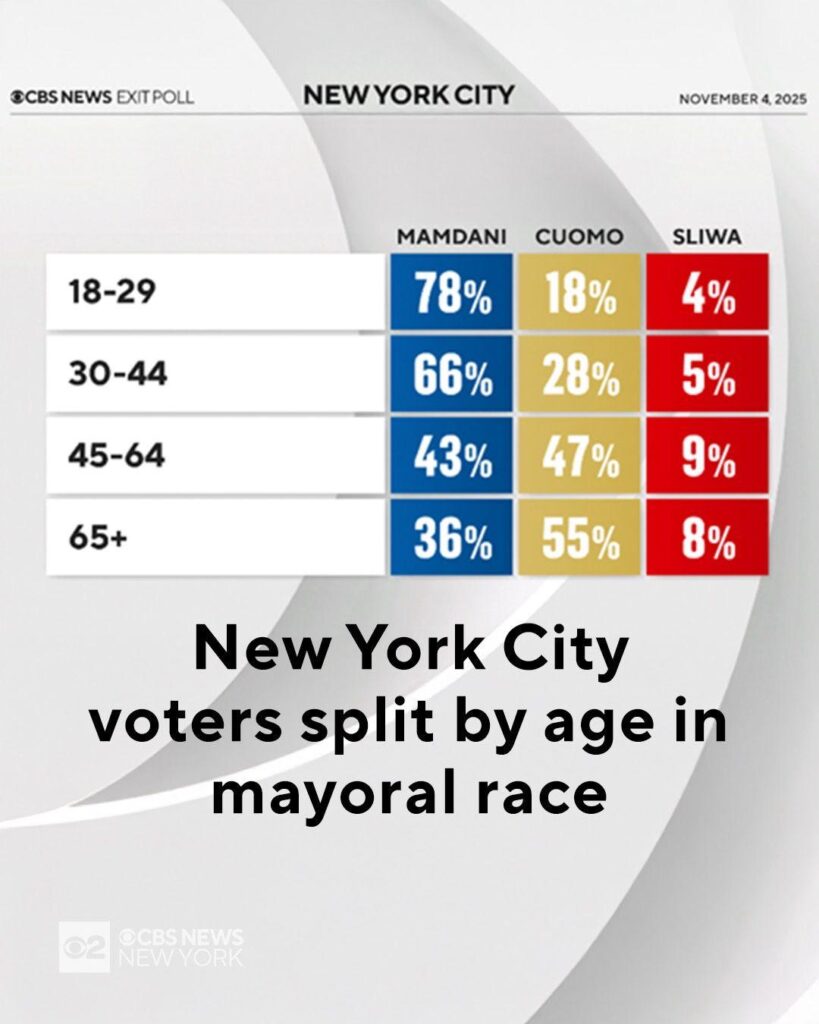
The survey, conducted across all five boroughs, found that younger voters overwhelmingly propelled Mamdani, the 34-year-old democratic socialist, to victory, while older New Yorkers remained firmly in Cuomo’s corner. Sliwa, the Republican nominee and perennial conservative firebrand, performed poorly across all demographics but retained a small, loyal constituency among older, more security-minded voters.
Among voters aged 18 to 29, Mamdani captured a staggering 78% of the vote — a figure that astonished even seasoned political analysts. Cuomo garnered a mere 18% in this bracket, while Sliwa polled at just 4%.
These numbers illuminate the growing generational realignment within New York City politics, in which progressive candidates draw their strength from young voters who came of age in an era defined by economic precarity, digital activism, and social justice movements.
“The youth vote wasn’t just a factor — it was the foundation of Mamdani’s campaign,” said a veteran Democratic strategist. “For younger New Yorkers, the language of socialism has become the language of reform. Rent freezes, free public transit, childcare — these aren’t radical concepts to them; they’re survival policies.”
For Mamdani, who had positioned himself as the voice of “a new, affordable New York,” the city’s disenchanted youth became the backbone of his insurgent movement. His social media-driven campaign, laced with calls for economic equality and police reform, struck a chord with a generation that views housing affordability and systemic inequality as existential threats.
The next age bracket — voters aged 30 to 44 — also tilted toward Mamdani, though by a narrower margin. He secured 66% of their votes, compared to Cuomo’s 28% and Sliwa’s 5%.
This cohort, often balancing rising costs of childcare, housing, and education, appeared drawn to Mamdani’s rhetoric about affordability and expanded social services. Yet, the 30-to-44 group also represents a more pragmatic base, one that appreciated Cuomo’s experience even as it leaned progressive.
“Many voters in their thirties and forties live at the economic breaking point,” explained a political science professor at Columbia University. “They’re not ideologues — they’re realists. Mamdani’s message of affordability appealed to them because it addressed immediate pain points, not abstract ideals.”
The tide turned sharply among voters aged 45 to 64, who split their allegiance between Mamdani and Cuomo — 43% to 47%, respectively — with Sliwa pulling in 9%.
This demographic, often homeowners and long-time residents, demonstrated deeper skepticism toward Mamdani’s socialist platform, particularly his calls for new taxes on the wealthy and rent freezes that critics claim could destabilize the city’s property market.
“Cuomo’s comeback message of competence and stability resonated with older middle-class voters,” said a campaign analyst familiar with exit polling data. “They’ve lived through the fiscal crises, the crime waves, and the populist promises. They crave order — not experiments.”
Indeed, this group’s nearly even split highlights the growing ideological tension within New York’s traditional Democratic base — a clash between the city’s liberal past and its increasingly radical future.
Among voters 65 and older, Cuomo dominated decisively, with 55% support compared to Mamdani’s 36% and Sliwa’s 8%.
For older New Yorkers, the election represented a referendum on the city’s cultural and political transformation. Many expressed concern over Mamdani’s affiliations with the Democratic Socialists of America and his polarizing positions on law enforcement, housing policy, and foreign affairs.
“Senior voters have long memories,” said a CBS News election analyst. “They remember when the city teetered on bankruptcy, when crime was rampant, and when charisma often led to chaos. For them, Cuomo — despite his controversies — symbolized a steady hand.”
Cuomo’s message of “responsible governance” and his emphasis on rebuilding trust in municipal institutions appealed to this bloc. Conversely, Sliwa’s law-and-order pitch, though once central to his political identity, failed to ignite enthusiasm beyond a small subset of conservative retirees.
The CBS News data paints a portrait of two New Yorks coexisting uneasily — one young, diverse, and insurgent, the other older, pragmatic, and nostalgic for a city of stability and restraint.
This division mirrors broader national trends in which generational politics increasingly supersede traditional party lines. For Mamdani, his success among younger voters represents a generational mandate, but one that may struggle to translate into broad governance given the skepticism of older constituencies.
As one longtime Democratic consultant observed, “Mamdani won the youth, but he hasn’t yet won the city’s trust. Governing New York means balancing idealism with realism, and that’s where his real test begins.”
For Andrew Cuomo, once a titan of New York politics, the exit poll underscores his waning influence among younger generations. Once the archetype of Democratic power, Cuomo’s brand of centrist pragmatism now appears antiquated to a generation reared on social media activism and ideological purity.
“The numbers are brutal for Cuomo among voters under 45,” said a CBS News analyst. “It’s not just about policy — it’s about perception. For younger voters, he represents the establishment they want to dismantle.”
Nevertheless, his 55% support among seniors and 47% among middle-aged voters demonstrates enduring respect among those who recall his tenure as governor with a measure of stability — even as it was marred by controversy.
The poll also delivers sobering news for the city’s Republican movement. Curtis Sliwa, despite his reputation as a populist crusader, captured only 4% to 9% across all age brackets. Even among older, more conservative demographics, his message failed to resonate in a city increasingly defined by progressive ideals and demographic diversity.
“The GOP has become a whisper in New York City politics,” remarked one political analyst. “Even when crime and cost of living dominate the headlines, the Republican brand carries too much historical baggage to make meaningful inroads.”
Mamdani’s victory — buoyed by the overwhelming enthusiasm of young voters — signals a seismic generational shift in the city’s political consciousness. The same city that once rallied behind reformers such as Ed Koch and pragmatists like Michael Bloomberg has now embraced a self-proclaimed socialist as its youngest mayor in over a century.
Yet, the very age-based fault lines that delivered him to power may also define the challenges ahead. His base of support lies among those least rooted in traditional political structures — renters, students, activists, and first-time voters. The durability of that coalition will depend on his ability to deliver tangible results in a city famous for its unforgiving expectations.
As CBS News concluded in its post-election analysis, “New York’s 2025 mayoral race was not merely a contest between candidates. It was a confrontation between generations — between the nostalgia of the past and the restless urgency of the future.”
And in that contest, youth triumphed — not just at the ballot box, but in shaping the city’s next political chapter.