



|
Getting your Trinity Audio player ready...
|
By: Fern Sidman – Jewish Voice News
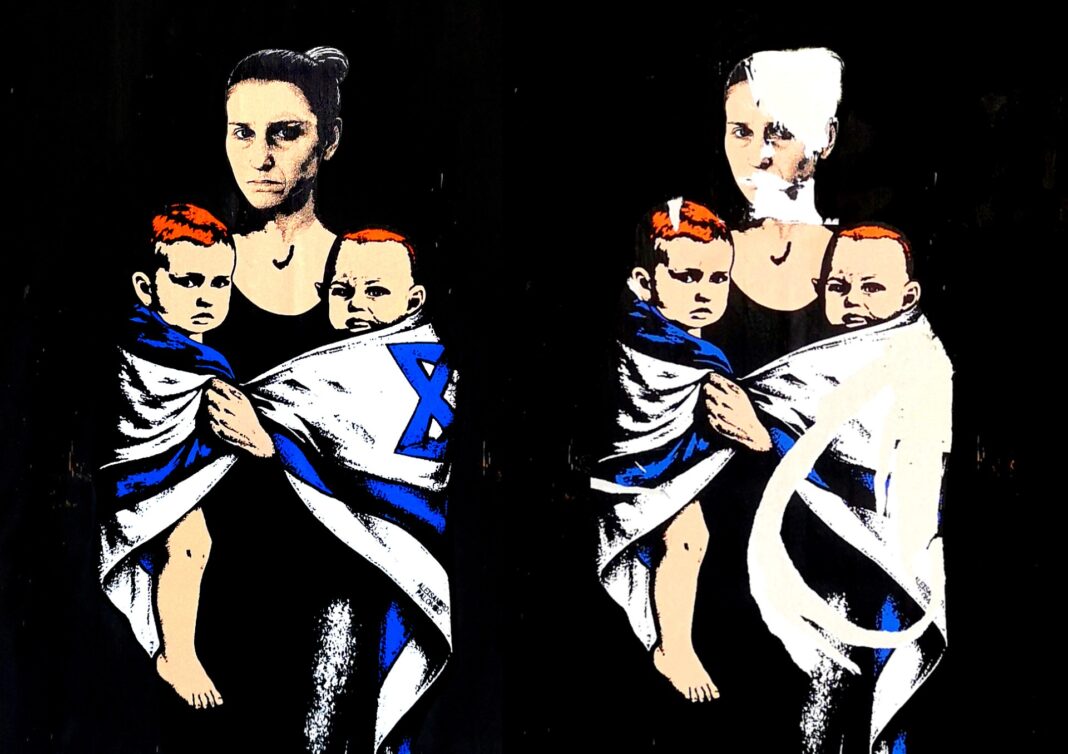
A chilling act of antisemitic vandalism has once again desecrated one of Milan’s most poignant public tributes to the victims of Hamas terror. The mural “October 7: The Hostages,” created by Italian artist aleXsandro Palombo, was defaced this week — its imagery of Shiri Bibas and her two young sons, Kfir and Ariel, brutally erased from a wall in the heart of the city.
The attack, which took place only steps from Milan’s famed Via Montenapoleone, obliterated both the Star of David and the face of Shiri Bibas, a mother whose abduction and subsequent murder by Hamas on October 7, 2023, became one of the defining symbols of Israel’s national trauma. The mural had depicted the young Israeli mother cradling her sons in an Israeli flag — a vision of maternal love and resilience transformed into a haunting image of loss. Now, all that remains is a void, scraped and bleached, as if an attempt had been made to erase memory itself.
Fox News Digital, which first reported on the incident, quoted Palombo as condemning the act as “a vile assault not only on the memory of Shiri and her children but on the moral conscience of the West itself.” He described the vandals as “cowards who despise freedom, democracy, and the values on which our civilization stands.”
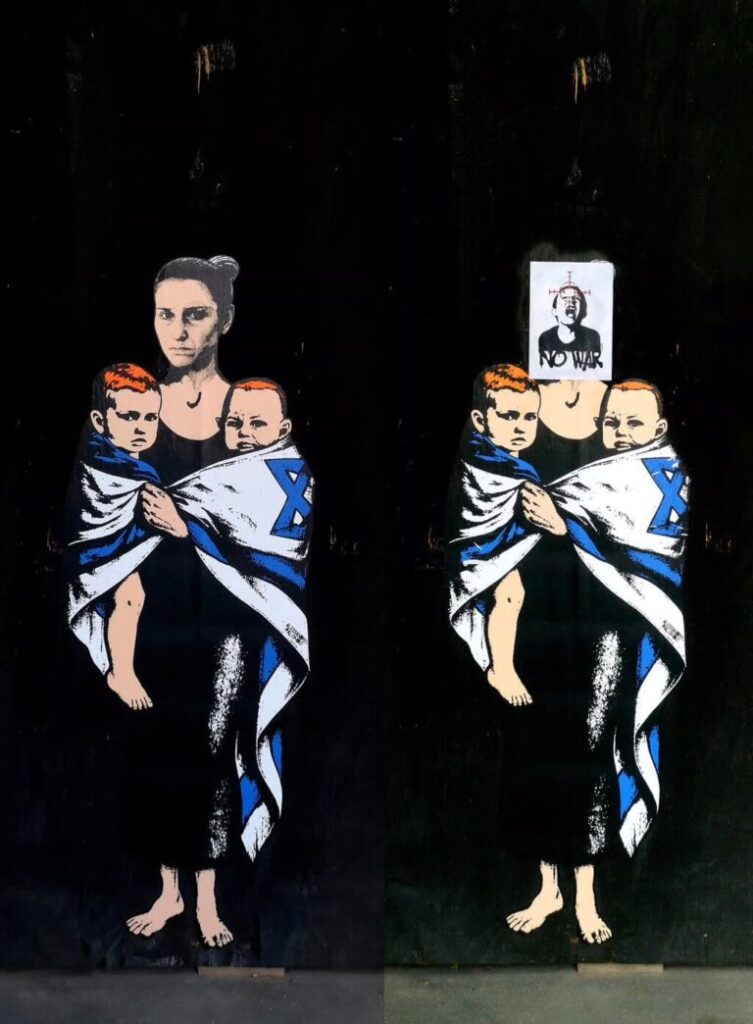
This is the second time that the mural has been targeted in recent months. The first assault occurred just days after its creation, when unknown perpetrators pasted over Shiri Bibas’s face with a poster showing a child trapped in the crosshairs of a gun, accompanied by the slogan “No War.” That act — grotesquely distorting pacifist rhetoric to obscure Jewish suffering — coincided with a memorial ceremony at Milan’s Central Synagogue for the victims of Hamas’s October 7 massacre.
French philosopher Bernard-Henri Lévy, in an impassioned statement following the first attack, called it “a vile gesture against the memory of the victims.” His words resonate even more powerfully now, as the repeated defilement of the mural underscores the persistence of antisemitism cloaked in political language.
The second attack went further than before. The vandals systematically removed the mother’s face and the Israeli flag — the two elements that most powerfully conveyed the humanity and identity of the victims. The precision of the damage suggests deliberate intent rather than random defacement.
“This was not graffiti or adolescent vandalism,” a local observer told Italian media. “This was ideological. It was meant to silence the image of Jewish grief.”
Indeed, this pattern reflects a growing wave of anti-Jewish hostility across Europe since the Hamas-led massacre of October 7, 2023, in which 1,200 Israelis and foreign nationals were slaughtered and hundreds taken hostage. While protests and social media campaigns have increasingly vilified Israel, street-level antisemitic incidents — from synagogue vandalism to public harassment of Jews — have surged. In Italy, the attack on Palombo’s mural now stands as a symbol of this broader moral unraveling.
aleXsandro Palombo, one of Italy’s most provocative contemporary artists, is known for his vivid, pop-culture-inflected works that challenge moral complacency and confront the darkest corners of human behavior. His art — often using familiar imagery from television and comics — transforms the banal into the sacred and the satirical into the searingly political.
Palombo’s “October 7: The Hostages” mural was part of a wider series dedicated to remembrance, depicting victims and survivors of antisemitic violence from the Holocaust to the present day. Each piece carries his signature mix of empathy and defiance, urging passersby not to forget.
In an interview following the latest attack, Palombo told reporters that his intention had never been to provoke but to preserve memory in public space. “When they erase a Jewish face, they are not only defacing a wall — they are attempting to destroy a people’s story,” he said. “My art is a defense of that story.”
Sadly, the defilement of the Bibas family mural is far from an isolated incident. As Fox News Digital and Italian outlets reported, Palombo’s other memorials have been repeatedly vandalized:
His tribute to Vlada Patapov, a survivor of the Nova Festival massacre, was defaced mere hours after its unveiling.
A mural of Anne Frank weeping while holding the Israeli flag was desecrated last year.
His powerful reinterpretation of the Warsaw Ghetto boy — depicted as a Hamas hostage — drew both international attention and malicious attacks.
Murals honoring Holocaust survivors Liliana Segre, Sami Modiano, and Edith Bruck — now preserved in Rome’s Shoah Museum — have also been targeted.
Perhaps most infamously, his piece titled “The Simpsons Deported to Auschwitz” has been vandalized five separate times, including on Yom HaShoah, the annual day of Holocaust remembrance.
The recurrence of these acts — often timed to coincide with Jewish memorial events — underscores their ideological nature. They are not isolated outbursts but deliberate assaults on collective memory.
In May, Italy’s anti-terror and political crimes division, Digos, charged a suspect for defacing several of Palombo’s murals with Nazi symbols and antisemitic graffiti. The man was accused of aggravated damage motivated by discrimination — a serious offense under Italian law. Authorities said he acted out of “deep ideological hostility toward the Jewish people.”
Nevertheless, the repeated attacks suggest that law enforcement alone cannot combat what Palombo and others describe as “an atmosphere of moral permissiveness” toward antisemitism disguised as political expression. “The boundary between legitimate criticism and hate has collapsed,” one Italian commentator wrote. “Erasing the Star of David has become the new badge of defiance.”
The mural’s destruction reverberates far beyond Italy. The Bibas family became emblematic of Israel’s anguish after October 7. The image of Shiri Bibas, with her red hair and her two small children wrapped in an Israeli flag, was among the most widely circulated photographs in the world in the days following the Hamas attack on Kibbutz Nir Oz. The family was abducted alive and later confirmed killed in Gaza.
For many Israelis, Shiri’s image represented both innocence and unimaginable suffering — a mother shielding her children from evil. For artist Palombo, she embodied “the universal cry of all mothers against barbarism.” The erasure of her image, therefore, is not merely antisemitic defacement; it is an attack on the sanctity of motherhood itself.
What makes this act particularly disturbing, commentators note, is that it occurred in Milan — a city long regarded as a bastion of European liberalism and culture. That such hatred could manifest itself not in the shadows but in the open heart of Italy’s fashion capital is a sobering reminder of how antisemitic narratives have seeped into mainstream discourse.
“Those who destroy these works are not resisting injustice,” Palombo said. “They are celebrating cruelty. They have replaced empathy with ideology.”
The erasure of Jewish symbols, from the Star of David to the Israeli flag, reveals not a protest against war but a denial of Jewish existence itself. As one editorial in Corriere della Sera observed, “What begins with vandalized murals too often ends with vandalized lives.”
Palombo remains undeterred. Even as his works are repeatedly defaced, he continues to restore them, repaint them, and create new ones. “Every time they destroy one,” he said, “I will paint another. Hatred erases — art restores.”
He has pledged to reconstruct the Bibas mural, insisting that “memory must be stronger than fear.” His persistence, echoed by Jewish communities and human-rights advocates worldwide, has transformed him into an unlikely guardian of remembrance — a role he embraces with quiet resolve.
“Art has always been the conscience of humanity,” he said. “When that conscience is attacked, we must defend it with our voices, our brushes, and our hearts.”
The attack on Palombo’s mural is more than vandalism. It is a warning — that Europe’s oldest hatred, once thought to have been consigned to history, is again defacing its walls and consciences. The attempt to erase the face of Shiri Bibas is an attempt to erase accountability, to efface the line between victim and aggressor.
Yet amid the desecration, one truth endures: remembrance cannot be destroyed. As long as artists like Palombo continue to paint, and as long as free societies refuse to look away, the erased face of Shiri Bibas will remain not a void but a mirror — reflecting what the civilized world must never forget
