
































|
Getting your Trinity Audio player ready...
|
By: Yisroel David
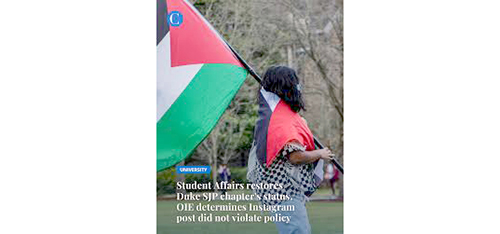
A controversial decision by Duke University has ignited an intense and far-reaching debate over the boundaries of acceptable speech, the persistence of antisemitic imagery, and the responsibilities of academic institutions in confronting hate. As detailed in a report on Wednesday in The Algemeiner, the university’s Office for Institutional Equity has reversed its earlier move to suspend a student organization after it shared a political cartoon widely condemned as antisemitic, concluding that the material, while offensive, did not violate institutional policy.
The decision has triggered widespread concern among Jewish students, legal experts, and advocacy organizations, many of whom argue that the university has failed to recognize the gravity of the imagery in question and has instead reinforced a troubling pattern of inconsistency in addressing anti-Jewish hostility on campus.
At the center of the controversy is a social media post published by Students for Justice in Palestine, a group active on campuses across the United States. According to The Algemeiner report, the illustration depicts a pig labeled “Zionism” holding a Star of David, interlocked with another pig labeled “United States Imperialism.” The image draws upon a long and deeply offensive tradition in which Jews have been depicted as animals, a form of dehumanization with roots stretching back centuries.
The Office for Institutional Equity acknowledged that the image “alludes to antisemitic tropes,” yet concluded that it did not create a sufficiently hostile educational environment to warrant disciplinary action under university policy. As a result, the group’s suspension was lifted, its funding restored, and its organizational privileges reinstated.
For many observers, the decision has been as perplexing as it has been troubling. Critics argue that the university’s acknowledgment of antisemitic content should have led to a decisive response, rather than a conclusion that effectively minimizes the impact of such imagery.
The controversy cannot be understood without recognizing the historical weight carried by the imagery in question. As emphasized in The Algemeiner report, depictions of Jews as pigs have long served as a vehicle for dehumanization. In medieval Europe, such imagery appeared in grotesque representations that sought to humiliate and degrade Jewish communities. During the 20th century, similar motifs were employed in propaganda to justify persecution and violence.
This history imbues the cartoon with a significance that extends far beyond its immediate context. For Jewish students encountering the image, it is not merely a political statement but a reminder of a legacy of hostility that has, at times, culminated in catastrophic violence.
The reaction among Jewish students at Duke was swift and unequivocal. According to The Algemeiner report, at least 10 formal complaints were filed with the university, each arguing that the image constituted a clear instance of antisemitic expression that should not be tolerated within an academic environment.
Despite these concerns, the university proceeded to close its investigation. In correspondence cited by The Algemeiner, an official explained that there was insufficient evidence to demonstrate that the post had created a hostile educational environment, a threshold required for disciplinary action under the relevant policy framework.
This reasoning has been met with skepticism and frustration. Critics contend that it sets an unreasonably high bar for recognizing harm, effectively requiring evidence of pervasive hostility before addressing individual instances of offensive conduct.
Students for Justice in Palestine has defended its actions, framing the controversy as an issue of free expression. In statements reported by The Algemeiner, the group argued that it had been subjected to unjust scrutiny and that the university’s initial suspension represented an overreach.
The organization further suggested that it had been compelled to engage legal counsel and public advocacy efforts to secure what it described as basic procedural rights. From its perspective, the outcome represents a vindication of its position and a reaffirmation of its ability to operate without undue interference.
However, this narrative has been sharply contested by Jewish advocacy groups and legal experts, who argue that the issue is not one of censorship but of accountability. They maintain that freedom of expression does not preclude institutions from addressing conduct that perpetuates harmful stereotypes and undermines the sense of safety and belonging among students.
Several prominent organizations and individuals have spoken out in response to the decision. The Louis D. Brandeis Center for Human Rights Under Law, as cited by The Algemeiner, emphasized that the use of animal imagery to describe Jews is a well-documented marker of antisemitism that should not be tolerated in any setting, particularly within institutions dedicated to education and inclusion.
Similarly, Carly Gammill of StandWithUs Saidoff Law, a legal nonprofit based in California, argued that contemporary expressions of antisemitism often repurpose historical motifs, making it essential for universities to recognize and respond to these patterns with clarity and resolve.
Students have also voiced their concerns. Shira Shasha, a student leader at Duke, described the imagery as rooted in traditions of dehumanization that have caused real harm. She argued that the absence of explicit intent to harm does not negate the impact of such representations, which can contribute to an atmosphere of hostility.
The current controversy has also revived longstanding concerns about what some describe as a double standard in the university’s approach to different forms of expression. As noted in The Algemeiner report, critics have pointed to earlier incidents in which pro-Israel student organizations faced obstacles to recognition or support, even in the absence of inflammatory rhetoric.
In 2021, for example, a student government decision to grant recognition to a pro-Israel group was vetoed following a public exchange that was not characterized as hateful. The university’s response to that situation, or lack thereof, has been cited by some as evidence of an inconsistent application of principles related to diversity and inclusion.
For these critics, the decision to reinstate Students for Justice in Palestine despite the acknowledged presence of antisemitic tropes reinforces a perception that certain forms of hostility are treated with greater leniency than others.
The events at Duke must be situated within a broader national context in which universities have grappled with rising tensions related to the conflict in the Middle East. Since the Hamas attacks of October 7, 2023, and the subsequent war, campuses across the United States have witnessed an increase in demonstrations, debates, and, in some cases, incidents of harassment.
While Duke has not experienced the most extreme manifestations of these tensions, as noted by The Algemeiner, the current controversy suggests that underlying issues remain unresolved. The challenge for the university lies in balancing its commitment to free expression with its responsibility to ensure an environment in which all students feel respected and secure.
At the heart of the debate is a fundamental question about the role of universities in addressing harmful speech. Should institutions intervene only when conduct meets a narrowly defined threshold of harassment, or should they take a more proactive stance in confronting expressions that, while not technically violative, carry significant historical and cultural weight?
Critics of Duke’s decision argue that the latter approach is necessary to uphold the values of inclusion and respect. By acknowledging the presence of antisemitic tropes yet declining to act, they contend, the university risks sending a message that such expressions are permissible.
Defenders of the decision, however, may argue that maintaining a high threshold for disciplinary action is essential to preserving academic freedom and preventing the suppression of controversial viewpoints.
For Jewish students at Duke, the issue is not abstract. It is experienced in the form of uncertainty about how the university will respond to expressions that touch on their identity and history. The decision to reinstate Students for Justice in Palestine has, for some, deepened this uncertainty.
As Ilan Sinelnikov, a student leader, told The Algemeiner, the outcome suggests that the consequences for such conduct may be minimal. This perception, whether accurate or not, has the potential to influence how students engage with one another and with the institution itself.
The controversy at Duke University, as chronicled by The Algemeiner, underscores the complexities and challenges facing academic institutions in an era of heightened political and cultural tension. The decision to reverse the suspension of Students for Justice in Palestine has brought to the forefront difficult questions about the nature of antisemitism, the limits of free expression, and the responsibilities of universities to their communities.
As the debate continues, the university faces a critical test of its ability to navigate these issues with nuance and integrity. The outcome will not only shape the experience of its students but also contribute to the broader conversation about how institutions of higher learning address the enduring challenge of hate in all its forms.



