

























|
Getting your Trinity Audio player ready...
|
(A7) As a Modern Orthodox rabbi who works at a Jewish day school in Montreal, Sorin Rosen knows his way around a prayer book. But that wasn’t always the case.
“I remember when I was a kid, and I started going to synagogue, I probably kept my siddur upside down for three months until someone said, ‘Hey, look, this is how it works,’” Rosen recalled about an experience he had as a teenager in his native Romania.
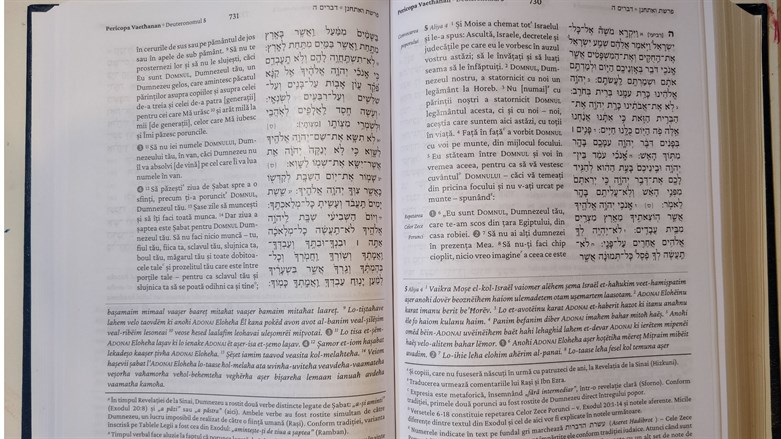
Now, Rosen has created a historic tool to help Jews like that younger version of himself: the first-ever Romanian-language chumash, or text of the Torah. “Tora si Haftarot,” which is both translated and transliterated into Romanian, will be unveiled at a ceremony Sunday at Bucharest’s Choral Temple meant to celebrate both the book itself and Rosen’s seven-year effort to bring it into the world.
“I anticipated it would be a long project. I didn’t expect it to take that long, but I was prepared to make a long-term commitment,” Rosen told the Jewish Telegraphic Agency. “It’s something that was always close to my heart. … I felt that if I can help people avoid that stage [of not knowing how to participate in Jewish practices] and facilitate their engagement, the endeavor was worthwhile.”
Rosen’s translation is his gift to a Jewish community he once led but ultimately decided he had to leave. Born in Bucharest to a Jewish father and Catholic mother, Rosen got involved in Jewish life as a teenager, ultimately becoming the country’s chief rabbi after graduating from Yeshivat Chovevei Torah, a Modern Orthodox seminary in New York City, in 2014. He was Romania’s first Modern Orthodox rabbi and, at 29, the youngest chief rabbi in Europe.
But after serving out a three-year contract, Rosen and his wife set their sights on living somewhere with a more robust Jewish community. They headed to Montreal, where both work in education technology and the family has integrated into the city’s thriving Orthodox community.
“As my kids were approaching school age, I wanted to be able to give them choices and opportunities for Jewish education,” Rosen said. “Unfortunately, Romania is struggling in this department.”
Romania was once a center of Jewish life, with a Jewish population of about 800,000 before the Holocaust. Its antisemitic regime murdered almost all of the Jews in some parts of the country early on, but ultimately a majority of the country’s Jews survived — before leaving for Israel or elsewhere in the second half of the 20th century, when Romania was unusual among Communist countries for allowing Jews to emigrate freely. Today, fewer than 10,000 Jews are estimated to live in Romania.
“I suspect the number is much closer to about 5,000,” Rosen said, noting that Romanian Jews tend to be secular in orientation and many have married non-Jews. He added, “The community members are, for the most part, very dedicated to Judaism; participating in Jewish holidays and community events and trying to keep ‘the flame’ alight.”
Now, they will have “Tora si Haftarot” as a tool to help them, joining several other Romanian-language translations of Jewish texts that Rosen has produced over the last decade.
The chumash stands out in a number of ways: Although there are several Romanian translations of the Hebrew Bible, all are from a Christian lens. This is the first Jewish Romanian translation, and it features not only Hebrew text but also phonetic transliteration of the entire text in the Latin alphabet. There are also roughly 4,000 short explanations and annotations based on such classical Jewish commentators as Rashi and Ibn Ezra and texts including the Midrash and the Talmud.
“For the community in Romania this is a phenomenal thing,” said Rosen. “For as much as they may want to be involved Jewishly, many don’t know how to read Hebrew. Or if they do, their Hebrew skills are quite poor.”



