



|
Getting your Trinity Audio player ready...
|
Phyllis Chesler
There’s little that’s very traditional about who I am and yet, in my later years, I find that I’m acting more and more like a traditional Jewish mother! I am so proud of my-son-the-judge. I don’t talk about it all that much, but when an opportunity arises, there I am, introducing him as my beloved boy, “the judge.” For the record, he’s 48 years old! Sometimes, to inspire laughter and pity in my two magnificent teenage granddaughters and my wonderful daughter-in-law, I refer to him as my “baby.” Yes. I. Do. Pretty weird, yes?
Anyway, there’s not much that I won’t do for him if I can, and he asked me to participate in a Q&A with him for the Gender Fairness Committee of the Supreme Court in NYC, perhaps also in NYS. My usual “fee” is that he must attend an opera with me. We just engaged in a spirited conversation on Monday, April 27th, in Our Year of the Lord. We are not allowed to share the recording, but please allow me to share a snippet of our back and forth, our give and take.
Q: Can you take us on a trip back in time? What was it like for women here in the 1960s? At home? In the workplace and public sphere? Can you tell us about segregated work ads? Job options for women? Access to Credit cards and banks? Access to birth control?
A: We could not receive bank loans in our own names. The want ads were segregated. Many jobs and the high-earning professions were for men only. We had no legal right to birth control or abortion. Birth control was won for us by Bill Baird, who is not a lawyer, in the Supreme Court in two precedent-setting decisions (Denny v. Griswold, 1965, argued by attorneys Thomas I. Emerson, Catherine Roraback, and Harriet Pilpel) and in (Eisenstadt v. Baird, 1972, argued by attorneys Joseph J. Balliro and Roy Lucas and supported by the ACLU). The first decision legalized birth control for married couples only, the second did so for anyone.
Sexual harassment and rape were even more normalized than they still are. Women were expected to keep quiet about it or risk losing their jobs. In 1966, three years after Betty Friedan published the best-selling The Feminine Mystique, two distinguished African American women, Aileen Hernandez and Pauli Murray, joined Friedan, a Jew, in co-founding the National Organization for Women (NOW). Friedan became NOW’s first President. NOW was our first and only civil rights organization, our NAACP. They launched an incredible number of lawsuits–all successful. NOW lobbied the Equal Employment Opportunity Commission (EEOC) and demanded that they, the EEOC, uphold and enforce the 1964 Title VII of the Civil Rights Act and the 1963 Equal Pay Act on behalf of women as well as African-Americans. An EEOC decision upholding sex-segregated ads was appealed–and the Supreme Court upheld NOW’s lawsuit.
From the start, NOW also demanded woman-centered, not doctor-oriented or doctor-dependent, abortion rights as well as the Equal Rights Amendment–which, outrageously, American women still do not have. Friedan co-founded the Reproductive Rights Action League (NARAL). NOW also lobbied for national childcare. Also in 1970, and rather incredibly, NOW, essentially led by Friedan, successfully lobbied against the appointment of G. Harrold Carswell to the Supreme Court; Judge Harry Blackmun replaced Carswell. In 1973, Chief Justice Blackmun would write the majority Supreme Court decision that upheld Roe v. Wade.
Sweet justice indeed!
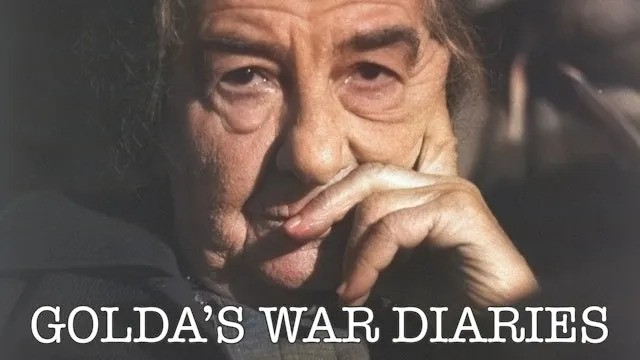
This past weekend, before the Q&A, while still recovering from a fall, a broken rib or two, and from an unexpectedly horrible reaction to a major dental archeological excavation, I also watched a new documentary about the great Golda Meir up at the always-splendid ChaiFlicks. What a leader! What a woman! (OK, she’s been mightily criticized for not being a feminist, but I know so many feminists who’ve also turned out not to be such good feminists.) I doubt that even the best among us would have had her will of steel, her diplomatic savvy, or been able to become her own military general (a new Aishes Lapidot), a fiery woman, a Light-Bringer, which is how the Biblical Deborah, a military warrior, a judge, and also a prophet, is described. Golda did all this while undergoing radiation treatments for leukemia. (Something she stopped during the War.) When Israeli soldiers finally managed to encircle Egypt’s Third Army, Golda stood fast. They would receive no food or water until Israel’s captive soldiers were all returned.
They finally were.
Golda was framed for the unpreparedness of the Israeli military forces. Although she was found innocent, she took the fall and resigned. This film puts paid to that erroneous accusation.
On the very same day Golda visited Israeli soldiers at the front, she traveled to America to meet with Henry Kissinger in person in a 24-hour trip–and turned out to accomplish her goal. America sent crucially needed military supplies.
I remember this moment in history very well. I attended a gathering for the silver-tongued Abba Eban in an Upper West Side apartment–I think it was hosted by Lee Strasberg. Eban talked about what was at stake. I also lived through it in another way: Israelis who happened to be in NYC were told to stay in place and help pack “stuff” for their country. Some slept on my couches and chairs and floors. I remember the meeting between Golda and Sadat–it’s in the documentary. Golda made Sadat laugh when she gave him a gift for his granddaughter’s birthday, saying: “Tell her it’s from the Old Lady…. I know that’s how you refer to me.” Oh, a much younger Sadat, whose wife, Jihan, I met when she accompanied him to the United Nations.
This 2023 documentary was directed by Yariv Mozer. It features a “lost” interview with Golda right before her death in 1978. There is also black-and-white footage of the 1973 Yom Kippur war–here’s a young Ariel Sharon, slim and handsome; there’s Moshe Dayan, who badly, perhaps even maliciously or simply arrogantly, misadvised Golda about the imminent danger of an attack by two Arab countries. Thereafter Dayan essentially collapsed and was of no use during this war. There’s a younger Dado Elazar, whom Golda appointed to sign the first-ever peace agreement with Egypt.
One more thing about Golda: There is an anthology titled Ha Horeshet, or The Ploughwoman: Memoirs of the Pioneer Women of Palestine, edited by Rachel Katnelson Shazar and translated by Maurice Samuel. You cannot imagine the hard and heroic labor in which these women engaged, the “women’s issues” with which they wrestled.
Writing only as D.D, this is Deborah Dayan, Moshe Dayan’s mother. Manya Wilbuschewitz-Shochat–there is not enough I can say about her. She was also a founder of the Hashomer Hatzair self-defense organization, rode horses wearing an Arab headdress, holding a rifle aloft. Shochat had to flee Moscow because she had been shipping guns to her brothers in British Mandatory Palestine. When the chief of the secret police came to arrest her, she killed him and got outta town fast. My friend and colleague Dr. Shulamit Reinharz has written about this amazing, unusual woman.
Here’s a bit of what one entry, titled “Borrowed Mothers,” has to say:
“The children are fully looked after. And there are even pedagogic theorists who say that it is actually better for the children not to have the mother constantly near them. But one look of reproach from the little one when the mother goes away, and leaves it with the stranger, is enough to throw down the whole structure of vindication. That look, that plea to the mother to stay, can be withstood only by an almost superhuman effort of the will…I am not speaking now of the constant worry that haunts the mother’s mind that something may have happened. And I need not bring in the feelings of the mother when her child falls sick—the flood of self-reproach and self-accusation.
“Can the mother of today…compel herself to be other than she is because she has become a mother? And the modern woman asks herself: Is there something wrong with me if my children don’t fill up my life? But the mother also suffers in the very work she has taken up. Always she has the feeling that her work is not as productive as that of a man, or even of an unmarried woman. The children too, always demand her, in health and even more in sickness. And this eternal inner division, this double pull, this alternating feeling of unfulfilled duty—today toward her family, the next day toward her work—this is the burden of the working mother.”
The writer is none other than G.M. Golda Meyerson (Meir). For the sake of her people and her nation’s survival, she too wrestled with all the “women’s issues.” We are blessed that she chose all of us and was willing to bear the price of maternal and wifely guilt.
Rest in Peace dearest Mother Warrior.
