



|
Getting your Trinity Audio player ready...
|
By: Andrew Carlson
In a dramatic escalation of tensions between entertainment and political power, late-night television host Jimmy Kimmel has found himself at the center of a fierce national debate over humor, free expression, and the limits of public discourse. As detailed in a report on Wednesday in USA Today, the controversy erupted following remarks made on his program that drew sharp condemnation from President Donald Trump and First Lady Melania Trump, igniting a broader clash over rhetoric and responsibility in an increasingly polarized political climate.
What began as a satirical monologue has now evolved into a high-profile confrontation involving the White House, a major media corporation, and federal regulators, raising fundamental questions about the intersection of entertainment and governance in the United States.
The genesis of the dispute can be traced to a segment aired on April 23rd, during which Kimmel delivered a mock version of a speech intended for the White House Correspondents’ Association dinner. In the course of that performance, he made a remark about the First Lady that he later characterized as a lighthearted observation tied to the age difference between her and the president.
At the time, the comment generated relatively limited reaction. However, events took a dramatic turn following a shooting incident at the actual Correspondents’ Dinner days later. Critics of Kimmel revisited the earlier joke, interpreting it in a far more serious and troubling light. As reported by USA Today, detractors accused the comedian of engaging in rhetoric that could be construed as endorsing violence against the president.
This reinterpretation of the joke quickly gained traction, particularly among supporters of the administration, who argued that such language contributed to an atmosphere of hostility.
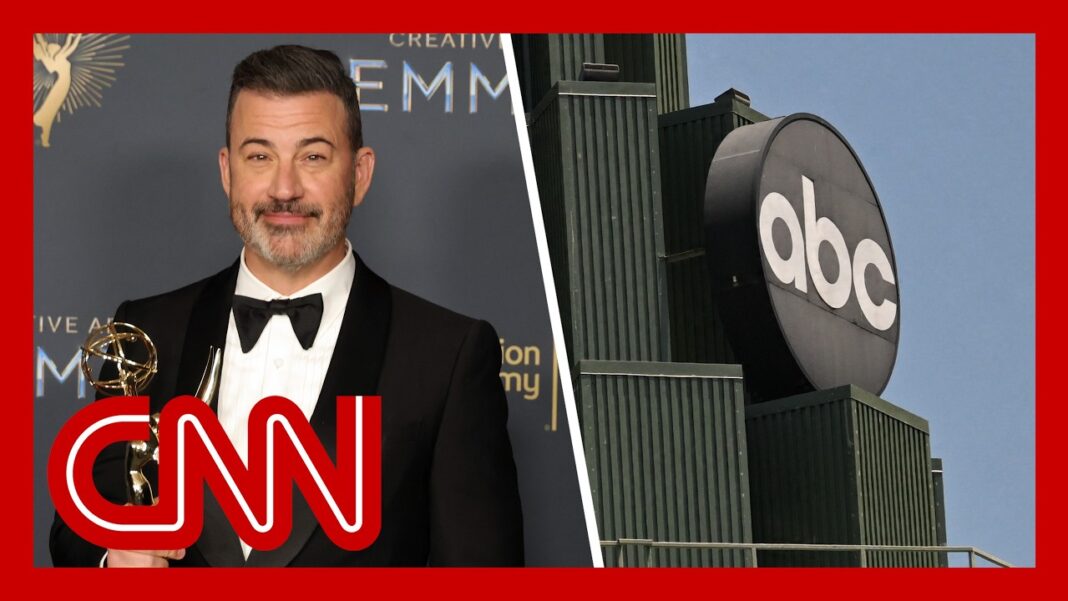
The response from the White House was swift and unequivocal. Melania Trump issued a statement condemning what she described as hateful and dangerous rhetoric, urging the network to take decisive action. President Trump went further, publicly calling for Kimmel’s immediate dismissal from his role at ABC, which is owned by the The Walt Disney Company.
These demands marked the latest chapter in a longstanding adversarial relationship between Kimmel and the president. The comedian has frequently used his platform to critique Trump’s policies and public statements, often employing sharp satire and pointed commentary.
The president’s call for Kimmel’s firing was disseminated through social media and quickly amplified across political and media circles. According to the USA Today report, the White House also faced inquiries regarding its position on the matter, though official responses remained limited.
Rather than retreating in the face of mounting criticism, Kimmel responded with characteristic defiance. Returning to the air on April 27th, he addressed the controversy directly, rejecting the accusations leveled against him and asserting that his remarks had been deliberately misinterpreted.
In his subsequent monologue on April 28th, Kimmel sought to highlight what he described as a striking inconsistency in the president’s own rhetoric. He aired a clip of Trump speaking during a ceremonial event with King Charles III, in which the president made a self-deprecating comment about his own longevity.
Kimmel seized upon the moment to underscore what he framed as hypocrisy, noting that the president appeared to have made a joke about his own mortality shortly after condemning similar humor. This juxtaposition became a central theme of Kimmel’s defense, as he argued that his critics were engaging in selective outrage.
He also reiterated his position that the original joke was intended as a benign observation rather than a malicious statement, emphasizing that it was rooted in the age difference between the president, 79, and the First Lady, 56.
The controversy has reignited longstanding debates about the boundaries of free speech, particularly in the context of political satire. Late-night television has historically served as a forum for commentary on public figures, often employing humor to critique those in positions of power.
However, the current climate has heightened sensitivities around such commentary, with critics on all sides scrutinizing the potential impact of language. As the USA Today report noted, the incident has prompted renewed discussion about whether comedic expression should be subject to the same standards as political discourse.
Supporters of Kimmel argue that his remarks fall squarely within the tradition of satirical critique, which has long been protected under the principles of free expression. They contend that attempts to penalize such speech risk setting a dangerous precedent.
The role of ABC and its parent company, The Walt Disney Company, has also come under intense scrutiny. In a previous incident in September 2025, Kimmel was temporarily suspended following pressure from federal officials over remarks made in a different context. That decision sparked widespread criticism, with many observers accusing the network of yielding to political influence.
In the current instance, however, Disney appears to be adopting a more resolute stance. As reported by USA Today, the network allowed Kimmel to return to the air without interruption, signaling a willingness to support its host despite external pressures.
This shift may reflect broader considerations within the media industry, including concerns about maintaining editorial independence and preserving public trust. The decision to stand by Kimmel has been interpreted by some analysts as an affirmation of the importance of protecting creative expression.
Complicating matters further is the involvement of the Federal Communications Commission, which has initiated an inquiry into Disney and its subsidiaries. The agency indicated that it is examining potential violations of federal communications law, including provisions related to discrimination.
While the investigation is not directly tied to Kimmel’s remarks, its timing has raised questions about the broader regulatory environment. Critics have suggested that the inquiry could be perceived as part of a pattern of increased scrutiny directed at media organizations.
The intersection of regulatory oversight and political controversy underscores the complexity of the situation, highlighting the multiple layers of accountability that shape the media landscape.
The controversy has elicited responses from across the political spectrum. While many Democratic figures have defended Kimmel’s right to free expression, some Republicans have also voiced concerns about the implications of government intervention in media affairs.
Notably, Senator Ted Cruz previously warned against the dangers of allowing authorities to determine which forms of speech are acceptable. Although his remarks were made in the context of an earlier incident, they have been widely cited in discussions surrounding the current controversy.
This convergence of viewpoints reflects a shared recognition of the importance of safeguarding fundamental freedoms, even amid deep political divisions.
At its core, the dispute raises fundamental questions about the role of comedy in a society characterized by intense polarization. Satire has long been a tool for challenging authority and provoking reflection, but its effectiveness depends on a shared understanding of context and intent.
In an environment where audiences are increasingly segmented and interpretations vary widely, the potential for miscommunication is heightened. Kimmel’s experience illustrates how a single remark can be perceived in radically different ways, depending on the perspective of the viewer.
As the USA Today report observed, the controversy reflects broader tensions in the cultural landscape, where humor, politics, and public perception intersect in complex and often unpredictable ways.
The long-term implications of this episode remain uncertain. The ongoing investigation by the Federal Communications Commission, combined with the continued scrutiny of Kimmel’s remarks, suggests that the issue is unlikely to fade quickly from public attention.
At the same time, the resilience of both the comedian and his network indicates a determination to navigate these challenges without compromising their core principles. Whether this approach will prove sustainable in the face of continued pressure remains to be seen.
The confrontation between Jimmy Kimmel and the Trump administration, as chronicled by USA Today, represents more than a dispute over a single joke. It is a reflection of deeper currents shaping the relationship between media, politics, and society.
In an era defined by rapid communication and heightened sensitivity, the boundaries of acceptable discourse are constantly being tested. The outcome of this particular conflict will likely influence how those boundaries are defined in the years to come.
For now, the episode stands as a vivid illustration of the challenges inherent in balancing humor and responsibility, freedom and accountability, and expression and interpretation in the modern public sphere.
