



|
Getting your Trinity Audio player ready...
|
By: Fern Sidman
In an era already fraught with misinformation and corrosive political rhetoric, recent remarks by former Georgia congresswoman Marjorie Taylor Greene have ignited a fresh wave of controversy—one that extends far beyond ordinary partisan discourse. Her assertion that President Trump was compelled to strike a covert “deal” with Israel in order to secure victory in the 2024 presidential election is not merely unsupported by evidence; it is emblematic of a deeply troubling pattern of insinuation that risks inflaming already rising levels of antisemitism.
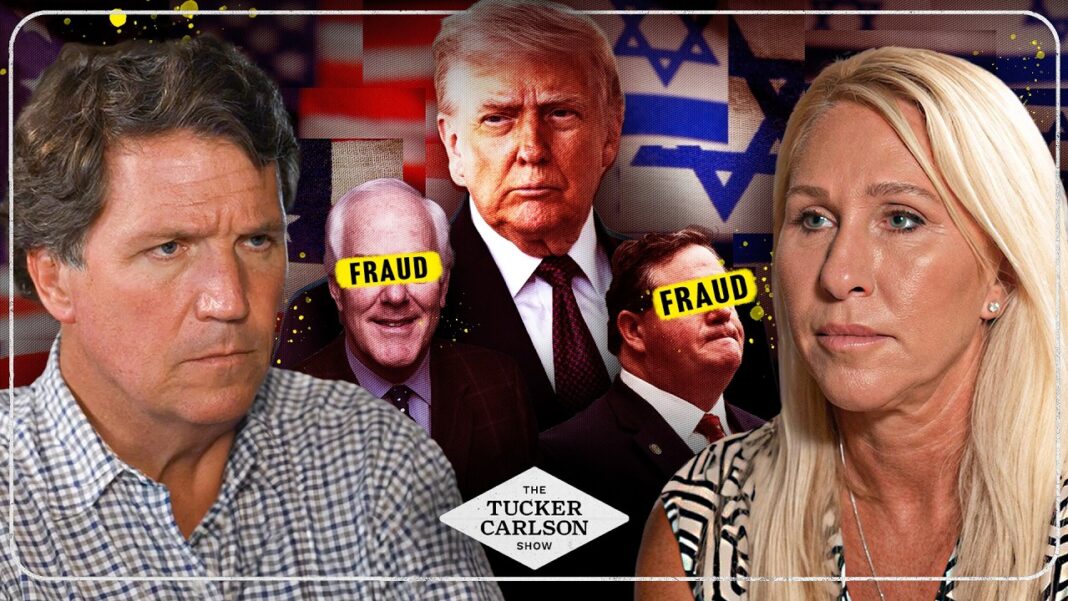
As reported on Thursday by The Daily Caller, Greene made these claims during an appearance on “The Tucker Carlson Show,” where she advanced a sweeping and conspiratorial narrative suggesting that American presidents are systematically beholden to Israeli interests. According to Greene, access to the presidency itself is contingent upon pledging allegiance to Israel—a proposition she presented not as speculation but as an established, if unspoken, political reality.
Such assertions demand careful and unequivocal rebuttal. They are not grounded in verifiable fact, nor do they withstand even cursory scrutiny of the historical and institutional processes that govern American elections. Instead, they echo a long-standing genre of conspiracy theories that attribute disproportionate and clandestine influence to Jewish individuals or institutions. These narratives, which have persisted in various forms for centuries, are characterized by their reliance on innuendo, selective interpretation, and the absence of credible evidence.
Greene’s remarks follow this pattern with disquieting fidelity. By alleging that “deals” with Israel are a prerequisite for presidential power, she constructs a narrative in which democratic outcomes are subordinated to hidden foreign control. This framing not only undermines confidence in the electoral process but also casts suspicion on a specific nation and, by extension, on Jewish communities more broadly. The implication is clear: that American leaders are not acting in accordance with national interests but are instead beholden to an external, and implicitly nefarious, influence.
The danger of such rhetoric lies not only in its inaccuracy but in its potential consequences. At a time when antisemitic incidents are rising in multiple regions, including the United States and Europe, the propagation of conspiracy theories that single out Jews or Israel as uniquely manipulative actors contributes to an atmosphere of hostility and mistrust. While Greene did not explicitly target Jewish individuals, the historical resonance of her claims is unmistakable. Assertions of secret control, undue influence, and covert allegiance have long been central to antisemitic ideology.
It is therefore essential to address these claims with clarity and precision. The United States maintains a strategic relationship with Israel, rooted in shared democratic values, security cooperation, and longstanding diplomatic ties. This relationship, like any bilateral partnership, is subject to debate and critique within the framework of democratic discourse. However, to characterize it as the product of hidden coercion or clandestine agreements is to depart from reasoned analysis and enter the realm of conjecture.
The electoral success of Donald Trump in 2024 can be attributed to a complex interplay of factors, including domestic policy positions, economic conditions, voter mobilization, and political strategy. To reduce this multifaceted outcome to an alleged secret pact with a foreign government is to ignore the realities of modern electoral politics. As The Daily Caller has noted in its reporting, Greene’s comments have been met with skepticism and criticism from across the political spectrum.
Moreover, the suggestion that American presidents uniformly “pledge their allegiance” to Israel is demonstrably false. U.S. foreign policy is shaped by a wide array of considerations, including national security interests, economic priorities, and geopolitical dynamics. While support for Israel has historically been a bipartisan feature of American policy, it has also been the subject of robust debate within Congress and among the public. This diversity of perspectives is a hallmark of democratic governance, not evidence of monolithic control.
Greene’s remarks also intersect with broader discussions about U.S. involvement in the Middle East, particularly in relation to Iran. Reports cited by The Daily Caller indicate that tensions between the United States and Iran have been influenced by a range of factors, including intelligence assessments, regional security concerns, and the actions of multiple state and non-state actors. While Israeli perspectives may inform American decision-making, they do not dictate it.
Indeed, internal debates within the U.S. government have often reflected divergent views on how to approach Iran. Some officials have expressed skepticism regarding military action, while others have emphasized the need to counter perceived threats. This plurality of viewpoints underscores the complexity of policy formulation and contradicts the notion of a singular, externally imposed agenda.
The resignation of former National Counterterrorism Center Director Joe Kent, who cited concerns about the influence of pro-Israel advocacy, has been invoked by some as evidence supporting Greene’s claims. Yet such interpretations overlook the broader context in which policy decisions are made. Advocacy groups, representing a wide range of interests, are a legitimate and longstanding feature of American democracy. Their existence does not equate to undue control, nor does it invalidate the autonomy of elected officials.
Similarly, reports that Israeli Prime Minister Benjamin Netanyahu engaged in discussions with the Trump administration regarding military strategy reflect the normal functioning of diplomatic relations. Allies routinely consult and coordinate on matters of mutual concern. To construe such interactions as evidence of coercion is to misrepresent their nature and significance.
It is also worth noting that the Trump administration justified its actions toward Iran on the basis of oft-repeated threats to American security. While critics have questioned the specifics of these assessments, the rationale provided was rooted in national defense considerations. Secretary of State Marco Rubio emphasized the risks posed by Iranian activities, highlighting the complexities inherent in evaluating and responding to evolving security challenges.
Against this backdrop, Greene’s claims appear not only unfounded but profoundly irresponsible. By advancing a narrative that lacks evidentiary support and echoes historically harmful tropes, she risks contributing to a climate of suspicion and division. The responsibility of public figures to engage in informed and measured discourse cannot be overstated, particularly when addressing issues that carry such significant historical and social weight.
The broader implications of this episode extend beyond the immediate controversy. They raise important questions about the role of rhetoric in shaping public perception and the boundaries of acceptable discourse in a democratic society. While freedom of expression is a fundamental principle, it is not without consequence. The dissemination of baseless conspiracy theories, particularly those that intersect with longstanding prejudices, has the potential to inflict real harm.
In confronting these challenges, it is incumbent upon both political leaders and the public to distinguish between legitimate critique and unfounded speculation. Criticism of foreign policy, including the U.S.-Israel relationship, is a vital component of democratic debate. However, such critique must be grounded in facts—and conducted with an awareness of its broader implications.
As The Daily Caller continues to document the evolving discourse surrounding these issues, the need for clarity and accountability remains paramount. The rejection of conspiracy theories is not merely a matter of intellectual rigor; it is a necessary step in safeguarding the integrity of public discourse and the cohesion of a diverse society.
Ultimately, the narrative advanced by Marjorie Taylor Greene does not illuminate the realities of American politics. Instead, it obscures them, replacing complexity with conjecture and evidence with insinuation. In doing so, it serves not as a contribution to informed debate but as a cautionary example of how rhetoric, when untethered from fact, can distort understanding and deepen division.
