



|
Getting your Trinity Audio player ready...
|
A Nation Confronts the Unthinkable: Starmer’s Sweeping Crackdown as Antisemitic Violence Shocks Britain
By: Fern Rosenblatt
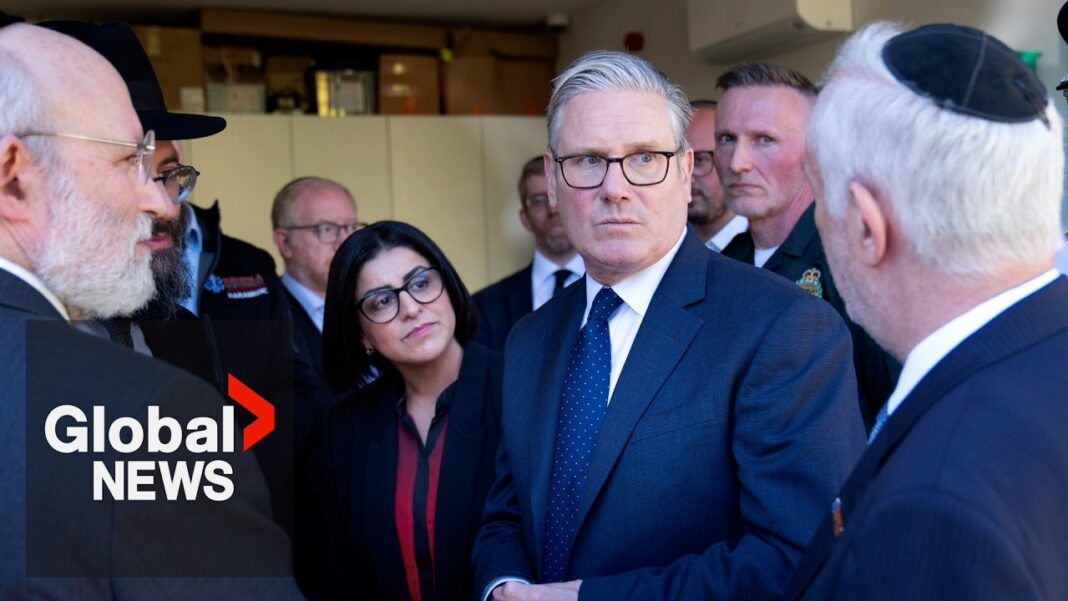
In a moment of profound national reckoning, Keir Starmer has unveiled a sweeping series of policy initiatives designed to confront what he described as an intolerable surge in antisemitic violence across the United Kingdom. The announcement, delivered in a forceful address on Thursday, followed the shocking stabbing of two Jewish men in the London suburb of Golders Green—an attack that has come to symbolize a broader and deeply unsettling escalation in hostility directed at Britain’s Jewish population.
According to an extensive report on Thursday by The Jewish Insider, the measures introduced by Starmer represent one of the most comprehensive governmental responses to antisemitism in recent British history. They encompass a multifaceted strategy aimed not only at enhancing physical security but also at addressing the ideological and structural drivers of anti-Jewish hatred.
At the core of the Prime Minister’s initiative is a significant increase in visible policing within Jewish communities. This includes the deployment of additional officers to neighborhoods with substantial Jewish populations, as well as enhanced coordination with community-based security organizations. The objective, Starmer emphasized, is to restore a sense of safety to citizens who, in his words, have been compelled to navigate their daily lives under the shadow of fear.
The urgency of these measures is underscored by the circumstances surrounding the latest attack. The two victims—one in his seventies, the other in his thirties—were assaulted in Golders Green, an area long recognized as a vibrant center of Jewish life in London. Both men were hospitalized but reported to be in stable condition. The Metropolitan Police swiftly classified the incident as an act of terrorism, a designation that reflects both the severity of the violence and the broader context in which it occurred.
This context, as detailed in The Jewish Insider report, is one of sustained and escalating aggression. In recent months, Jewish individuals and institutions across London have been subjected to a series of attacks that range from physical violence to acts of arson. The cumulative effect has been to create an atmosphere of pervasive insecurity, one that community leaders have described in stark terms.
Among those voices is Ephraim Mirvis, who has characterized the situation as a “sustained campaign of violence and intimidation.” His assessment reflects a growing consensus that the current wave of incidents cannot be dismissed as isolated occurrences but must instead be understood as part of a broader and more organized pattern.
Starmer’s response extends beyond immediate security measures to encompass legislative reform. The Prime Minister announced plans to introduce stricter immigration controls aimed at preventing individuals identified as “hate preachers” from entering the country. This initiative is coupled with efforts to curtail the activities of extremist organizations operating under the guise of charitable work, as well as proposals to expedite the legal process for those accused of antisemitic offenses.
In articulating these policies, Starmer sought to strike a balance between the protection of civil liberties and the imperative of public safety. “We protect freedom of speech and peaceful protest in this country,” he acknowledged, before drawing a clear line between legitimate expression and the glorification of violence. He specifically condemned demonstrations in which participants display imagery associated with acts of terror or employ slogans that, in his view, amount to incitement.
Particularly contentious is his assertion that the phrase “globalize the intifada” constitutes a call for violence against Jews. By framing such language as inherently extremist, Starmer signaled a willingness to pursue legal action against those who use it. This position, while supported by many within the Jewish community, is likely to provoke debate regarding the boundaries of permissible speech.
The Prime Minister also addressed concerns about the potential involvement of foreign actors in fomenting antisemitic activity within the United Kingdom. Investigations by British authorities are reportedly exploring whether recent attacks may be linked to external influences, including the activities of Iran. Starmer emphasized the need for enhanced powers to counter what he described as “malign threats” posed by such states, announcing plans to fast-track relevant legislation.
The gravity of the situation is further illustrated by a series of incidents that have occurred in rapid succession. In the past week alone, an individual who admitted to setting fire to a London synagogue was released on bail, as were two suspects implicated in a separate arson attack on another synagogue. Additionally, a building formerly associated with a Jewish charity was targeted in yet another act of arson. These developments have raised serious questions about the adequacy of existing legal frameworks and the deterrent effect of current sentencing practices.
The escalation of violence is not confined to the capital. As The Jewish Insider has reported, antisemitic attacks have also been recorded in other parts of the country. A particularly harrowing incident occurred during Yom Kippur last year, when two men were killed in a combined car-ramming and stabbing attack at a synagogue in Manchester. That event marked a grim milestone, underscoring the lethal potential of the current wave of hostility.
In the aftermath of that tragedy, Starmer pledged to do “everything” within his power to protect the Jewish community, including the allocation of substantial emergency funding to enhance security. The measures announced this week can be seen as an extension of that commitment, reflecting both the persistence of the threat and the government’s determination to confront it.
Yet the effectiveness of these initiatives will ultimately depend on their implementation. Critics have argued that previous responses to antisemitism have been insufficient, characterized by strong rhetoric but limited practical impact. The challenge for Starmer’s administration will be to translate its ambitious policy agenda into tangible improvements in safety and security.
The broader societal implications of the current crisis are equally significant. The rise in antisemitic incidents has prompted a reevaluation of the United Kingdom’s self-image as a tolerant and inclusive society. For many British Jews, the recent surge in violence has shattered a sense of stability that had long been taken for granted. The necessity of heightened security measures—while reassuring in the short term—also serves as a stark reminder of the vulnerabilities that persist.
Community leaders have emphasized that addressing antisemitism requires more than law enforcement alone. It demands a comprehensive approach that includes education, public awareness, and the promotion of intercommunal dialogue. Starmer’s speech, with its emphasis on both security and ideology, suggests an awareness of this complexity. However, the path forward will require sustained effort and collaboration across multiple sectors of society.
The international dimension of the issue cannot be ignored. Antisemitism is not confined by national borders, and developments in one country often resonate elsewhere. The United Kingdom’s response to the current crisis may therefore serve as a model—or a cautionary tale—for other nations grappling with similar challenges.
As the government moves to implement its new policies, the eyes of the world will be on Britain. The stakes are high, not only for the safety of Jewish citizens but for the integrity of the nation’s democratic values. The ability to confront hatred without compromising fundamental freedoms is a test that few societies have navigated successfully.
In his address, Starmer sought to convey both resolve and urgency. His words reflected a recognition that the current moment demands more than incremental change. “Words of condemnation are no longer sufficient,” echoed the sentiment expressed by Chief Rabbi Mirvis—a sentiment that has come to define the national mood.
The events of recent months have laid bare the depth of the challenge. From violent assaults in London to deadly attacks in Manchester, the pattern is clear and deeply troubling. The question now is whether the measures announced this week will mark a turning point or merely another chapter in an ongoing struggle.
For Britain’s Jewish community, the answer cannot come soon enough. The promise of safety and belonging—cornerstones of any democratic society—hangs in the balance.
In confronting this crisis, the United Kingdom faces a defining moment. The choices made in the weeks and months ahead will shape not only the immediate response to antisemitism but the broader trajectory of the nation’s commitment to justice, equality, and the protection of its most vulnerable citizens.
