



|
Getting your Trinity Audio player ready...
|
By: Yisroel David
Amid intensifying regional instability and sustained military pressure, the Lebanese militant organization Hezbollah appears to be advancing a critical and deeply concerning dimension of its operational capabilities: the rapid expansion of its drone and unmanned aerial vehicle arsenal. Despite what might reasonably have been expected to constitute severe logistical constraints—namely the disruption of traditional smuggling corridors and the curtailment of aerial supply routes—the group has reportedly succeeded in amassing a formidable stockpile of both surveillance and explosive drones.
As detailed in a report on Friday by Israel National News, this development represents not merely an incremental enhancement of Hezbollah’s military toolkit but a strategic transformation that carries profound implications for the evolving nature of conflict in the region. The emergence of drones as a central instrument of asymmetric warfare has already reshaped battlefields across multiple theaters, and Hezbollah’s apparent proficiency in this domain suggests a deliberate and sustained effort to adapt to contemporary modes of engagement.
The scale of the reported accumulation is striking. According to sources cited in Hezbollah-affiliated media, the organization has secured a “significant and large” inventory of unmanned systems in recent months. This expansion has occurred despite the collapse of key supply lines that historically facilitated the transfer of weapons and technology. The fall of the Assad regime in neighboring Syria disrupted a principal land corridor long utilized for smuggling operations, while intensified scrutiny has curtailed direct aerial shipments from Iran, Hezbollah’s principal state sponsor.
Under such conditions, the continued growth of the group’s drone arsenal raises urgent questions regarding the mechanisms by which these capabilities are being sustained and expanded. The apparent resilience of Hezbollah’s procurement networks suggests a degree of adaptability and ingenuity that has not been fully accounted for in existing countermeasures. Indeed, the limited success of enforcement efforts underscores this challenge. Lebanese authorities, according to reporting referenced by Israel National News, have reportedly intercepted only a single truckload of drones since June of the previous year—a figure that appears incongruous with the scale of the buildup described.
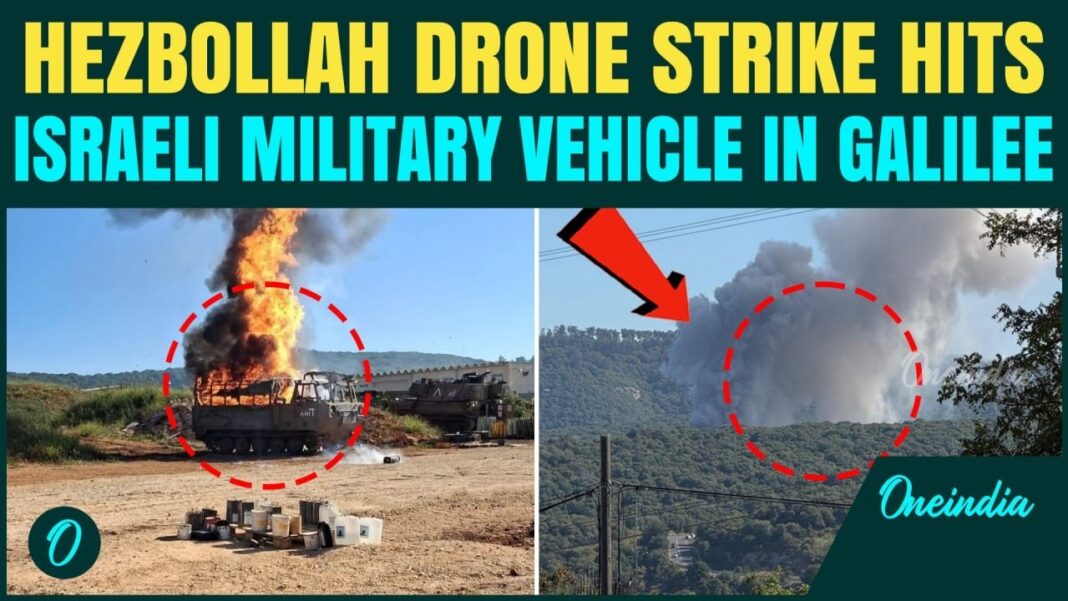
The operational consequences of this expansion are already evident. Since the resumption of hostilities, drone attacks have resulted in the deaths of three soldiers from the Israel Defense Forces in southern Lebanon. These incidents illustrate the lethal potential of relatively low-cost unmanned systems when deployed with precision and intent. Unlike traditional forms of weaponry, drones offer a combination of reach, stealth, and flexibility that complicates defensive measures and increases the vulnerability of both military and civilian targets.
The strategic significance of this shift cannot be overstated. Drones enable Hezbollah to project power in ways that circumvent conventional limitations, allowing for targeted strikes without the need for direct confrontation. They also serve as instruments of psychological warfare, instilling uncertainty and fear through their unpredictable and often invisible presence. The proliferation of such capabilities thus represents a multiplier effect, amplifying the organization’s overall threat profile.
Further insight into the mechanisms underpinning this development has emerged through investigative reporting, including analysis published by the “Intelli Times” intelligence blog and cited by Israel National News. A targeted strike conducted approximately one month ago south of Beirut brought renewed attention to the individuals facilitating Hezbollah’s drone operations. The operative killed in that strike, identified as Mohammad Shihab, was publicly known as a photographer and filmmaker with a specialization in aerial imagery. His professional persona, which included work with the Lebanese Army, provided an effective civilian cover for activities that were, in reality, deeply embedded within the organization’s logistical and technological infrastructure.
Shihab’s case exemplifies a broader pattern in which ostensibly civilian expertise is repurposed for military ends. His documented presence in China, where he is believed to have acquired both technical knowledge and access to drone systems, highlights the transnational dimensions of Hezbollah’s procurement strategy. By leveraging global commercial markets and training opportunities, the organization appears to be circumventing traditional restrictions on the transfer of military technology.
The dual-use nature of drone technology further complicates efforts to curtail its proliferation. Systems designed for commercial or recreational purposes can be modified with relative ease to carry explosive payloads or conduct reconnaissance missions. This adaptability blurs the line between civilian and military applications, creating challenges for regulatory frameworks that must balance legitimate use against security concerns.
Shihab is believed to have played a central role in this process, facilitating the acquisition and conversion of drones for operational deployment. His connections to Hezbollah operatives and his position within the supply chain underscore the importance of individual actors in sustaining the organization’s capabilities. The elimination of such figures, while tactically significant, does not necessarily disrupt the broader network, which appears to be both decentralized and resilient.
The implications of Hezbollah’s drone expansion extend beyond the immediate theater of conflict. They reflect a broader trend in which non-state actors increasingly adopt advanced technologies to offset conventional disadvantages. This evolution challenges traditional conceptions of military power and necessitates a reevaluation of existing strategies for deterrence and defense.
For regional actors, the stakes are considerable. The integration of drones into Hezbollah’s arsenal enhances its ability to conduct cross-border operations and increases the risk of escalation. It also complicates the operational environment for opposing forces, which must contend with a threat that is both diffuse and technologically sophisticated.
Internationally, the situation raises questions about the effectiveness of current efforts to control the spread of drone technology. The accessibility of commercial systems, combined with the relative ease of modification, suggests that similar capabilities may become increasingly widespread among other non-state actors. This prospect underscores the need for coordinated approaches that address both supply and demand, as well as the underlying conditions that enable such proliferation.
As Israel National News continues to monitor and report on these developments, the urgency of the issue becomes ever more apparent. The narrative emerging from the region is one of adaptation and escalation, in which technological innovation is reshaping the parameters of conflict. Hezbollah’s expanding drone arsenal is not merely a tactical enhancement; it is a strategic evolution that carries significant implications for security, stability, and the future of warfare.
In this context, the challenge for policymakers and military planners is to anticipate and respond to a threat that is both dynamic and multifaceted. The lessons of recent engagements suggest that traditional approaches may be insufficient, requiring instead a combination of technological countermeasures, intelligence capabilities, and international cooperation.
The skies above southern Lebanon, once dominated by conventional aircraft, are increasingly populated by smaller, more elusive machines—silent, adaptable, and potentially devastating. Their presence signals a new phase in the region’s ongoing conflict—one defined not by the scale of force but by the precision and ingenuity with which it is applied.
