



|
Getting your Trinity Audio player ready...
|
By: Fern Sidman
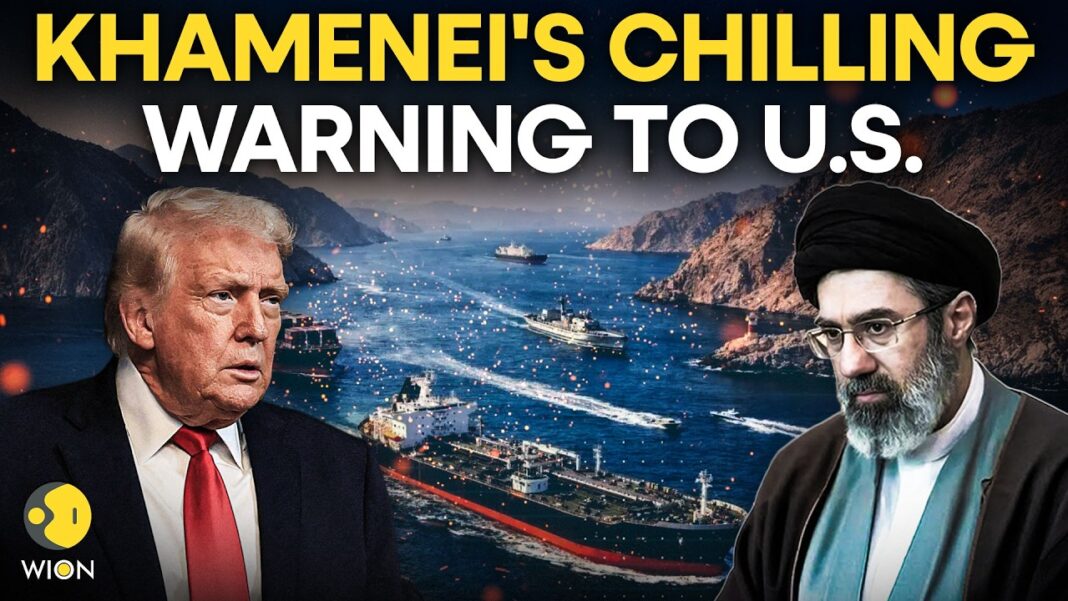
In a declaration that has sent ripples across diplomatic, military, and strategic circles worldwide, Mojtaba Khamenei has delivered a resolute and uncompromising defense of Iran’s nuclear and missile capabilities, while issuing a stark and provocative warning to the United States regarding its continued military presence in the Persian Gulf. The statement, released in written form on Thursday, underscores not merely a continuation of Iran’s established policy but an intensification of its rhetoric at a moment of acute geopolitical tension.
As reported and analyzed on Thursday by World Israel News, the timing of Khamenei’s remarks is far from incidental. They arrive in the aftermath of weeks of heightened confrontation between Tehran and Washington, culminating in a fragile ceasefire that has done little to dispel mutual distrust. The imposition of a United States naval blockade targeting Iranian-linked shipping in the Strait of Hormuz has further exacerbated tensions, transforming one of the world’s most strategically vital waterways into a flashpoint of potential escalation.
At the heart of Khamenei’s message lies an unequivocal assertion: Iran will not relinquish what it regards as its “core national capabilities.” These capabilities, he articulated, are not merely instruments of statecraft but integral components of national identity and sovereignty. In language that blends ideological conviction with strategic intent, he declared that “ninety million proud and honorable Iranians” view the nation’s scientific, technological, and military achievements—spanning nanotechnology, biotechnology, nuclear development, and missile systems—as assets to be safeguarded with the same vigilance as territorial integrity.
This expansive framing serves a dual purpose. Domestically, it reinforces a narrative of resilience and self-reliance, positioning technological advancement as a source of collective pride and unity. Internationally, it signals a firm rejection of external pressure, particularly from Western powers seeking to curtail Iran’s nuclear ambitions. As the World Israel News report observed, such rhetoric reflects a broader strategic posture in which compromise is perceived not as diplomacy but as capitulation.
Equally striking was Khamenei’s pointed warning directed at foreign military forces operating in the Persian Gulf. In a statement that has drawn widespread attention, he declared that the only conceivable future for the United States in the region would be “at the bottom of its waters.” This vivid and confrontational imagery underscores the depth of Tehran’s opposition to American military presence and serves as a stark reminder of the volatility that characterizes the region.
The Persian Gulf occupies a central position in global geopolitics, serving as a critical conduit for energy supplies and international trade. The presence of United States naval forces has long been justified as a stabilizing factor, intended to ensure the security of maritime routes and deter hostile actions. Yet from Iran’s perspective, this very presence constitutes a primary source of instability. Khamenei articulated this view with clarity, asserting that “the presence of American forces in the Persian Gulf is the main source of insecurity.”
This fundamental divergence in threat perception lies at the core of the enduring standoff between Tehran and Washington. While the United States frames its role as protective and stabilizing, Iran views it as intrusive and destabilizing. The result is a persistent cycle of action and reaction, in which each side’s measures to enhance security are interpreted by the other as provocations.
Khamenei’s vision for the future of the region further illuminates this divide. He envisages a Persian Gulf free from American influence, a region in which local states assume full responsibility for their own security and development. “By God’s help and power,” he proclaimed, “the bright future of the Persian Gulf region will be a future without America, one serving the progress, comfort and prosperity of its people.” This aspiration, while reflective of Iran’s strategic ambitions, challenges the existing security architecture that has long depended on external involvement.
Central to this broader vision is Iran’s steadfast commitment to its nuclear and missile programs. Despite sustained international pressure, including sanctions and diplomatic initiatives, Tehran has consistently resisted calls to halt uranium enrichment or dismantle its missile arsenal. The latest statement from Khamenei, as detailed by World Israel News, reinforces this position with renewed vigor.
Iran has long maintained that its nuclear program is intended solely for peaceful purposes, a claim that remains a point of contention with Western governments. Critics argue that the continued expansion of enrichment capabilities raises concerns about potential weaponization, while Iran insists that its activities are consistent with its rights under international agreements. This impasse has proven resistant to resolution, with successive rounds of negotiation yielding limited progress.
The strategic logic underpinning Iran’s stance is multifaceted. Nuclear and missile capabilities serve as deterrents against external threats, particularly in a region marked by historical conflict and shifting alliances. They also function as symbols of technological achievement, reinforcing Iran’s aspiration to be recognized as a significant regional power. By framing these capabilities as “national assets,” Khamenei effectively elevates them beyond the realm of policy into that of identity, making any concession politically and ideologically fraught.
The broader regional context further complicates the situation. The Persian Gulf is home to a constellation of states with diverse interests and alignments, many of which rely on United States security guarantees. Khamenei’s call for the removal of American forces implicitly challenges these arrangements, raising questions about the feasibility of a security framework based solely on regional actors.
As the World Israel News report emphasized, the interplay between rhetoric and reality is a critical factor in assessing the trajectory of the current crisis. Statements such as those issued by Khamenei are not merely expressions of intent; they are strategic signals that influence perceptions, shape expectations, and inform policy decisions. The risk lies in the potential for misinterpretation, where rhetorical escalation could precipitate unintended consequences.
The imposition of a naval blockade in the Strait of Hormuz has added a new dimension to this already complex dynamic. As one of the world’s most important maritime chokepoints, the strait is vital to the global energy market. Any disruption to its flow has immediate and far-reaching implications. The blockade, aimed at Iranian-linked shipping, represents a significant escalation in economic pressure and underscores the extent to which the confrontation has expanded beyond the realm of diplomacy.
In this context, the importance of measured and informed analysis cannot be overstated. Reporting from World Israel News provides critical insights into the evolving situation, offering a detailed account of both the rhetoric and the underlying strategic considerations. By situating Khamenei’s remarks within a broader geopolitical framework, such coverage enables a more nuanced understanding of their implications.
The path forward remains uncertain. The fragile ceasefire that currently holds between Tehran and Washington is susceptible to disruption, particularly in an environment characterized by heightened tension and mutual suspicion. Whether the current standoff will give way to renewed negotiation or escalate into further confrontation is a question that looms large over the region.
What is clear, however, is that Khamenei’s declaration represents a decisive moment in the ongoing saga. It encapsulates the fundamental tensions that define the relationship between Iran and the United States, as well as the broader challenges facing the international community in addressing issues of security, sovereignty, and technological advancement.
As the world watches with increasing concern, the Persian Gulf stands as both a symbol and a battleground—a region where competing visions of order and authority converge. In this charged atmosphere, the words of Iran’s supreme leader carry weight far beyond their immediate context, shaping the contours of a conflict that continues to unfold with profound implications for global stability.
