






























|
Getting your Trinity Audio player ready...
|
By: Fern Sidman- Jewish Voice News
A tense confrontation in a hallway of the United States Capitol this week has reverberated far beyond its brief, heated moments, reigniting urgent debate over antisemitism, political protest, and the increasingly blurred line between criticism of Israel and hostility toward Jews. According to a report that appeared on Saturday at VIN News, Rabbi Yaakov Menken, a nationally prominent Orthodox Jewish leader and executive vice president of the Coalition for Jewish Values, says he was targeted by a pro-Palestinian activist “simply for being a Jew”—a charge that has intensified scrutiny of activist tactics and the atmosphere surrounding Israel-related discourse in Washington.
When “Free Palestine” Becomes a Weapon Against Random Jews
In the clip making the rounds, pro-Palestinian activists spot a Jewish man, start chanting “Free Palestine” at him, and the moment he pushes back, they flip the script: suddenly he’s the “racist.” It’s a slick little… pic.twitter.com/uizwR88Du8
— Jewish Breaking News (@JBreakingNews) December 13, 2025
The encounter, captured on video on December 12 and widely circulated on social media, shows an activist affiliated with the left-wing protest group CodePink approaching Rabbi Menken in a Capitol hallway and chanting slogans accusing Israel of “occupation.” Menken, visibly composed but resolute, responds forcefully, defending Israel’s actions in the aftermath of the October 7, 2023 Hamas terror attacks and emphasizing that Israeli hostages remain in captivity. The exchange, while heated, does not escalate into physical confrontation.
Yet as VIN News has reported, the implications of the incident extend well beyond a verbal clash. For Menken, the episode crystallized a concern he has voiced repeatedly in recent years: that overt antisemitism is increasingly cloaked in the language of anti-Zionism, and that Jewish individuals are being singled out not for their political views, but for their identity.
Rabbi Yaakov Menken is no stranger to the corridors of power. For decades, he has been a visible and influential Orthodox Jewish presence in Washington, frequently testifying before congressional committees, briefing lawmakers, and serving as a leading voice on issues ranging from antisemitism and religious liberty to Israel and Middle East policy. As executive vice president of the Coalition for Jewish Values, he represents hundreds of Orthodox rabbis across the United States.
According to the information provided in the VIN News report, Menken’s reputation as a measured but uncompromising advocate has made him both respected and controversial. His commentary often emphasizes Jewish historical continuity, civil rights protections for religious minorities, and what he describes as the moral necessity of confronting antisemitism in all its forms.
In the aftermath of the Capitol incident, Menken took to X to articulate what he believes motivated the confrontation.
“I’m not a political Zionist at all,” he wrote, in a statement quoted extensively by VIN News. “I am a Jew, and that is why I was targeted, nothing more.”
That assertion has become a focal point of the broader discussion. Menken’s claim is not merely that he was challenged on policy grounds, but that the activist’s decision to approach him was rooted in visual identification—his appearance as an Orthodox Jewish rabbi—rather than any known political stance.
The video footage, reviewed by VIN News, shows the CodePink activist initiating the encounter, loudly chanting accusations tied to Israeli actions. Menken responds by invoking the October 7 attacks and the ongoing plight of Israeli hostages, underscoring what he characterizes as Israel’s right—and obligation—to defend its citizens against terrorism.
Observers have noted that Menken does not engage in personal insults, nor does he initiate the confrontation. Instead, he challenges the activist’s framing and questions the moral consistency of condemning Israel while minimizing or ignoring Hamas atrocities.
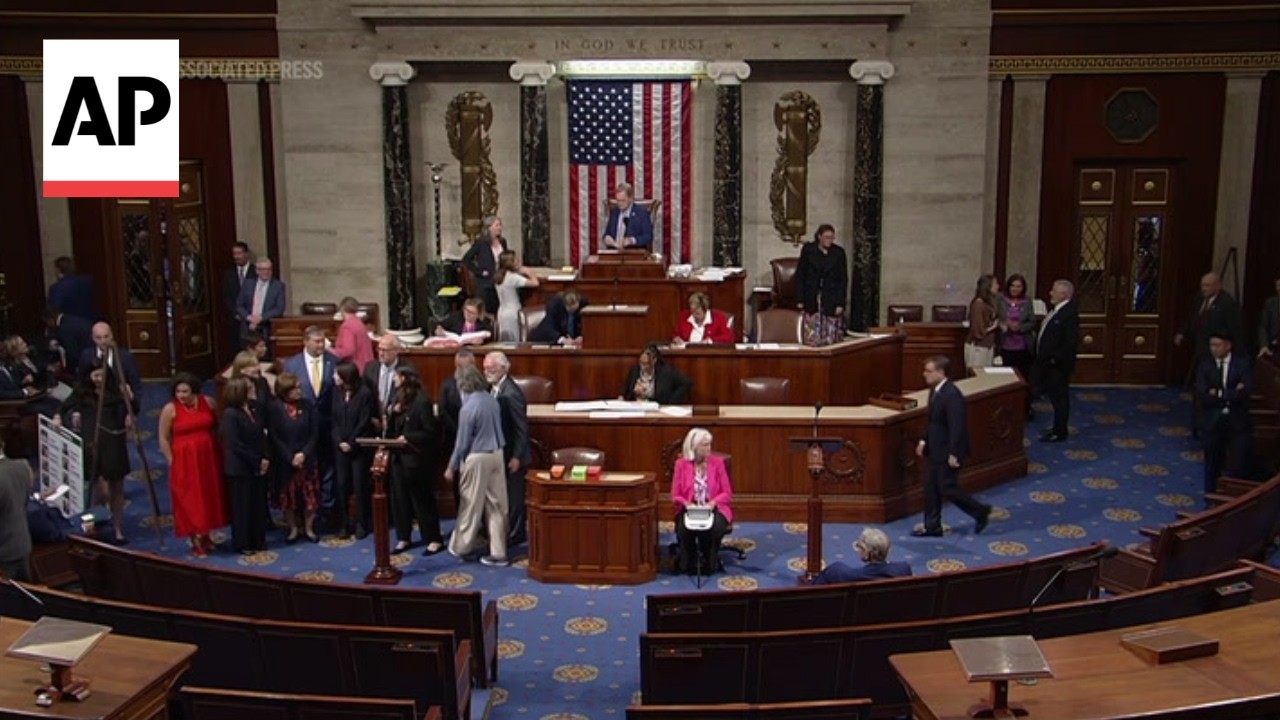
The exchange occurs against a backdrop of heightened tensions on Capitol Hill. Just days earlier, lawmakers had convened a House hearing examining Jewish historical and religious ties to Judea and Samaria—a subject that has long inflamed passions and polarized debate. As VIN News has reported, the hearing itself drew protests and sharp rhetoric from activists who oppose Israeli claims to the territory.
Menken later said that the timing and location of the confrontation were not coincidental. The Capitol, he argued, has become an increasingly volatile arena for Israel-related activism, where Jewish individuals are often treated as stand-ins for the policies of a sovereign state.
Central to Menken’s response—and to the coverage by VIN News—is his contention that anti-Zionism is being used as “a new pretense for Jew-haters.” This assertion reflects a growing concern among Jewish leaders that the distinction between legitimate criticism of Israeli government policies and hostility toward Jews as a collective is being deliberately eroded.
Menken’s critics argue that anti-Zionism is a political position, not a form of bigotry. Yet as VIN News notes, Jewish advocacy organizations have documented a rising number of incidents in which Jewish individuals, including those who do not publicly support Israeli policy, are confronted, harassed, or intimidated solely on the basis of perceived association with Israel.
Menken’s own background complicates simplistic narratives. He has repeatedly emphasized that his religious identity does not automatically align him with any specific political ideology regarding the Israeli state. Nevertheless, he argues, activists increasingly treat Jewish identity itself as a provocation.
“What we are witnessing,” Menken told associates after the incident, according to VIN News, “is the normalization of targeting Jews in public spaces under the banner of political protest.”
The activist involved in the confrontation was identified as being affiliated with CodePink, a group known for its confrontational protest style and vocal opposition to U.S. support for Israel. CodePink has staged demonstrations in congressional offices, hearings, and public events, often drawing media attention for its disruptive tactics.
While CodePink has defended its activism as principled opposition to war and occupation, critics argue that its methods cross ethical lines. As VIN News has reported, Jewish leaders have increasingly accused such groups of fostering environments in which antisemitic rhetoric flourishes unchecked.
Menken himself has been careful to distinguish between dissent and discrimination. In his public statements, he has affirmed the right to criticize governments, including Israel’s. What he rejects, he says, is the personalization of that criticism—particularly when it manifests as harassment of Jews who are not acting as political representatives.
The incident has also prompted renewed reflection on the climate within the Capitol itself. Lawmakers and staffers have acknowledged privately, according to the report at VIN News, that protests related to Israel and Gaza have grown more frequent, more intense, and more emotionally charged since October 7.
For Jewish visitors and officials, this environment can feel particularly fraught. Menken’s confrontation, though brief and nonviolent, has become emblematic of a deeper unease: that Jewish presence in political spaces is increasingly contested, and that identity alone can make one a target.
Menken has warned that such dynamics threaten not only Jewish safety, but the integrity of democratic discourse. When individuals are confronted based on who they are rather than what they say, he argues, the space for meaningful debate collapses.
In reflecting on the incident, Menken said it reinforced his longstanding concerns about the direction of public discourse surrounding Israel and Jews. According to the information contained in the VIN News report, he believes that the Capitol confrontation is not an isolated episode, but part of a broader pattern unfolding across universities, public institutions, and civic spaces nationwide.
“This is not about policy disagreements,” Menken wrote in a follow-up post. “This is about the willingness to treat Jews as legitimate targets.”
Jewish organizations have echoed that warning, pointing to data showing a sharp rise in antisemitic incidents since October 2023. While motivations vary, many incidents share a common feature: the conflation of Jewish identity with Israeli state actions, regardless of individual views.
The Capitol hallway confrontation involving Rabbi Yaakov Menken may have lasted only minutes, but its resonance is likely to endure. As the VIN News report emphasized, the episode encapsulates a critical moment in the ongoing struggle to define the boundaries between political protest and bigotry.
For Menken, the message is stark. In his view, the incident demonstrates that Jewish identity itself has become politicized—and, in some circles, demonized. Whether lawmakers, activists, and institutions will confront that reality remains an open question.
What is clear, however, is that the encounter has sharpened an already urgent national conversation. As VIN News reported, the challenge facing American society is not merely how to debate Israel, but how to ensure that such debates do not devolve into the targeting of Jews simply for being who they are.



