


















|
Getting your Trinity Audio player ready...
|
By: Fern Sidman
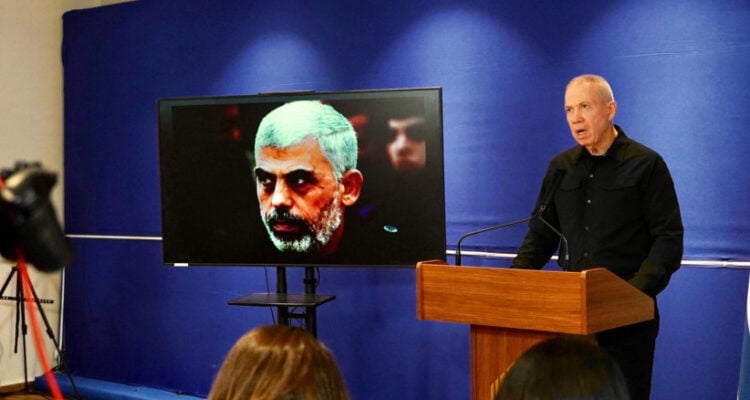
New testimony presented before the investigative committee headed by Maj. Gen. (res.) Sami Turgeman has unearthed a striking revelation: Israel twice came close to eliminating Hamas’s two most dangerous commanders—Yahya Sinwar and Muhammad Deif—but the operations were halted by the political echelon, according to a detailed report on Tuesday by Israel National News.
The testimony, described as both sobering and incendiary, outlines how in 2022 and again in 2023, the Israel Defense Forces’ Southern Command proposed a sweeping operational initiative that included precision assassinations of Hamas’s top leadership, targeted strikes on military infrastructure, and limited ground maneuvers designed to reduce the organization’s military footprint. Yet despite professional backing from security services, including significant support within the Shin Bet, the government declined to greenlight the plan.
What emerges from the testimony, as the Israel National News report noted, is a portrait of a government strategy rooted in maintaining what officials termed “quiet” in the Gaza Strip—an approach that, according to multiple senior commanders, amounted to a dangerous miscalculation.
According to those who briefed the committee, the political leadership repeatedly demonstrated reluctance to endorse actions that risked destabilizing the status quo with Gaza. The result, several top officers testified, was systemic indecision at critical junctures.
The Southern Command’s plan was ambitious but precisely targeted. Testimony indicates that the proposal included intelligence-driven strikes on Sinwar and Deif, both of whom Israel has sought for decades. Under the proposed operation, senior Hamas commanders would be struck simultaneously, while IDF units executed carefully limited ground incursions designed to damage Hamas’s command-and-control facilities.
As Israel National News reported, support for the plan was significant among the Shin Bet leadership, who viewed Sinwar’s growing brazenness—including direct incitement and public calls for escalating attacks on Israel—as reason enough to act. That the government ultimately rejected the proposals twice has prompted pointed criticism from within Israel’s security establishment.
Committee witnesses described a political calculus shaped by the belief that Hamas governance in Gaza—however hostile—was preferable to the chaos that might follow its collapse, and that maintaining relative quiet through economic incentives and limited containment was the best way to prevent a large-scale war.
According to testimony cited in the Israel National News report, this doctrine amounted to “preserving Hamas rule in Gaza at almost any cost.”
The aborted operations, according to individuals familiar with the testimony, reached advanced stages in both years. Operational plans had been drafted and refined. Intelligence assessments had been completed. The Chief of Staff reportedly offered preliminary approval for further planning.
Yet in both instances, the political echelon withheld final authorization. The committee was told that the government’s repeated hesitation “blunted operational momentum” and prevented the IDF from leveraging windows of opportunity that might never reappear.
One senior officer testified that the lost opportunities represented not mere procedural delays but strategic errors of the highest order — failures with consequences that continue to reverberate across the region.
“The misconception of the political leadership,” the officer said, “led to the cancellation of initiatives that could have changed the course of events.”
The missed chances loom especially large given the extraordinary threat posed by both Hamas leaders.
Sinwar, the mastermind behind Hamas’s military resurgence and the architect of the terror organization’s violent strategy, has been a central figure in fomenting regional instability. Deif, the elusive commander of the Izz ad-Din al-Qassam Brigades, has survived multiple assassination attempts and is widely considered Hamas’s most dangerous military strategist.
According to the information provided in the Israel National News report, the IDF and Shin Bet believed in both operational windows—2022 and 2023—that intelligence, logistics, and military preparedness aligned in ways that made a successful strike plausible.
But approval never came.
Several testifying officers noted that subsequent events have demonstrated the steep price of hesitation. Although testimony did not explicitly reference the October 7, 2023, massacre—which the Turgeman committee is broadly tasked with understanding—many hinted that eliminating Sinwar and Deif prior to that day could have drastically altered the trajectory of Hamas’s operations.
What motivated the political leadership to pull back?
Testimony presented to the committee suggests a combination of domestic and international considerations. Decision-makers feared a major retaliation from Hamas that could plunge Israel into war at a time when the strategic environment was deemed unfavorable. They were also concerned about international backlash, especially amid shifting diplomatic dynamics with Arab states and growing global scrutiny of Israeli operations.
According to the information contained in the Israel National News report, ministers were guided by a doctrine that emphasized “containment first”—preventing escalation by tolerating a certain degree of Hamas aggression while incentivizing stability through economic measures, including Qatari funding that reached Gaza regularly under Israeli oversight.
This approach, widely criticized in retrospect, framed Hamas governance as undesirable but manageable. Those who testified told the committee that such a posture inevitably led to paralysis when opportunities arose to decisively weaken the terror group.
“The political echelon feared escalation more than it valued decisive action,” one officer said.
The Shin Bet’s reported support for the operation is one of the most striking revelations in the testimony. For years, internal debates existed within the security establishment over balancing operational risk against the necessity of neutralizing Hamas’s most lethal figures.
But by 2022, according to testimony reported by Israel National News, the Shin Bet had shifted decisively. Sinwar’s increased incitement, his public calls for large-scale attacks, and Hamas’s expanding military infrastructure created what the agency viewed as a clear and immediate threat.
Testifying officials said that while earlier Shin Bet positions were sometimes interpreted as cautious or even hesitant, by 2022–2023 the calculus had changed: eliminating Sinwar and Deif was not merely advantageous but necessary.
The testimony indicates that even when the Chief of Staff authorized operational planning to proceed, no definitive green light followed. Officers described cycles of preparation followed by political cold feet, which left the IDF unable to act at the critical moment.
The committee repeatedly heard that such hesitation created systemic dysfunction. Senior commanders said that repeated political reversals eroded operational confidence, created uncertainty within Southern Command, and impaired the IDF’s ability to capitalize on tactical and intelligence advantages.
One commander, speaking under confidentiality, was quoted by Israel National News as describing a sense of “watching history unfold in slow motion,” with opportunities slipping away as political leaders deferred action yet again.
The Turgeman committee’s work is ongoing, and further testimony is expected to deepen public understanding of how Israel’s strategic doctrine toward Gaza evolved—and where it faltered.
The revelations already disclosed raise profound questions: Did a desire for short-term quiet blind Israel to long-term danger? Did political caution shield the country from immediate conflict, only to expose it to greater catastrophe later? And could the elimination of Sinwar and Deif years earlier have prevented the horrors that unfolded across Israel?
These are not merely academic questions. They cut to the heart of the state’s strategic posture and its ability to anticipate and neutralize threats before they explode into national trauma.
If the testimony reported by Israel National News is any indication, Israel is now confronting the possibility that some of its most devastating challenges were not inevitable—but preventable.