



|
Getting your Trinity Audio player ready...
|
Operation Epic Fury Enters Critical Phase: Pentagon Declares Strategic Gains as Pressure Mounts on Iran
By: Fern Sidman
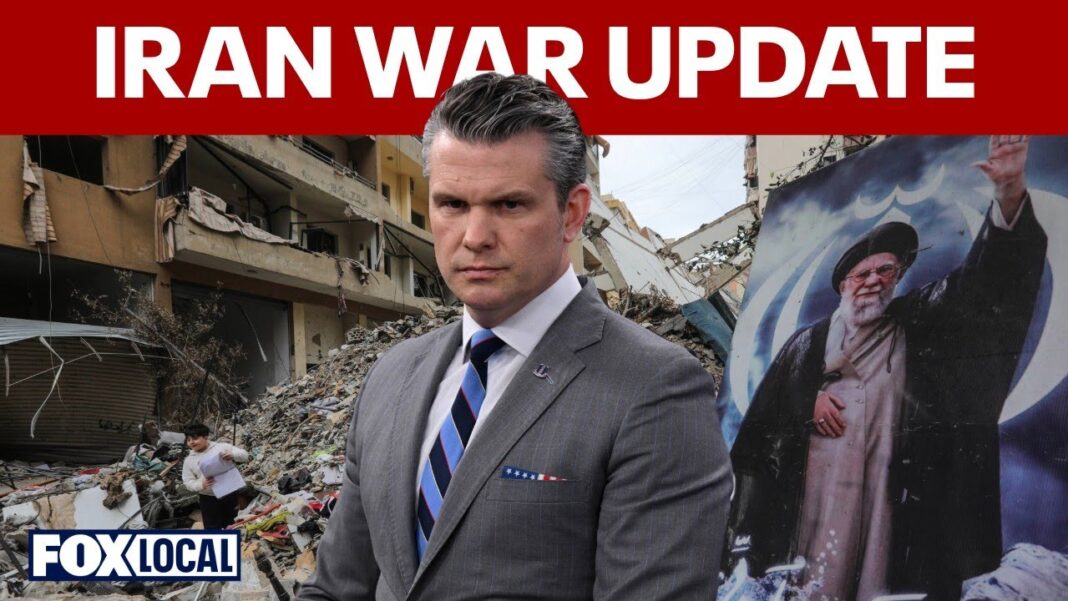
In a high-profile briefing that underscored the evolving dynamics of one of the most consequential military campaigns in recent years, United States Defense Secretary Pete Hegseth and Chairman of the Joint Chiefs of Staff Dan Caine presented an extensive assessment of Operation Epic Fury, outlining what they described as substantial strategic achievements while signaling a pivotal transition toward a new and uncertain phase.
As detailed in a report on Friday by Israel National News, the Pentagon’s leadership conveyed a message of confidence tempered by caution, emphasizing that while the initial military objectives have largely been realized, the broader geopolitical contest remains far from resolved. At the center of this unfolding narrative lies the United States’ overarching objective: preventing Iran from attaining nuclear weapons capability while compelling its leadership to engage in meaningful diplomatic negotiations.
Speaking before assembled reporters, Hegseth characterized Operation Epic Fury as having delivered what he termed a “decisive military result” within a remarkably compressed timeframe. The campaign, he explained, was designed to degrade Iran’s operational capabilities, disrupt its strategic ambitions, and reassert American dominance in critical maritime corridors.
According to the information provided in the Israel National News report, the Defense Secretary emphasized that the operation’s success should not be measured solely by its immediate tactical outcomes but by its broader strategic impact. By significantly constraining Iran’s ability to project power and influence regional shipping lanes, the United States has, in his view, reshaped the balance of power in a manner that creates new opportunities for diplomacy.
Hegseth framed the current moment as one of choice for Tehran, presenting the Iranian leadership with what he described as a clear and consequential decision: pursue a negotiated settlement or face the prospect of renewed and potentially intensified military pressure.
Central to the operation’s strategy has been the establishment and expansion of a robust naval blockade in the Strait of Hormuz, a critical artery for global energy supplies. Hegseth described the blockade as “ironclad,” underscoring its effectiveness in restricting Iranian maritime activity while allowing carefully monitored passage for non-Iranian vessels.
The significance of this effort cannot be overstated. The Strait of Hormuz serves as one of the most strategically vital waterways in the world, with a substantial portion of global oil shipments passing through its narrow channels. By asserting control over this chokepoint, the United States has effectively exerted pressure not only on Iran but also on the broader international energy market.
Israel National News reported that despite the blockade’s stringent enforcement, a limited number of vessels have been permitted to transit the strait under controlled conditions. This selective approach reflects an attempt to balance strategic objectives with the need to mitigate disruptions to global commerce.
The blockade’s scope continues to expand, with additional naval assets being deployed to reinforce its effectiveness. Hegseth confirmed that a second aircraft carrier is expected to join the operation, further enhancing the United States’ capacity to project power and maintain control over the region.
In addressing recent incidents involving Iranian actions against commercial shipping, Hegseth adopted a markedly firm tone. He described reports of Iranian speedboats targeting vessels as indicative of a broader pattern of destabilizing behavior, one that the United States is prepared to counter decisively.
Citing directives from President Trump, the Defense Secretary made clear that American forces have been authorized to employ lethal force in response to attempts to deploy naval mines or otherwise threaten maritime security. The rules of engagement, he emphasized, leave little room for ambiguity.
“If Iran is putting mines in the water or threatening American shipping or forces, we will act without hesitation,” Hegseth stated, reinforcing the administration’s commitment to maintaining the integrity of international waterways.
This posture reflects a broader strategy of deterrence, aimed at discouraging further Iranian provocations while signaling the United States’ willingness to escalate if necessary.
General Caine provided additional details on the operational aspects of the blockade, highlighting the extensive measures undertaken to enforce its provisions. According to his account, numerous vessels have altered their course in response to the presence of American forces, underscoring the blockade’s deterrent effect.
Israel National News reported that enforcement actions have included the seizure of at least one vessel and the interception of multiple tankers linked to Iran in regions extending beyond the immediate theater of operations. These activities, conducted across the Pacific and Indian Oceans, demonstrate the global reach of the campaign.
The detention of crews associated with intercepted vessels further underscores the seriousness with which the United States is approaching enforcement. Such measures serve not only to disrupt Iranian operations but also to convey a clear message regarding the consequences of noncompliance.
Despite the intensity of the campaign, a ceasefire between the United States and Iran remains in effect, creating a complex and often contradictory dynamic. While overt hostilities have been temporarily suspended, both sides continue to maneuver for advantage, particularly in the maritime domain.
Iran has reportedly sought to assert its own authority within the Strait of Hormuz, engaging in activities such as the collection of tolls and the seizure of vessels. These actions, in turn, have prompted responses from American forces, resulting in a series of confrontations that underscore the fragility of the current arrangement.
President Trump’s remarks, as cited by Israel National News, reflect a nuanced approach to this situation. While expressing confidence in the United States’ control over the strait, he has also indicated a willingness to pursue a negotiated resolution, provided that it meets certain criteria.
“I want to make the best deal,” the President stated, emphasizing quality over expediency. This perspective suggests that while there is no immediate urgency to conclude negotiations, the administration remains open to diplomatic engagement under the right conditions.
The ramifications of Operation Epic Fury extend beyond the immediate context of US Iran relations, influencing a broader network of regional dynamics. Notably, a separate ceasefire between Israel and Lebanon has been extended following discussions at the White House, reflecting the interconnected nature of conflicts across the Middle East.
The Israel National News report highlighted the role of Iran and its affiliated groups in shaping these dynamics, noting that developments in one arena often have cascading effects elsewhere. The extension of the Israel Lebanon ceasefire, therefore, can be seen as part of a broader effort to stabilize the region while maintaining pressure on Tehran.
Amid these developments, the Pentagon itself has undergone notable changes, including the departure of Navy Secretary John Phelan at the direction of President Trump and Defense Secretary Hegseth. While the specific reasons for this decision have not been fully elaborated, it reflects the ongoing evolution of leadership within the defense establishment during a period of heightened activity.
Such changes may have implications for the implementation and oversight of ongoing operations, particularly as the campaign enters its next phase.
As Operation Epic Fury transitions from its initial phase to a more complex and potentially protracted stage, the stakes remain extraordinarily high. The combination of military pressure, economic constraints, and diplomatic maneuvering has created a volatile environment in which the actions of all parties will be closely scrutinized.
The Israel National News report emphasized the significance of this moment, portraying it as a critical juncture in the broader effort to address Iran’s strategic ambitions. The decisions made in the coming weeks and months will likely have far-reaching consequences, not only for the immediate participants but for the international community as a whole.
The Pentagon’s briefing on Operation Epic Fury provides a detailed and multifaceted picture of a campaign that has achieved notable successes while simultaneously entering a new and uncertain phase. With the United States asserting control over key maritime routes and Iran facing mounting pressure, the stage is set for a decisive period in which diplomacy and military readiness will coexist in delicate balance.
As reported by Israel National News, the situation remains fluid, characterized by both opportunity and risk. Whether this moment leads to a durable resolution or further escalation will depend on the choices made by leaders on all sides, choices that will shape the trajectory of regional and global stability for years to come.
