































|
Getting your Trinity Audio player ready...
|
According to a new report from the federal government’s Bureau of Labor Statistics this week, the US economy added 303,000 jobs for the month of March while the unemployment rate fell slightly to 3.8%. In what has become a familiar pantomime, reporters from the legacy media were sure to declare this a “blowout jobs report” while Richmond Fed president Tom Barkin described the report as “quite strong.”
This report showed, however, that the jobs economy continues to follow a pattern that began in December of last year: namely, full-time jobs are disappearing and the “job growth” reported so enthusiastically by the media is virtually all part-time jobs. Moreover, nearly a quarter of new payroll jobs are government jobs. If we look more closely at this report, what we really find is that the total number of employed persons has fallen by nearly 400,000 jobs in four months and that 1.8 million full-time jobs have disappeared over the same period.
Establishment Survey vs. Household Survey
The establishment survey report shows that total jobs—both part-time and full-time—increased, month over month, in March by 303,000. The establishment survey measures only total jobs, however, and does not measure the number of employed persons. That means that even when job growth comes mostly from people working multiple part-time jobs, the establishment survey shows big increases while the total number of employed persons does not. In fact, total employed persons can fall while total jobs increases.
This may help explain why there is a sizable gap between the establishment survey and the household survey since early 2022. If we look at the total increase in both measures over the past three years, we find a gap has opened and persisted over more than two years. Indeed, as of the March report, the gap is at 3.5 million. The household survey also shows that total employed persons has been virtually unchanged for eight months. Since August 2023, total employed persons has decreased by 34,000. Over the same time period, total “jobs” has increased by more than 1.7 million. Since November, total employed persons has fallen by 400,000.
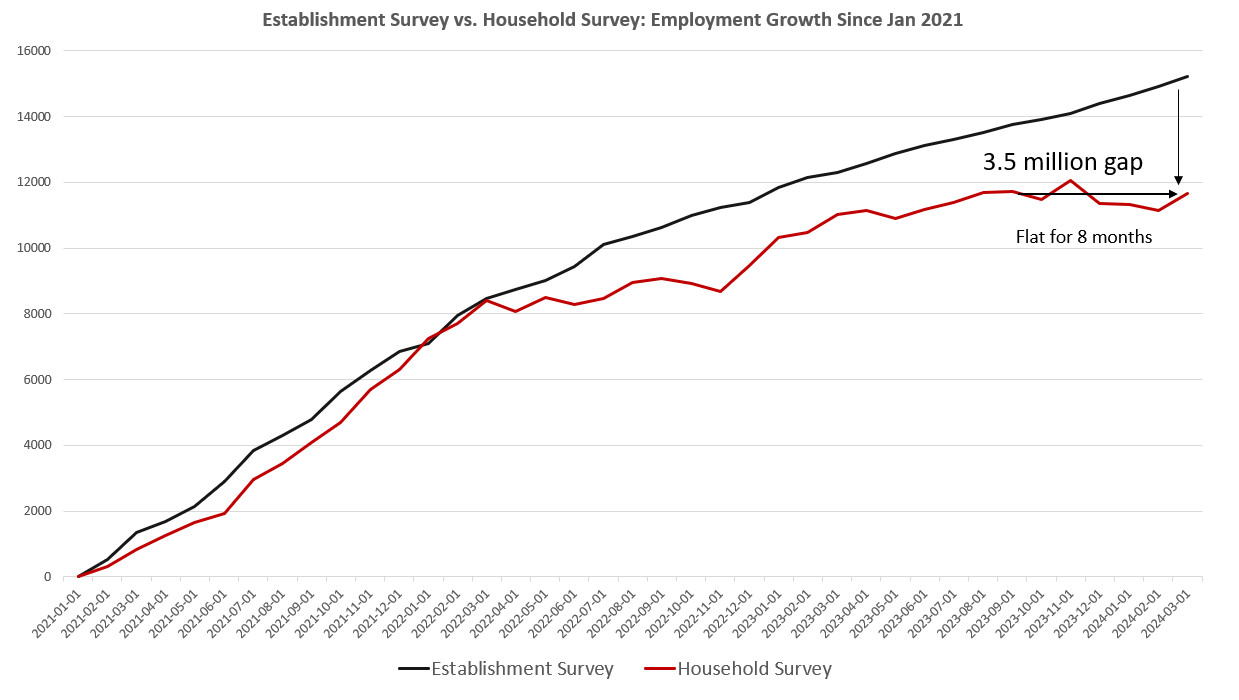 Assuming that the establishment survey is a realistic picture of the economy at all—an assumption that may or may not be true—then the current economy is producing many more jobs than actual workers.
A Recession in Full-Time Jobs
Looking at total growth in employed persons, versus total growth in “jobs” we find that there is virtually no growth in employed persons in spite of constantly rising totals of jobs. It appears the job growth we do see is overwhelmingly part-time jobs only.
Over the same eight months that total employed persons has stagnated—and total jobs increased 1.7 million—we find only growth in part-time jobs. Since August 2023, total part-time jobs has increased by 1.4 million. During the same period, full-time jobs fell by more than 1.3 million. That is, net job creation during that period has been all part-time. The graph shows the month-over-month change in both full-time and part-time:
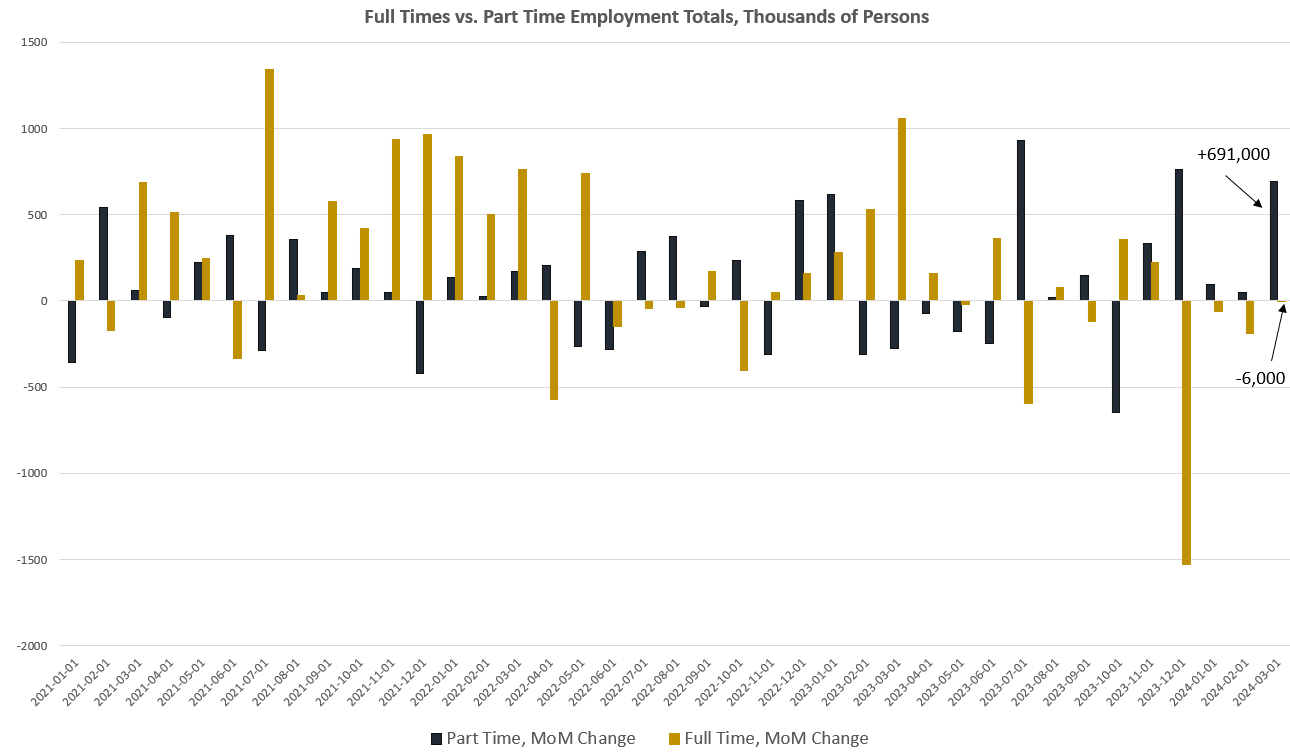 Over the past two months, in fact, the year-over-year measure of full-time jobs has fallen into recession territory. Full-time jobs were down, year over year, in both February and March. Over the past fifty years, any time full-time jobs fall year over year for two months in a row or more, the United States has been in recession, or about to enter a recession:
 The full-time jobs indicator now reflects what we’ve seen in temporary jobs for months. For decades, whenever temporary help services are negative, year over year, for more than three months in a row, the US is headed toward recession. This measure has now been negative in the United States for the past seventeen months.
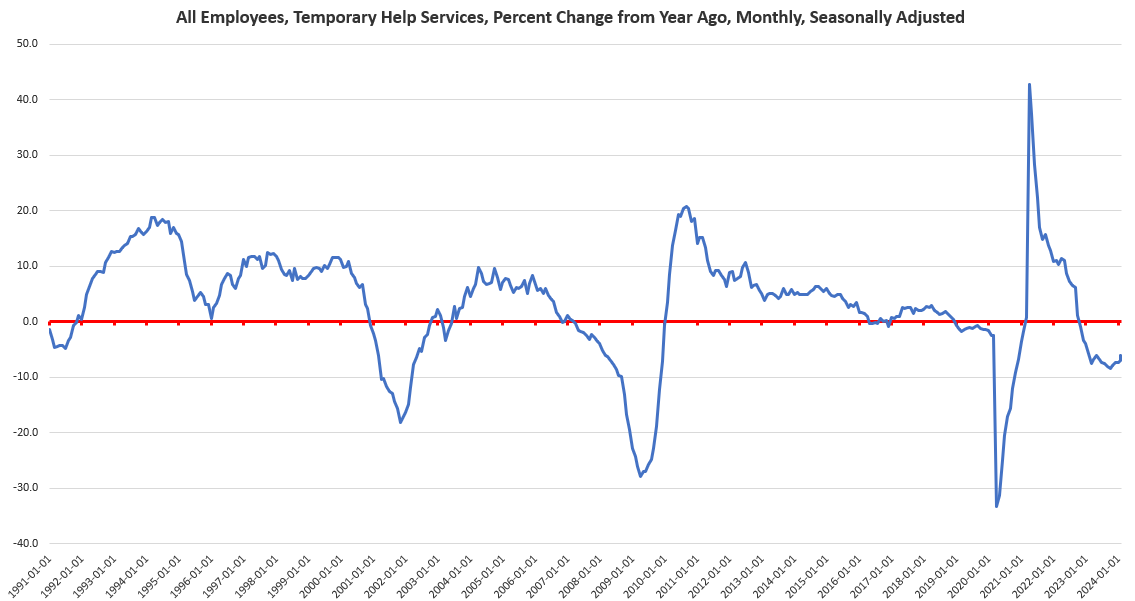 This is to be expected in a weakening economy. Empirical studies have shown that economies tend to shift to part-time work in times for economic downturn as a means of allowing employers more flexibility in reducing costs. This has been observed internationally, and not just in the United States.
Similarly, temporary jobs are often the first jobs to be eliminated by firms, and as the BLS puts it, “flexible labor arrangements provided by temp agencies allow firms to scale down their operations readily and without the added expense of separation pay or having to let go of their best workers.” In a weakening economy, there is no longer a need to use THS workers as a means of screening potential new workers or adding work hours to supplement the full-time work force. It appears that over the past year, the need for new workers is fading fast and dropping temp workers is a cheap way to cut costs.
That the United States is hardly in a jobs boom is also supported by the fact that average weekly hours have been flat over the past year.
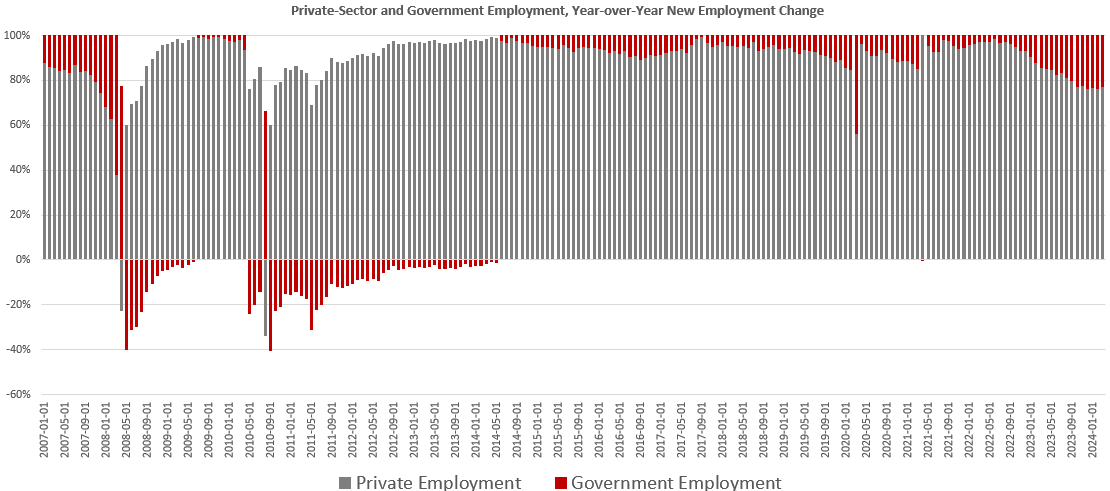
Another concerning aspect of this report is the fact that government jobs make up more than 20 percent of all new jobs. Of the 303,000 new payroll jobs added according to the establishment survey, 71,000 of those were government jobs—or 23 percent. Historically, this ratio suggests an approaching recession since, in times of solid economic growth, government jobs rarely make up more than ten or twelve percent of job growth. Year over year, government jobs have been responsible for more than 20 percent of all growth in jobs—also an indicator of recession.
 If we take a larger look around, we find plenty of worrisome data in the leading indicators: The Philadelphia Fed’s manufacturing index is in recession territory. The same is true of the Richmond Fed’s manufacturing survey. The Conference Board’s Leading Indicators Index continues to point to recession. The yield curve points to recession. Commercial real estate is in big trouble. Net savings turned negative for only the second time in decades in 2023, and has been negative now for four quarters in a row. The economic growth we do see is being fueled by the biggest deficits since covid.
Indeed, the establishment survey’s monthly “blowout” job growth is one of the few bits of good news in economic data coming out of the federal government. As questionable as these numbers are, they do lead to one good political phenomenon: the Federal Reserve is using that “good” jobs numbers as political cover to avoid an immediate return to the full-blown easy-money policies we saw for most of the past decade. Since 2022, rising price inflation has forced the central bank to allow interest rates to increase to more reasonable levels. After more than a decade of ultra-low interest rate policy, price inflation became impossible to ignore. Now, after more than a year of slightly-more-reasonable interest-rate policy, pressure from elected officials and the Wall Street lobby has been mounting. The “strong” jobs numbers, however, have allowed Fed officials to claim that there is no immediate need to force the policy interest rate back down to under one percent. Once recession becomes undeniable, however, we can expect the central bank to again open the money spigots. Price inflation will again surge.
Ordinary Americans are caught in the middle of all this. Thanks to fifteen years of ultra-easy money, Americans are seeing the cost of living soar, even as the economy shifts to more part-time work. The Fed’s efforts to rein in inflation have done nothing to reverse the 20-percent devaluation of the dollar that consumers have endured over the past four years. The Fed is so committed to monetary inflation, it is unlikely to take any hawkish position that might actually reduce the cost of living. Rather, the Fed is in a holding pattern until the political dam finally breaks and the Fed turns back to dovish policy. As Daniel LaCalle showed this week, that’s a recipe for stagflation. There is plenty of rough water ahead.



