

























|
Getting your Trinity Audio player ready...
|
By: Ariella Haviv
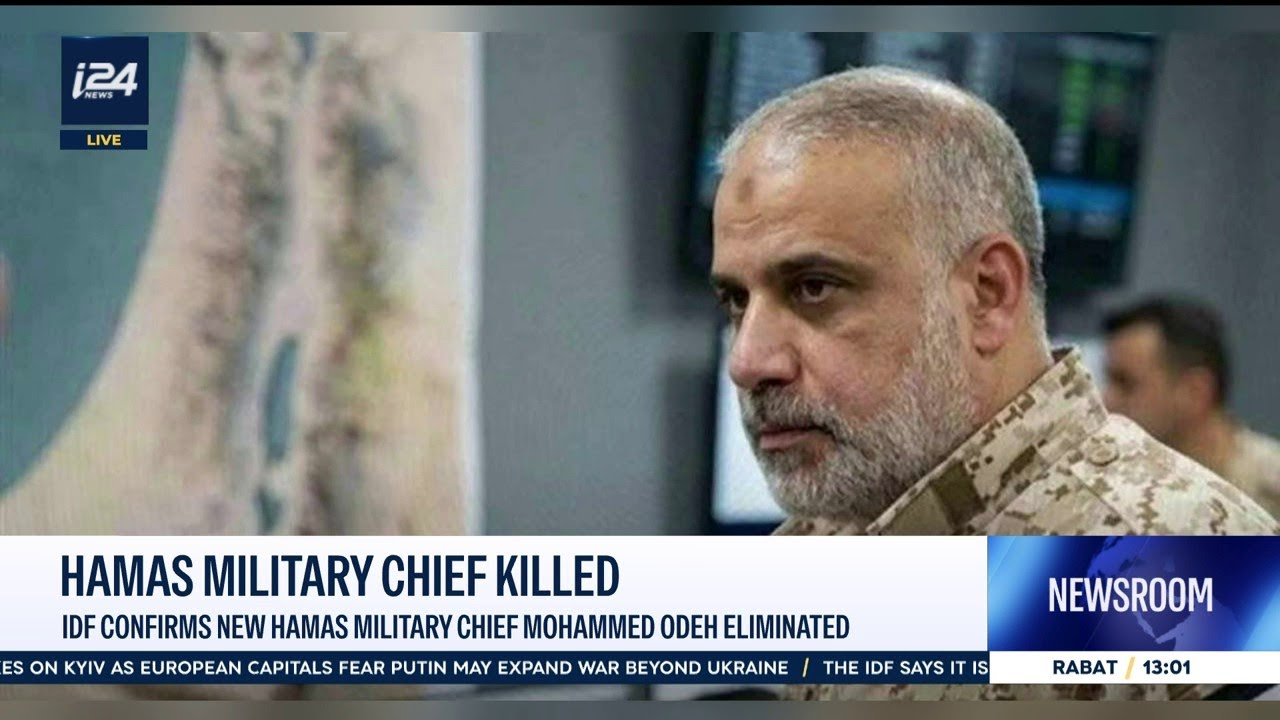
In what Israeli defense officials increasingly describe as a systematic dismantling of Hamas’ wartime command infrastructure, the Israel Defense Forces announced Wednesday that it had successfully eliminated Mohammed Odeh, the recently appointed commander of Hamas’ military wing in Gaza, only days after he assumed the role vacated by the slain Izz al-Din al-Haddad. According to a report on Wednesday by Ynet News, the rapid succession of targeted eliminations has now left only a single senior military commander from Hamas’ original October 7 operational hierarchy still alive inside the Gaza Strip: Imad Aqel, a shadowy and longtime figure deeply embedded within the organization’s logistical and operational architecture.
The killings mark another major milestone in Israel’s sustained effort to methodically eradicate the senior military leadership responsible for orchestrating the October 7 massacre, which triggered the ongoing war and fundamentally altered the security landscape of the Middle East. Israeli officials have repeatedly vowed that every architect and participant connected to the attacks would eventually be located and neutralized, regardless of rank, operational role, or location.
Following confirmation of Odeh’s death, Prime Minister Benjamin Netanyahu and Defense Minister Israel Katz issued a forceful joint statement underscoring the government’s unwavering posture.
“We will continue to pursue everyone who took part in the October 7 massacre,” the two leaders declared. “Sooner or later, Israel will reach them all.”
The statement reflected not only Israel’s determination to exact military accountability, but also the broader strategic objective driving the campaign: the systematic erosion of Hamas’ command continuity, operational coherence, and institutional survivability.
According to the Ynet News report, the IDF accompanied Wednesday’s announcement with the release of an updated organizational chart identifying the senior Hamas military leadership that existed at the time of the October 7 attacks. The visual document starkly illustrated the extent of Hamas’ attrition. Nearly every senior commander listed on the chart has now been killed.
Only Imad Aqel remains.
For years, Aqel largely operated outside the glare of international attention, cultivating a reputation within Hamas as a discreet yet highly consequential operational figure. Unlike some of Hamas’ more public-facing commanders, Aqel specialized not in propaganda or overt political messaging but in the far less visible machinery sustaining Hamas’ military apparatus: logistics, weapons procurement, operational support systems, infrastructure management, and wartime continuity planning.
Israeli intelligence officials increasingly view those functions as central to Hamas’ long-term survivability.
Born in 1971 in the Jabaliya refugee camp in northern Gaza, Aqel emerged from one of the Strip’s most densely populated and impoverished environments. Ynet News noted that the harsh socioeconomic realities of Jabaliya played a formative role in shaping many early Islamist activists who eventually gravitated toward Hamas during its formative years.
At a young age, Aqel became involved with the local Islamist networks from which Hamas itself later emerged. When the organization formally established the Izz ad-Din al-Qassam Brigades in the early 1990s, Aqel reportedly joined its operational ranks, initially occupying junior roles before gradually ascending through training and field assignments.
Over time, he developed into one of Hamas’ most experienced institutional operatives.
According to Ynet News, Aqel became associated during the 1990s and early 2000s with various armed cells targeting both Israeli interests and Palestinian Authority security structures. His activities reflected the often violent internal Palestinian power struggles that accompanied Hamas’ rise as both a militant and political force.
One particularly notable incident occurred on October 7, 2002, when Palestinian sources accused a Hamas cell led by Aqel of carrying out the killing of Rajeh Abu al-Yahiya, a senior figure within Gaza’s Palestinian security services.
The assassination triggered severe tensions between Hamas and the Palestinian Authority.
The Palestinian Authority reportedly demanded that those responsible be surrendered, viewing the killing not merely as an isolated terrorist operation but as a direct challenge to its governing legitimacy inside Gaza.
Yet Aqel survived.
Indeed, survival has become one of the defining characteristics of his career.
Ynet News reported that in 2003 Israel allegedly attempted to eliminate Aqel in a targeted operation conducted in central Gaza. The strike reportedly killed several individuals and wounded others, but Aqel himself escaped unharmed.
The near miss only deepened his reputation within Hamas circles as an elusive and resilient operative.
Over the subsequent years, Aqel continued expanding his role within Hamas’ military infrastructure. Israeli and Palestinian sources alike increasingly linked him to efforts aimed at strengthening the organization’s logistical networks, weapons production systems, and operational resilience.
Though not always directly tied to front-line attacks, his influence appeared deeply embedded in the underlying structures that enabled Hamas’ broader military campaigns.
Ynet News further reported that Aqel was accused of involvement or indirect association with multiple attempted attacks, including the 2006 attempted assault at the Karni crossing conducted by cells affiliated with the Popular Resistance Committees.
That operation formed part of a broader wave of militant activity targeting Israeli crossings, military infrastructure, and civilian areas during the height of escalating violence in the Second Intifada’s aftermath.
Again, Aqel endured.
During Operation Cast Lead in 2009, Israel reportedly bombed his residence in the Nuseirat refugee camp. Yet once more, Aqel was absent from the location at the time of the strike and escaped injury.
His repeated survival through successive Israeli military campaigns has contributed to an almost mythic status within segments of Hamas’ operational hierarchy.
But while Aqel may have avoided death repeatedly, the organization surrounding him has suffered devastating attrition.
According to Ynet News, Aqel currently serves as head of Hamas’ “home front staff,” a role encompassing responsibility for logistics, weapons production, infrastructure coordination, supply management, and support functions for combat forces operating throughout Gaza.
He is also considered a member of Hamas’ military council inside the enclave and one of the key figures responsible for preserving operational continuity during wartime conditions.
Those responsibilities may now render him even more strategically significant following the eliminations of both Haddad and Odeh.
Israeli defense officials increasingly believe that targeting Hamas’ senior military leadership creates not only immediate tactical disruption but also long-term institutional fragmentation. By repeatedly eliminating replacement commanders shortly after appointment, Israel aims to create a climate of operational instability, psychological exhaustion, and pervasive insecurity within Hamas’ leadership structure.
The rapid elimination of Odeh appears to exemplify precisely that strategy.
According to the Ynet News report, Odeh had been appointed only approximately 10 days earlier to replace Izz al-Din al-Haddad, himself killed in a prior Israeli strike. Israeli officials described Odeh as one of the principal architects of the October 7 massacre and accused him of direct responsibility for the deaths, kidnappings, and injuries inflicted upon Israeli civilians and soldiers.
His death therefore carried both symbolic and operational significance.
Israeli officials believe the elimination campaign also sends a powerful message to lower-level Hamas operatives still embedded inside Gaza: no senior figure is beyond reach, no appointment guarantees survival, and the Israeli intelligence apparatus continues penetrating Hamas’ internal structures despite the ongoing war.
Ynet News noted that Israeli security officials now view the weakening of Hamas’ military leadership inside Gaza as increasingly shifting influence toward the organization’s political leadership operating outside the enclave.
That evolving imbalance could significantly affect future ceasefire negotiations and broader discussions surrounding postwar governance arrangements in Gaza.
Indeed, Israeli officials are now closely monitoring who Hamas appoints as Odeh’s successor — and whether anyone is even willing to assume such a precarious role.
The position increasingly resembles a death sentence.
At the same time, Aqel’s survival complicates Israel’s efforts to declare complete dismantlement of Hamas’ operational command system. Unlike more visible militant leaders, Aqel’s expertise lies precisely in maintaining institutional continuity during periods of extreme pressure.
That capability may prove critically important for Hamas as it attempts to preserve residual operational functionality amid relentless Israeli military pressure.
Israeli intelligence officials are also acutely aware that logistical and support networks often outlast frontline commanders in asymmetric conflicts. While battlefield leaders may be eliminated, organizations frequently regenerate through surviving logistical cadres capable of rebuilding communications, weapons production, recruitment, and infrastructure systems.
In that sense, Aqel may represent something even more dangerous from Israel’s perspective: not merely another commander, but a custodian of Hamas’ institutional memory and operational resilience.
Complicating matters further are reports that Aqel’s own family has suffered losses during the war. Ynet News reported that his son, Mohammed Imad Aqel, was allegedly killed in Israeli strikes conducted inside Gaza.
Such personal losses may further deepen Aqel’s commitment to sustaining Hamas’ military operations despite mounting devastation throughout the enclave.
Yet Israel’s broader campaign continues advancing.
Since October 7, Israeli forces have systematically targeted Hamas’ command hierarchy through a combination of intelligence penetration, precision airstrikes, surveillance operations, and special operational coordination between the IDF and Shin Bet security services.
The cumulative effect has been severe.
Senior Hamas commanders once believed untouchable have been eliminated one after another. Command structures have repeatedly fractured. Replacement leaders increasingly survive only days or weeks before being targeted themselves.
The strategic objective extends beyond individual killings.
Israel seeks to degrade Hamas’ ability to operate as an organized military entity capable of coordinated large-scale warfare. By disrupting leadership succession and institutional continuity, Israeli planners hope to reduce Hamas from a structured military force into fragmented militant remnants lacking coherent command authority.
Whether that objective is fully achievable remains uncertain.
History demonstrates that terrorist organizations often regenerate even after suffering catastrophic leadership losses. Yet Israeli officials argue that the scale, precision, and persistence of the current campaign are unprecedented.
And as Ynet News repeatedly emphasized throughout its reporting, one reality now appears undeniable:
The Hamas military hierarchy that orchestrated the October 7 attacks has been almost entirely erased.
Only Imad Aqel remains.



