


























|
Getting your Trinity Audio player ready...
|
By: Chaya Sora Jungreis-Gertzulin
The upcoming chag of Shavuos is also known as “Z’man Matan Toraseinu”, the Yom Tov that commemorates the giving of the Torah. It is asked, why the name “Matan” Toraseinu, meaning the “giving” of the Torah, and not “Kabbolas” Toraseinu, the “receiving” of the Torah.
The Chiddushei Harim, Rav Yitzchok Meir Alter, the founder and first rebbe of the Ger dynasty (1799-1866), offers an insightful explanation. He teaches that the giving of the Torah was a momentous event that happened at a specific time, while the receiving of Torah happens all the time, in every generation. No matter where life takes us, no matter how much time passes, the gift of Torah remains constant. It is always with us.
The Torah is not just a gift to gather dust on our bookshelves. It is our guidebook, teaching us a way of life. It is not merely a book to be read, but a life to be lived.
The Torah encompasses 613 mitzvos, both positive and negative. Each one is there for a specific purpose, each one helps us live our lives as committed Jews.
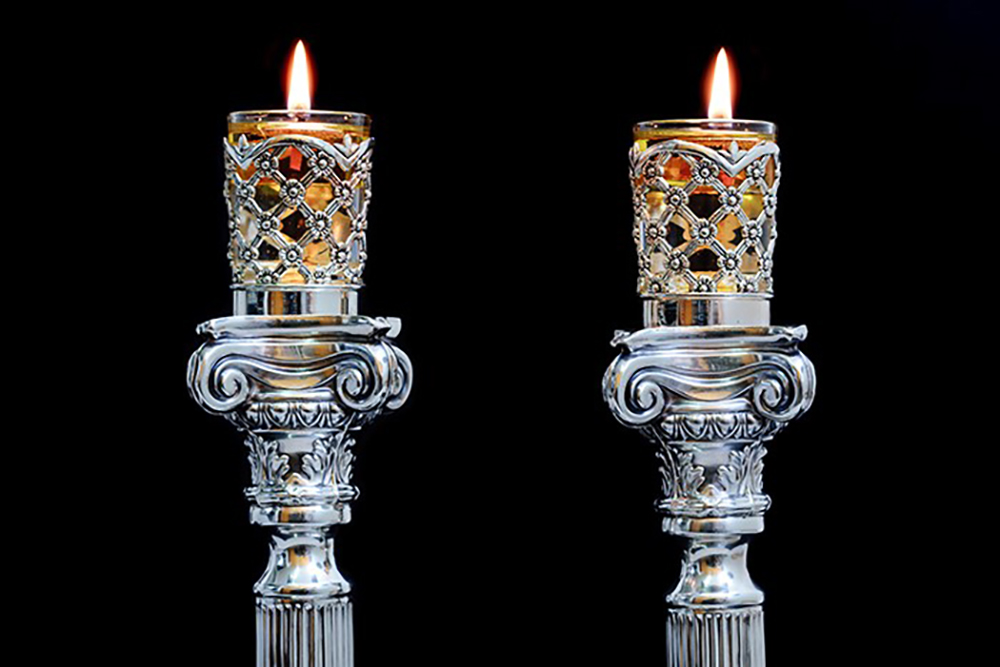
The Lubavitcher Rebbe wanted to increase awareness about the importance of Shabbos candlelighting. To do so, he encouraged the publication of candlelighting information in the print media. For five years, from 1994 through 1999, a group of supporters sponsored a small ad on the front page of the New York Times. Every Friday, in the exact same space on the bottom left corner of the front page, a notice for Jewish women to light Shabbos candles appeared. It read as follows: “Jewish Women/Girls – Light Shabbos Candles 18 minutes before sunset. Candlelighting this Friday in New York is at ____. (ADVT.)” I remember the ad clearly. Seeing Shabbos candlelighting on the front page filled me with Jewish pride.
On January 1, 2000, the New York Times published a special edition in honor of the Millennium. It contained three front pages – past, present, future. Besides printing the daily front page of current news, it carried the front page printed 100 years earlier – January 1, 1900, and a “pretend” page with a look into the future. A page of prediction, Friday, January 1, 2100. Its headlines told of robots demanding the right to vote, Iceland’s winning the World Cup, and statehood for Cuba. And there, on the bottom left, was a little ad, reminding Jewish women the time of candlelighting. This time, it wasn’t a paid advertisement, but the decision of the New York Times editors.
When asked about reprinting the ad on a page depicting the future, the Times production manager, a non-Jew, commented. “We really don’t know what will happen in the year 2100. It is impossible to predict the future. But of one thing you can be certain, that in the year 2100 Jewish women will be lighting Shabbos candles.”
What a powerful statement. To be defined by our commitment to G-d, Torah and mitzvos. To be recognized for our eternal link to Shabbos, no matter the world events around us. That despite our fast paced, forever changing world, Jewish women will always light Shabbos candles.
It was on a Shabbos morning, the 6th Sivan 2448, over 3,000 years ago, that our ancestors gathered at the foot of Har Sinai, ready to hear the Aseres HaDibros, the Ten Commandments. Ready to accept HaShem’s Torah. The Midrash teaches that the nation that stood as Sinai was joined by the millions of neshamos, their descendants yet to be born. Also with them, were the neshamos of future converts, who would take upon themselves a Torah life. Together, they made a pledge, na’aseh v’nishma, we will do and we will listen. Na’aseh, we will do, precedes v’nishma, we will listen, telling us the commitment to do is not contingent on our understanding of HaShem’s ways. First and foremost, we do. We elevate ourselves by living Torah. It is only then that we can delve into v’nishma, to listen, to learn, to comprehend.
Our strength is derived from our past. We follow in the ways and teachings of our ancestors. Imagine, a pledge made over 3,000 years ago, still stands strong today. A promise that come Shavuos, we renew year after year. Like the generations before us, we too say na’aseh, we will do.
The fourth of the Aseres HaDibros is the keeping of Shabbos. “V’shomru Bnei Yisroel es haShabbos, Bnei Yisroel shall observe the Shabbos, la’a’sos es haShabbos l’dorosam bris olam, to make the Shabbos an eternal covenant for their generations.” (Shemos 31:16)
L’dorosam, for generations. Torah, mitzvos, Shabbos, have withstood the test of time. The power of Am Yisroel. The strength of the souls that stood at Sinai.
I was in the city on a Friday afternoon. My father zt”l was in the hospital. It was hard to say goodbye and pull myself away, but the hour was late and I had to get home for Shabbos. My son came to stay with his zeide, and I was on my way.
As I was walking towards the subway, a young woman came running over to me. “You will know, you will know.” Know what, I wondered aloud. “You will know what time candlelighting is.”
L’dorosam. For generations. As the editors of the New York Times realized, there will always be Jewish women lighting Shabbos candles.
Interestingly, in these very days leading up to Shavuos, there has even been a broader public recognition of the importance of Jewish heritage and Shabbos observance. How uncanny it is that just recently, President Trump, recognizing the centrality of Shabbos to our people, called upon “all Jewish Americans to observe a national Sabbath from sundown on May 15 to nightfall on May 16.” A Shabbos of rededication. Is that not what Shavuos is all about? It is our time to rededicate ourselves, follow in the path of our ancestors and proclaim na’aseh v’nishma.
The gift of Torah remains with us. We just have to let it be our guide.
Shabbat Shalom!
Chaya Sora
Chaya Sora can be reached at [email protected]
This article was written L’zecher Nishmas / In Memory Of HaRav Meshulem ben HaRav Osher Anshil HaLevi, zt”l and Rebbetzin Esther bas HaRav Avraham HaLevi, zt’l



