





















|
Getting your Trinity Audio player ready...
|
By: Fern Sidman
Under the soaring rotunda of the Manhattan Supreme Court at 60 Centre Street—an edifice long synonymous with the majesty of law and the solemnity of justice—a different kind of reckoning unfolded on Tuesday afternoon. Within its marble embrace, where jurisprudence has for generations been rendered with deliberation and gravity, more than two hundred individuals gathered not to argue cases or adjudicate disputes, but to bear witness to memory itself. It was a gathering marked not by the cadence of legal argument, but by the quiet, reverent cadence of remembrance.
The occasion was Holocaust Remembrance Day, a moment set aside each year to confront the incomprehensible abyss into which millions were cast, and to reaffirm the enduring imperative that such darkness must never again be permitted to descend upon humanity. Sponsored by the Jewish Lawyers Guild and the Gender Fairness Committee of the Supreme Court, Civil Branch, the ceremony transformed the courthouse into a sanctuary—an unlikely yet profoundly fitting setting in which the principles of justice and the memory of its most catastrophic betrayal converged.
Presiding over the ceremony was the Honorable Justice Martin Shulman, whose presence as both jurist and communal figure lent the gathering a particular resonance. Serving as Master of Ceremonies, he opened the proceedings with remarks that were at once measured and deeply moving, invoking not only the historical enormity of the Holocaust but also its enduring moral implications.

Justice Shulman spoke of the necessity of remembrance not as a passive act, but as a form of moral vigilance. To remember, he suggested, is to resist the erosion of truth, to stand against the insidious forces of denial and distortion that seek to diminish or obscure the past. In an era marked by a troubling resurgence of antisemitism, both in the United States and across the globe, his words carried an added urgency. Commemoration, he emphasized, is not merely an act of honoring the dead; it is a bulwark against the reemergence of the ideologies that sought their destruction.
The gathering drew strength not only from its symbolic setting but from the distinguished individuals who lent their voices to the commemoration. Among them was the Honorable Adam Silvera, whose role as Deputy Chief Administrative Judge for New York City Courts places him at the helm of one of the most complex judicial systems in the nation. His remarks reflected both his administrative acumen and his profound awareness of the ethical dimensions of law. In recalling the Holocaust, he spoke of the catastrophic consequences that arise when legal systems are subverted, when the machinery of justice is turned toward persecution rather than protection.
Equally compelling were the reflections of the Honorable Suzanne J. Adams, whose stewardship of the Manhattan Civil Supreme Court encompasses a vast and intricate judicial apparatus. She spoke of the responsibility borne by those who operate within the legal system—to ensure that the principles of fairness and equality are not merely aspirational, but actively upheld in every proceeding, every judgment, every act of governance. In her words, the memory of the Holocaust served as both a warning and a guide, a reminder of the fragility of justice and the necessity of its vigilant defense.
The Honorable Lisa Sokoloff added her voice to the chorus of remembrance, drawing upon her extensive legal career to illuminate the human dimensions of the law. Her reflections were deeply personal, imbued with a sense of empathy that transcended the formalities of her judicial role. She spoke not only of the victims of the Holocaust but of the enduring impact of their loss—on families, on communities, on the very fabric of human civilization. Her words served as a poignant reminder that behind every statistic lies an individual life, a story extinguished, a future denied.
Each of these judicial leaders brought their own unique voice and perspective to the remembrance, highlighting the shared responsibility of legal institutions in ensuring that the horrors of the Holocaust are never forgotten and that the values of justice, humanity, and dignity endure.
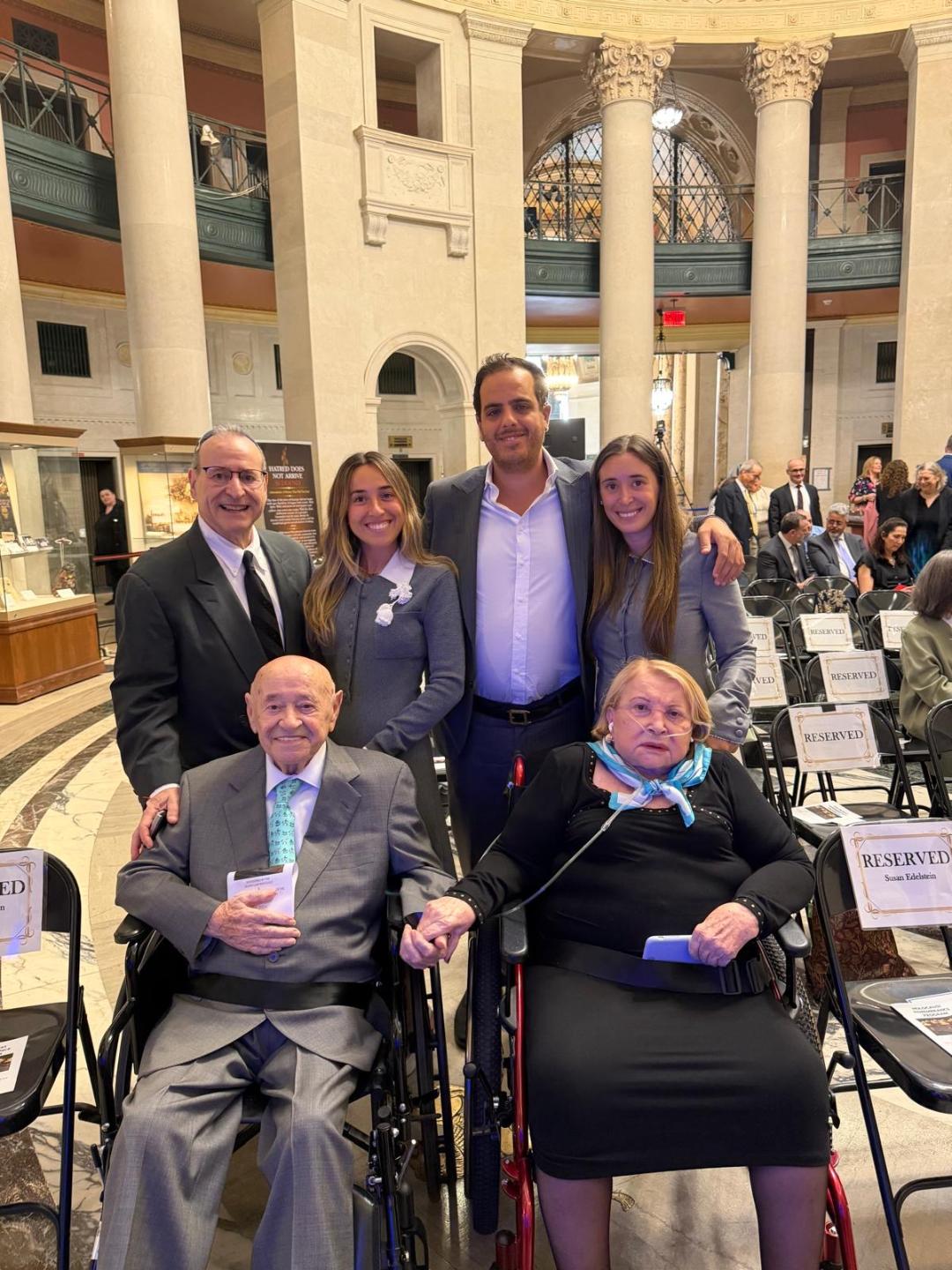
This act of illumination, at once simple and profoundly symbolic, served as a bridge between past and present, between silence and testimony. Those called forward to light the traditional candles were not merely participants in a ceremonial gesture; they were custodians of memory, bearers of stories etched in sorrow and resilience. Among them stood Jamison Levy, the Honorable Matthew Bondy, Ronald Edelstein and Susan Edelstein alongside their mother, Holocaust survivor, Florence Edelstein, Rena Allen, and the Honorable Melissa A. Crane. Each carried within them the weight of histories fractured by violence, yet preserved through remembrance and continuity.
It was one candle in particular however that brought the assembly to a moment of profound emotional crescendo. Approaching the stand with quiet dignity was Mrs. Florence Edelstein, a Holocaust survivor whose presence embodied the living continuum between catastrophe and renewal. As she rose, accompanied tenderly by her children Ronald and Susan, and with her husband Michael and grandchildren in the audience, the assemblage responded with heartfelt applause—an outpouring of reverence for a life that had endured what defies comprehension.
In that moment, Florence Edelstein ceased to be merely an individual; she became a living testament to the indomitable resilience of the human spirit. Her story, chronicled in her memoir “Feigele: A Memoir,” is not simply a narrative of survival, but a chronicle of transformation—a journey from the depths of despair to the heights of renewal. A reader of her memoir once said of Mrs. Edelstein, “she’s not just a survivor, but a hero.” And that she is.
Another reader said, “This is a poignant and compelling account of the life of a woman who not only survived but thrived, overcoming harrowing events. This book is a very important contribution to the world so that we and those after us may never forget the Holocaust and the faces of the people who were betrayed by most of the world.”
Offering a compelling retrospective of her remarkable life was Judge Silvera. He relayed the following to those gathered.
Born in 1936 in the town of Zamosc in eastern Poland, Florence—then known as Feigele—entered a world rich in familial warmth and spiritual devotion. Her early years were shaped by the rhythms of a close-knit Jewish community, where faith and tradition infused daily life with meaning. Her grandfather, a rabbi, imparted sacred Torah teachings to young students within the humble confines of a kitchen study hall, while her parents sustained the family through the modest operation of a small restaurant.
This fragile world, so abundant in love and continuity, was shattered with the arrival of war. In 1941, as Nazi forces advanced, the town was cleaved into opposing spheres of occupation. Feigele’s family fled eastward, embarking on a perilous odyssey that would test the limits of human endurance. A grueling train journey, marked by deprivation and disease, nearly claimed her life.
Stricken with typhus, she survived where others—two children afflicted alongside her—did not.
Exile became a grim succession of landscapes: Siberia, Kazakhstan, Uzbekistan. In each place, survival was measured in meager rations and unyielding hope. Thirty grams of bread per day became both sustenance and symbol—a reminder of the precariousness of life and the tenacity required to preserve it.
When the war finally receded, it did not restore what had been lost. Returning to Poland in 1946, the family encountered not liberation but lingering hostility. Antisemitism, far from extinguished, persisted with unsettling vigor. Displacement continued, leading mother and daughter to Germany and eventually to a displaced persons camp—a transient refuge for those who had nowhere else to go.
In 1950, at the age of thirteen, Feigele arrived in the United States, stepping onto a new continent burdened by memory yet animated by possibility. The Bronx became her first American home, a place where she began to rebuild not only her life but her sense of belonging. Through friendships forged with fellow refugees and cultural immersion at the Workmen’s Circle Mitlshul, she reclaimed fragments of identity that war had threatened to erase.
Her journey carried her briefly to South Carolina, where she encountered a society unfamiliar with her heritage yet, in its own way, welcoming. But it was in New York City that her roots would ultimately take hold. There, amid the bustling rhythms of urban life, she encountered a moment that would alter the course of her destiny: a dance.
Clad in a borrowed dress, lacking even the means for proper attire, she attended an event that would bring her into the orbit of Munia—later known as Michael Edelstein, a fellow survivor and gifted dancer. Their connection, forged in shared experience and mutual understanding, blossomed into a partnership that would endure a lifetime. Their marriage, modestly arranged on a winter holiday for financial necessity, became the foundation upon which a new chapter would be built.
From humble beginnings, the couple constructed a life defined by perseverance and enterprise. A small loan—merely five dollars—became the seed from which a thriving business grew. Through diligence and vision, they established a roofing company and later expanded into real estate, embodying the archetype of the American dream. Yet their success was not measured solely in material terms; it was reflected in their commitment to family, community, and philanthropy.
Florence Edelstein emerged not only as the heart of her household but as a formidable force within the family enterprise. She managed operations, guided decisions, and cultivated an acumen that extended into art collection and financial investment. Her journey from destitution to prosperity was not merely a personal triumph; it was a repudiation of the forces that had sought to reduce her to nothing.
Florence Edelstein’s presence at the ceremony carried a resonance that extended far beyond biography; it was imbued with a profound spiritual continuity that has defined her life from its earliest moments.
From her childhood in eastern Poland—where faith, tradition, and devotion formed the very fabric of daily existence—her connection to her religious Jewish heritage was not merely cultural, but sustaining. In the darkest hours of displacement, starvation, and uncertainty, it was this unwavering devotion to Hashem that fortified both her spirit and that of her family. The rhythms of belief, the quiet strength drawn from prayer and tradition, became a source of endurance when the material world offered little hope.
Throughout her long and remarkable life, that same steadfast commitment to her faith has remained a guiding force, shaping not only her personal journey but also her expansive philanthropic vision. Her generosity has been neither incidental nor symbolic; it has been deeply purposeful, rooted in a profound sense of responsibility to the Jewish people and to the preservation of Jewish life and dignity. In particular, her dedication to supporting communities in Israel stands as a testament to this enduring bond.
In this sense, Florence Edelstein’s legacy transcends survival alone. It is a legacy of faith translated into action, of memory transformed into compassion, and of a lifelong commitment to strengthening Jewish life across the world. Her story, illuminated by both suffering and triumph, reveals not only the resilience of the human spirit but the sustaining power of belief, and the enduring capacity of one individual to uplift an entire people.
Today, Florence Edelstein resides in Manhattan with her beloved husband Michael. Her home overlooking Central Park is a vista that symbolizes both the beauty of life and the serenity hard-won through decades of perseverance. There, she continues to host weekly gatherings, bringing together family across generations. Children, grandchildren, and great-grandchildren gather around her table, their presence a living refutation of the attempt to extinguish an entire lineage.
As the ceremony drew to a close, the assemblage participated in the collective chanting of El Maleh Rachamim—the Jewish prayer for the souls of the departed. Reverberating through the solemn rotunda, the prayer’s ancient words called upon God’s infinite mercy to grant rest and peace to the victims of the Holocaust.
“God full of Mercy,” the prayer implores, “grant perfect rest under the wings of Your Divine Presence to the souls of all the holy and pure who were slaughtered.”
As the assembled participants began to disperse, their footsteps echoed softly across the marble floors. Yet the resonance of the event lingered, imprinted upon the space and upon those who had gathered within it. The courthouse would return to its daily functions, its corridors once again filled with the rhythms of legal life. But for a brief, transcendent moment, it had served as something more—a sanctuary of remembrance, a testament to the enduring power of memory, and a solemn reminder of the responsibilities that accompany it.
In that sacred convergence of law and memory, beneath the vast and watchful dome, the past was not merely recalled; it was honored, mourned, and woven into the living fabric of a society determined never to forget.



