








|
Getting your Trinity Audio player ready...
|
By: Fern Sidman
In what may come to be remembered as one of the most consequential miscalculations in modern British political history, Prime Minister Keir Starmer’s decision to bar foreign journalists from entering the United Kingdom ahead of a major public rally that was held on Saturday has not only failed in its stated objective but has instead precipitated a profound crisis of democratic legitimacy. The episode, far from suppressing dissent, appears to have galvanized it—transforming what might have been a routine political demonstration into one of the largest and most symbolically potent anti-government mobilizations in recent years.
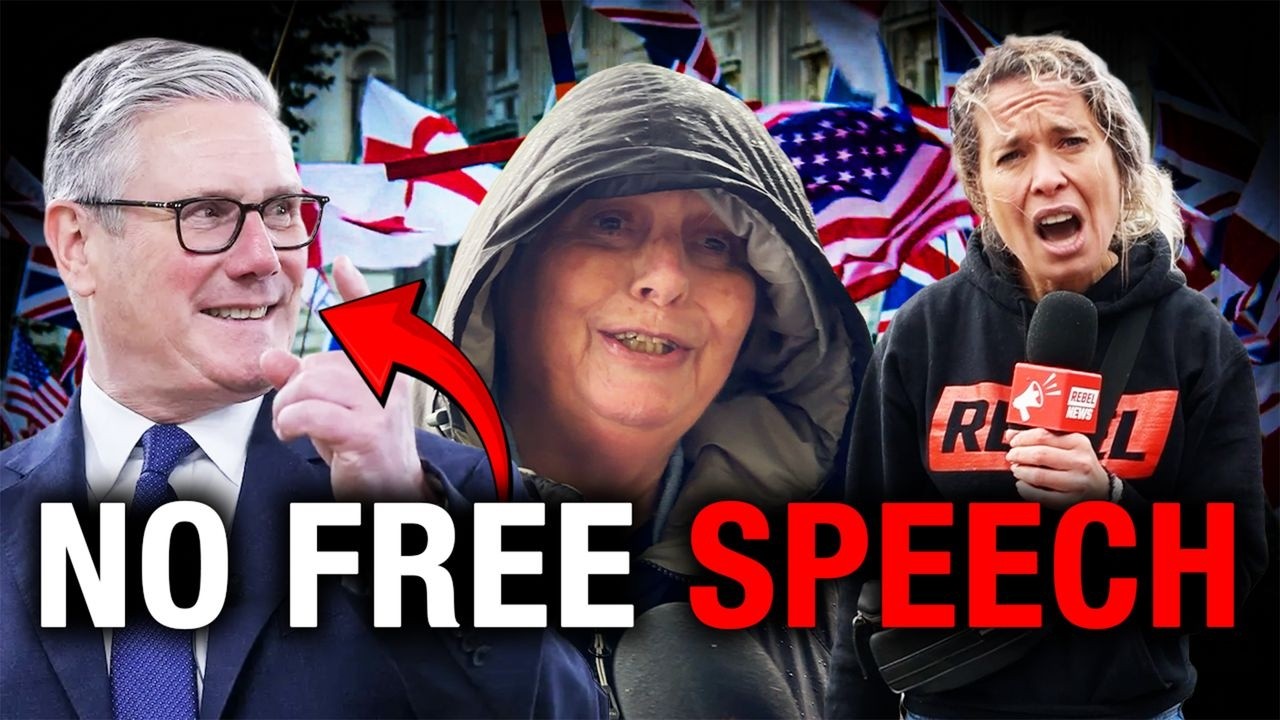
The facts, stark and unambiguous, demand serious reflection. According to official announcements, the Home Office imposed entry bans on 11 foreign nationals in advance of the May 16 “Unite the Kingdom” rally in central London. Among those barred were journalists and commentators, including prominent media figures such as Rebel News founder Ezra Levant. The stated rationale was to prevent what the government characterized as an “extremist” gathering—language that Prime Minister Starmer himself amplified in public remarks.
Starmer did not merely describe the rally as controversial; he escalated the rhetoric to existential proportions, framing it as “a battle for the soul of our nation.” In doing so, he elevated a domestic political demonstration into a matter of national crisis, thereby justifying, in his view, extraordinary measures. Yet it is precisely this escalation—both rhetorical and operational—that has drawn the most intense criticism.
For what followed was not the quiet containment of a fringe event, but rather a spectacle of state power deployed on a scale typically reserved for moments of acute national emergency. The Metropolitan Police mobilized more than 4,000 officers, supplemented by drones, mounted units, canine teams, and, most controversially, live facial recognition technology. These are not tools ordinarily associated with the management of peaceful political expression; they are instruments of surveillance and control, deployed here against citizens exercising their right to assemble.
And yet, despite—or perhaps because of—this formidable display of authority, the rally proceeded with a scale and intensity that appears to have caught the government off guard. Initial police estimates had anticipated a turnout of approximately 50,000 participants. In reality, the crowd swelled far beyond those projections, with some estimates placing attendance in the tens of thousands and others suggesting numbers approaching the hundreds of thousands. The precise figure may be contested, but the visual reality was unmistakable: London’s streets were filled with demonstrators, and the government’s attempt at containment had manifestly failed.
The implications of this sequence of events are both immediate and far-reaching. At its core, the decision to ban journalists—particularly foreign journalists—represents a direct affront to the principles of transparency and accountability that underpin democratic governance. It is one thing to regulate entry on grounds of national security; it is quite another to exclude members of the press in order to shape or suppress the narrative surrounding a political event.
As critics have pointed out, “You don’t ban foreign journalists to stop a fringe event. You ban foreign journalists when you’re afraid of what the footage will show.” This observation, stark in its simplicity, captures the essence of the controversy. The act of exclusion, far from neutralizing the rally’s impact, conferred upon it a new and potent significance: that of a struggle not merely over policy, but over the very boundaries of permissible discourse.
Indeed, the government’s actions appear to have furnished rally organizers with precisely the narrative they needed to amplify their message. “Every ban Starmer issued handed organizers a government-censorship narrative,” one observer noted. “Every officer deployed turned a political rally into a national confrontation.” In this sense, the government’s strategy did not merely fail; it actively contributed to the expansion and intensification of the very movement it sought to contain.
The context in which these events unfolded only deepens their significance. The rally occurred just days after a dramatic electoral setback for the Labour Party, in which Reform UK secured more than 1,350 council seats and gained control of 13 councils. These results, achieved in a single election cycle, represented a substantial erosion of Labour’s local government base, with losses concentrated in key regions such as Essex and Sunderland.
Rather than responding to this political shift with introspection or recalibration, the government appears to have adopted a posture of confrontation. The labeling of the rally as “extremist” and “hatred and division” was not merely descriptive; it was strategic, intended to delegitimize the event and its participants. Yet such language, when deployed against a large and visibly diverse crowd, risks undermining the credibility of those who use it.
For the images broadcast across domestic and international media told a different story: one of mass participation, civic engagement, and, above all, visibility. Starmer may have characterized the moment as “a battle for the soul of our nation,” but in the arena of public perception, it was the demonstrators who appeared to seize the initiative. The “visual battle,” as some have described it, was not won in the corridors of power but in the streets of London, where the scale of the turnout rendered attempts at marginalization implausible.
Equally troubling is the apparent inconsistency in the government’s approach to public demonstrations. While the “Unite the Kingdom” rally was subjected to extraordinary scrutiny and restriction, a rival pro-Palestine march was permitted to proceed on the same day. This disparity raises legitimate questions about the criteria by which events are assessed and regulated. If the principles of free expression and assembly are to retain their meaning, they must be applied consistently, not selectively.
The deployment of advanced surveillance technologies, including live facial recognition, further compounds these concerns. Such tools, while potentially valuable in specific security contexts, carry significant implications for civil liberties. Their use in the context of a political demonstration signals a willingness to normalize practices that, in other circumstances, would be regarded as deeply intrusive.
The broader trajectory suggested by these developments is one of increasing tension between state authority and public dissent. The combination of restrictive measures, expansive rhetoric, and visible enforcement creates an environment in which political opposition is not merely contested but actively constrained. This is not a path that any democratic society should tread lightly.
It is also a path that carries inherent risks for those who pursue it. As the events of May 16 demonstrate, attempts to suppress or delegitimize opposition can produce precisely the opposite effect, drawing greater attention to the issues at stake and mobilizing a wider constituency. “The suppression didn’t shrink the movement—it advertised it,” as one analysis succinctly observed.
In this sense, the government’s response may have accelerated a process of political realignment already underway. The electoral gains of Reform UK and the mass turnout at the rally are not isolated phenomena; they are interconnected expressions of a shifting political landscape. By responding to these developments with measures that appear heavy-handed and exclusionary, the government risks reinforcing the very dynamics it seeks to counter.
The role of the press in this context cannot be overstated. A free and independent media is essential not only for informing the public but for holding power to account. The decision to exclude journalists—particularly on grounds that appear to be political rather than security-related—strikes at the heart of this function. It is a precedent that, if left unchallenged, could have far-reaching implications for the future of democratic discourse in the United Kingdom.
Ultimately, the events surrounding the “Unite the Kingdom” rally represent more than a single episode; they are a lens through which to examine the evolving relationship between government, media, and the public. They raise fundamental questions about the limits of state authority, the resilience of democratic norms, and the capacity of societies to navigate periods of political upheaval without sacrificing core principles.
For Prime Minister Starmer, the episode stands as a cautionary tale. In seeking to control the narrative, he may have inadvertently amplified it. In attempting to suppress a demonstration, he may have transformed it into a symbol. And in banning journalists, he may have drawn more attention to the very images he sought to prevent from being seen.
As one commentator put it with striking clarity: “This isn’t a fringe moment. This is what a political realignment looks like in the streets.” Whether that assessment proves accurate in the long term remains to be seen. What is certain, however, is that the decisions made in moments such as these will shape not only immediate outcomes but the broader contours of democratic life for years to come.



