




















|
Getting your Trinity Audio player ready...
|
Wartime Scandal Explodes as Naftali Bennett Accuses Netanyahu of Qatar Ties
By: Tzirel Rosenblatt
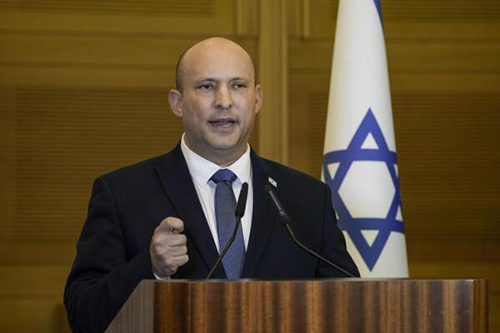
Israel’s already turbulent political landscape was jolted anew on Monday as former Prime Minister Naftali Bennett leveled some of the gravest accusations ever uttered against a sitting Israeli leader, charging Prime Minister Benjamin Netanyahu with overseeing—or at minimum concealing—what Bennett described as “the most serious act of treason in Israeli history.” The claims, tied to the expanding “Qatargate” affair, have ignited fierce debate across the political spectrum and raised profound questions about governance, accountability, and national security at a moment of existential strain for the Jewish state.
According to a report on Monday at VIN News, Bennett’s statement followed fresh media revelations alleging that senior advisers in Netanyahu’s office maintained improper financial and political ties to Qatar during the height of Israel’s war against Hamas. In a sharply worded declaration, Bennett asserted that Netanyahu’s inner circle had “betrayed the State of Israel and IDF soldiers during wartime,” accusing them of acting “on behalf of Qatar for financial gain,” while Netanyahu himself, Bennett alleged, worked to suppress the truth.
“Whether Netanyahu knew or did not know that his office was working for the enemy in time of war, both possibilities require his immediate resignation,” Bennett said, in remarks quoted in the VIN News report. The formulation was deliberate and devastating: either scenario, Bennett argued, represents a catastrophic failure of leadership incompatible with continued service as prime minister.
At the core of the Qatargate allegations is the claim that three of Netanyahu’s closest advisers were effectively operating as paid agents for Qatar—and by extension, for Hamas—during an active conflict in which Israeli soldiers were fighting and dying. Bennett did not mince words. He alleged that these advisers were advancing the interests of a state that openly bankrolls Hamas, even as Israeli troops were being killed by weapons purchased with Qatari funds. Bennett framed this not merely as a policy dispute, but as a moral and strategic betrayal with blood-soaked consequences.
“This can certainly explain why the Israeli government failed in the ultimate goal it set for itself in the war: the destruction of Hamas,” Bennett said, tying the alleged misconduct directly to what many Israelis already view as an unfulfilled wartime objective. Qatar’s declared interest, Bennett emphasized, is Hamas’s survival; Israel’s stated goal is its eradication. “They chose sides,” he said. “Instead of acting for Israel, they acted for Israel’s enemies.”
The gravity of Bennett’s accusations is magnified by the timing. Israel remains embroiled in a multi-front conflict, with the Gaza war still reverberating domestically and internationally, hostages yet to be returned, and northern and southern borders under constant threat. Against this backdrop, any suggestion that senior figures within the Prime Minister’s Office may have been compromised by a foreign power—particularly one aligned with Hamas—cuts to the heart of Israel’s national trauma since October 7.
As VIN News has reported, Bennett went further, accusing Netanyahu’s office of systematically working to malign Egypt—a regional actor widely regarded as hostile to Hamas—while simultaneously “whitewashing” Qatar’s role. Such conduct, Bennett argued, actively harmed Israel’s strategic interests by undermining cooperation with an anti-Hamas partner and legitimizing a pro-Hamas patron. Even if the actions of Netanyahu’s staffers ultimately fall short of criminal culpability, Bennett insisted, they constitute an unforgivable ethical and security breach: “a betrayal of our soldiers.”
The former prime minister’s rhetoric was unmistakably calibrated not only to indict Netanyahu but also to position Bennett himself as a future alternative. Having signaled his intention to return to frontline politics, Bennett pledged that if elected to lead Israel’s next government, he would establish a state commission of inquiry with broad investigative powers. Such a commission would examine not only the Qatargate affair but also the wider question of “aid to an enemy state in time of war”—language that underscores the unprecedented severity with which Bennett views the allegations.
The Qatargate scandal itself remains under active investigation by Israeli authorities. The allegations center on claims that individuals close to Netanyahu received payments linked to Qatar while promoting its interests within Israel’s corridors of power. Netanyahu has categorically denied any wrongdoing, dismissing the probes as politically motivated and accusing his opponents of exploiting wartime sensitivities to score partisan points. His office has yet to respond in detail to Bennett’s latest statements, but allies have portrayed the former prime minister’s remarks as reckless, inflammatory, and destabilizing.
Still, the political and public resonance of Bennett’s accusations cannot be easily dismissed. The language he employed—“treason,” “enemy,” “betrayal”—is almost without precedent in modern Israeli discourse when directed at a sitting prime minister. As the VIN News report observed, such terms are not merely rhetorical flourishes; they invoke the deepest fears of a society forged in war and sustained by the principle of collective responsibility.
Legal experts caution that allegations of treason carry a specific and stringent definition under Israeli law, one that requires proof of intent and concrete actions taken to aid an enemy during wartime. Whether the actions attributed to Netanyahu’s advisers meet that threshold remains an open question. Yet, as analysts told VIN News, Bennett’s argument is as much moral as it is legal. He is accusing Netanyahu of presiding over a system so compromised that even ignorance would constitute disqualifying negligence.
The controversy also casts a harsh spotlight on Qatar’s long-standing and deeply ambivalent role in the region. For years, Qatar has positioned itself as a mediator between Israel and Hamas, hosting Hamas leaders in Doha while also facilitating the transfer of funds into Gaza—often with Israel’s tacit consent—to maintain calm. Critics, including Bennett, argue that this arrangement empowered Hamas and prolonged its rule. Supporters counter that Qatari mediation was a pragmatic necessity in the absence of better alternatives. The Qatargate allegations threaten to reframe this entire policy paradigm as not merely flawed but dangerously compromised.
Public reaction has been swift and polarized. Families of fallen soldiers and hostages have demanded transparency, while opposition figures have echoed Bennett’s call for accountability. Netanyahu’s supporters, meanwhile, accuse Bennett of exploiting national grief and wartime anger to rehabilitate his own political fortunes. The resulting clash has deepened existing fissures within Israeli society, already strained by judicial reform battles, security failures, and questions of leadership credibility.
What is undeniable is that the Qatargate affair strikes at the core of public trust. In a country where military service is nearly universal and the social contract is inseparable from national defense, any suggestion that leaders may have placed foreign interests above Israeli lives is uniquely corrosive.
As investigations continue, the immediate political future remains uncertain. Will Netanyahu weather yet another storm, as he has so many times before? Or has Bennett’s intervention marked a turning point, transforming simmering suspicion into an existential challenge to Netanyahu’s leadership?
For now, Israel stands at a crossroads. The allegations aired by Bennett demand answers that go beyond partisan loyalties. They compel a reckoning with how power is exercised, how conflicts of interest are policed, and how a nation at war safeguards its moral compass. Whether Qatargate ultimately proves to be a scandal of criminal dimensions or a political conflagration fueled by mistrust, its impact on Israel’s political psyche is already profound—and likely irreversible.



