






























|
Getting your Trinity Audio player ready...
|
By: Fern Sidman
In a striking rebuttal to one of the most emotionally charged narratives emerging from the Gaza conflict, the Israel Defense Forces (IDF) on Sunday released documentary evidence refuting international media claims that young Palestinian children were victims of starvation allegedly caused by Israeli policy. The IDF’s Coordinator of Government Activities in the Territories (COGAT) revealed that two children whose images have circulated widely in global outlets, and who were described as suffering from famine, are in fact afflicted by rare genetic conditions unrelated to the war.
According to a report that appeared on Israel National News (INN), the revelations shine a harsh spotlight on what Israel describes as a deliberate disinformation campaign orchestrated by Hamas and amplified uncritically by segments of the international press. The IDF insists that such mischaracterizations, though emotionally compelling, distort the truth of the conflict and manipulate global audiences into assigning Israel blame for tragedies it did not cause.
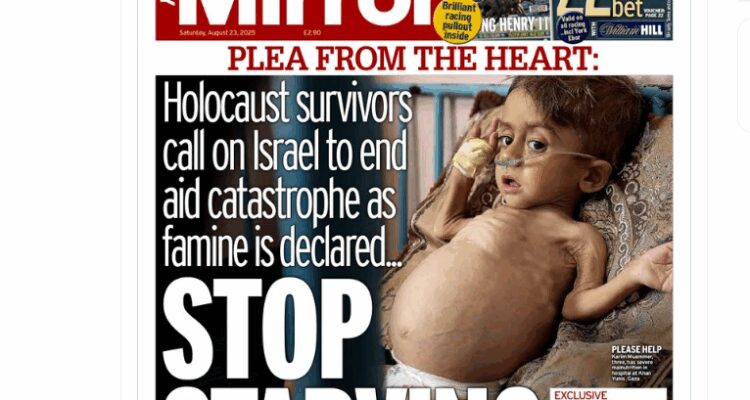
The controversy escalated over the weekend when the UK’s Daily Mirror splashed across its Saturday front page the image of three-year-old Karim Ali Fouad Abu Mu’amar. The headline suggested that Karim was a victim of famine in Gaza, purportedly caused by Israel’s blockade and military operations.
Within 24 hours, the IDF countered the report with evidence that Karim’s condition is medical, not nutritional. “The Facts: Karim suffers from a genetic illness – Fanconi syndrome – which led to muscle and urinary tract weakness,” COGAT wrote in a detailed post on X, formerly Twitter.
As INN reported, Fanconi syndrome is a rare hereditary disorder affecting kidney function and metabolism. COGAT noted that Karim’s family has a history of the disease, with other relatives also afflicted. “This is a hereditary disease that affected other family members as well,” the IDF statement explained, rejecting the famine allegation as baseless.
“This case exemplifies how Hamas continues to spread false narratives as part of a deceptive propaganda campaign,” COGAT continued, “while media outlets around the world continue to serve as their platform without any verification.”
Karim’s story echoes a similar controversy from just weeks earlier, when the image of five-year-old Osama al-Rakab began circulating online as supposed evidence of children “starved by Israel.” International activists seized on the photograph, and social media platforms lit up with accusations of Israeli cruelty.
Yet, as INN revealed in its coverage, the truth was again starkly different. COGAT clarified that Osama suffers from a severe genetic condition wholly unrelated to the conflict. “The Facts: Osama suffers from a serious genetic illness unrelated to the war,” COGAT emphasized.
Far from being abandoned or denied care, the IDF underscored its role in facilitating Osama’s medical treatment abroad. On June 12, Israeli authorities coordinated his exit from Gaza, together with his mother and brother, through Ramon Airport. “He is now receiving treatment in Italy,” COGAT explained, stressing that Israel had actively ensured Osama’s medical needs were addressed despite the ongoing war.
According to the information provided in the INN report, this intervention illustrates Israel’s dual commitment: to continue prosecuting its war against Hamas, while simultaneously extending humanitarian corridors for medical emergencies.
Israeli officials argue that such cases demonstrate Hamas’s calculated use of misinformation as a weapon of war. By presenting children with congenital illnesses as famine victims, Hamas seeks to evoke visceral outrage in the international community and erode Israel’s moral standing.
“Tragic images rightfully stir strong emotions,” COGAT wrote in a statement, “but when they’re misused to fuel hatred and lies, they do more harm than good. Don’t let compassion be exploited for propaganda. Check the facts before parroting blame.”
The INN report highlighted the broader strategy at play: Hamas and its affiliates have long relied on emotive visuals to drive media narratives. By circulating harrowing images absent context, the group pressures international opinion to conflate Israel’s military campaign against Hamas with civilian suffering — even when the latter has wholly unrelated causes.
The IDF’s exposés have intensified criticism of international media outlets, many of which have been accused of disseminating Hamas-driven narratives without adequate fact-checking. The Daily Mirror’s front-page portrayal of Karim Abu Mu’amar as a famine victim is now being held up as a particularly egregious example.
As INN reported, critics argue that this failure to scrutinize Hamas-supplied information has become a recurring pattern. “Too often, media organizations rush to print highly charged images without conducting even minimal verification,” one Israeli official told INN. “In doing so, they unwittingly — or perhaps knowingly — become mouthpieces for terrorist propaganda.”
For Israel, the stakes are not merely reputational but strategic. Misleading reports about alleged starvation feed into international campaigns to delegitimize Israel, amplify calls for sanctions, and fuel anti-Israel sentiment worldwide.
The IDF’s documentation is part of a larger effort to distinguish between the real humanitarian needs in Gaza — which Israel acknowledges and works to alleviate — and the fictitious narratives constructed for political ends.
INN has documented numerous cases in which Israel has facilitated the transfer of food, medical supplies, and patients out of Gaza, even in the midst of intense fighting. Israeli officials argue that such efforts are systematically erased or ignored by outlets that prefer narratives portraying Israel as deliberately starving civilians.
Indeed, the reality of children with tragic genetic illnesses does not diminish the legitimate suffering in Gaza caused by war. But, as the IDF emphasizes, attributing every case of medical distress to Israeli policy is neither truthful nor helpful in resolving genuine humanitarian issues.
The IDF’s revelations underscore an urgent call for greater accountability among international media organizations. By failing to differentiate between medical tragedies and war-induced suffering, outlets risk both undermining their own credibility and fanning the flames of antisemitic incitement.
According to the information contained in the INN report, Israeli officials are urging media outlets to apply the same standards of verification to Palestinian claims as they would to any other conflict. “Journalism requires skepticism,” one senior official remarked, “but too often we see a suspension of critical judgment when it comes to Hamas-supplied stories.”
The misuse of children’s suffering, officials add, is particularly egregious. Exploiting congenital diseases to indict Israel is seen not only as propaganda but also as a profound moral failing that instrumentalizes innocent lives for political gain.
The cases of Karim Abu Mu’amar and Osama al-Rakab represent more than isolated misreports; they epitomize a broader battle over truth in the Gaza war. As Israel National News has consistently emphasized, Israel faces not only a military confrontation with Hamas but also a propaganda war in which disinformation is a principal weapon.
By exposing the factual medical histories of these children, Israel seeks to remind the world that compassion must be rooted in truth, not manipulation. In the words of COGAT: “Tragic images rightfully stir strong emotions, but when they’re misused to fuel hatred and lies, they do more harm than good.”
As the war grinds on, the global audience — and the media that inform it — will face a crucial choice: to scrutinize, verify, and report responsibly, or to become unwitting conduits of deception in one of the world’s most enduring conflicts.



