
















By: Rufus McGee
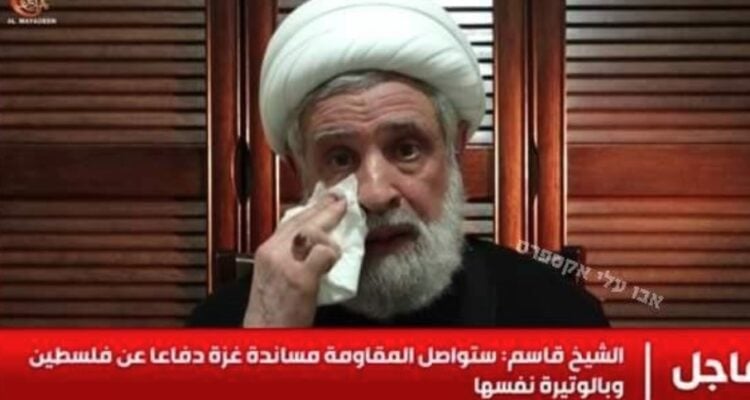
Hezbollah Secretary-General Naim Qassem has forcefully rejected any proposal that would allow Israel to maintain security buffer zones inside southern Lebanon, declaring that neither permanent nor temporary Israeli-controlled areas will be accepted and reiterating his organization’s longstanding demand for a complete Israeli withdrawal from all Lebanese territory.
The remarks, reported on Wednesday by Al Jazeera and widely circulated throughout the region, underscore the continuing volatility along the Israel-Lebanon frontier and highlight the formidable diplomatic obstacles confronting efforts to establish a durable security arrangement following months of cross-border hostilities.
Qassem’s comments arrive at a particularly sensitive moment, as regional and international mediators continue exploring mechanisms designed to reduce tensions along one of the Middle East’s most combustible fault lines. While military activity has fluctuated in intensity over recent months, the fundamental disagreements between Israel, Lebanon, and Hezbollah regarding border security, territorial sovereignty, and long-term strategic arrangements remain largely unresolved.
According to the Al Jazeera report, Qassem categorically dismissed the notion of any Israeli-controlled security zones in southern Lebanon, arguing that such proposals would represent an unacceptable infringement upon Lebanese sovereignty.
“There will be no yellow zones and no red zones,” Qassem declared, according to Al Jazeera’s reporting, signaling Hezbollah’s unequivocal opposition to any arrangement that would permit a continuing Israeli presence or special security corridor inside Lebanese territory.
The statement reflects one of Hezbollah’s most consistent positions throughout decades of conflict with Israel: that any Israeli military presence on Lebanese soil is unacceptable and must ultimately end.
The dispute over buffer zones has long occupied a central place in discussions concerning security along the northern Israeli border.
Israeli officials have repeatedly argued that enhanced security measures near the frontier are necessary to protect communities in northern Israel from attacks, infiltrations, rocket fire, and other security threats. Israeli policymakers frequently point to years of hostilities and the presence of heavily armed Hezbollah forces near the border as evidence that additional safeguards may be required.
Supporters of stronger border security measures contend that civilian populations in northern Israel have repeatedly endured significant disruptions and security threats stemming from instability along the frontier.
Israeli officials have therefore maintained that any long-term arrangement must include mechanisms capable of preventing renewed military buildup near the border.
However, Lebanese authorities and Hezbollah have consistently rejected such proposals.
According to the Al Jazeera report, Qassem’s latest remarks emphasized that Hezbollah views buffer zones not as legitimate security measures but as violations of Lebanese territorial integrity.
For Hezbollah and many of its supporters, the issue extends beyond military considerations and touches upon broader questions of national sovereignty, territorial rights, and resistance to foreign military presence. The disagreement illustrates the profound challenges facing diplomatic negotiators attempting to stabilize the border.
Even when both sides express support for reducing violence, they frequently disagree regarding the fundamental architecture of any future security framework. What one side views as a necessary defensive measure, the other often perceives as an infringement upon sovereign rights.
Al Jazeera noted that Qassem’s comments come amid ongoing discussions regarding regional security arrangements that could potentially influence future ceasefire efforts and broader diplomatic initiatives.
The stakes extend far beyond the immediate border area.
The Israel-Lebanon frontier has historically served as one of the most sensitive geopolitical flashpoints in the Middle East. Periods of relative calm have repeatedly been interrupted by outbreaks of violence, military exchanges, and political crises that reverberate throughout the region.
The latest dispute highlights how fragile the security environment remains.
Although international actors have devoted considerable resources to preventing a wider regional escalation, the underlying issues that fuel tensions have not disappeared.
Questions regarding military deployments, border demarcation, deterrence, and sovereignty continue to generate profound disagreements among the parties involved.
Al Jazeera’s reporting indicates that Hezbollah remains firmly committed to its position that Israel must withdraw completely from what the organization regards as Lebanese territory. That demand has been a recurring theme in Hezbollah’s public messaging for many years and remains central to its strategic narrative.
For Hezbollah, maintaining pressure on Israel regarding territorial issues serves both political and ideological purposes. The Iranian-backed terror organization has historically portrayed itself as a resistance movement dedicated to defending Lebanese territory and confronting Israeli military influence.
As a result, concessions regarding border arrangements are often viewed within Hezbollah as politically unacceptable.
The broader regional context further complicates the situation. The Middle East remains in a period of significant uncertainty, with multiple conflicts, diplomatic negotiations, and shifting alliances unfolding simultaneously.
Developments involving Gaza, Iran, Syria, and other regional actors continue to influence calculations on both sides of the Israel-Lebanon border. Consequently, local security disputes cannot easily be separated from wider geopolitical dynamics.
Many analysts believe that progress in one area could affect negotiations elsewhere, while setbacks could quickly reverberate throughout the broader region. The latest comments reported by Al Jazeera therefore carry implications beyond the immediate dispute over buffer zones. They provide insight into Hezbollah’s negotiating posture and offer a reminder of how difficult it may be to secure a comprehensive and lasting arrangement acceptable to all parties.
Diplomatic efforts aimed at reducing tensions generally require compromise. Yet Qassem’s remarks suggest that Hezbollah sees little room for compromise when it comes to the question of Israeli-controlled zones inside Lebanon. That position may complicate future mediation efforts.
International diplomats have frequently emphasized the importance of confidence-building measures, security guarantees, and mutually acceptable arrangements designed to reduce the risk of renewed conflict. However, such initiatives often depend upon flexibility from all sides.
The categorical nature of Qassem’s rejection indicates that at least one significant area of disagreement remains firmly entrenched. At the same time, Israeli officials continue to stress their own security concerns. They argue that any future arrangement must effectively address threats to communities living near the border and prevent conditions that could lead to renewed hostilities.
The resulting impasse illustrates why the frontier remains one of the most difficult security challenges in the region. Neither side appears prepared to abandon core positions that it regards as essential to national security and political legitimacy.
As reported by Al Jazeera, Qassem’s latest statement serves as a stark reminder that despite ongoing diplomatic efforts, fundamental disagreements continue to divide the parties involved.
The debate over buffer zones is ultimately about more than geography. It encompasses competing visions of security, sovereignty, deterrence, and regional order. Until those broader issues are addressed, the prospects for a comprehensive and enduring settlement along the Israel-Lebanon border are likely to remain uncertain.
For now, Hezbollah’s message appears unmistakable: the organization rejects any Israeli-controlled buffer zone in southern Lebanon and insists that only a complete Israeli withdrawal can form the basis for a future arrangement. Whether diplomatic negotiations can bridge that divide remains one of the most consequential unanswered questions facing the region today.



