











Israeli Flag Dispute at World Cup Match Sparks Controversy Over FIFA Rules and Double Standards
By: Chaya Abecassis
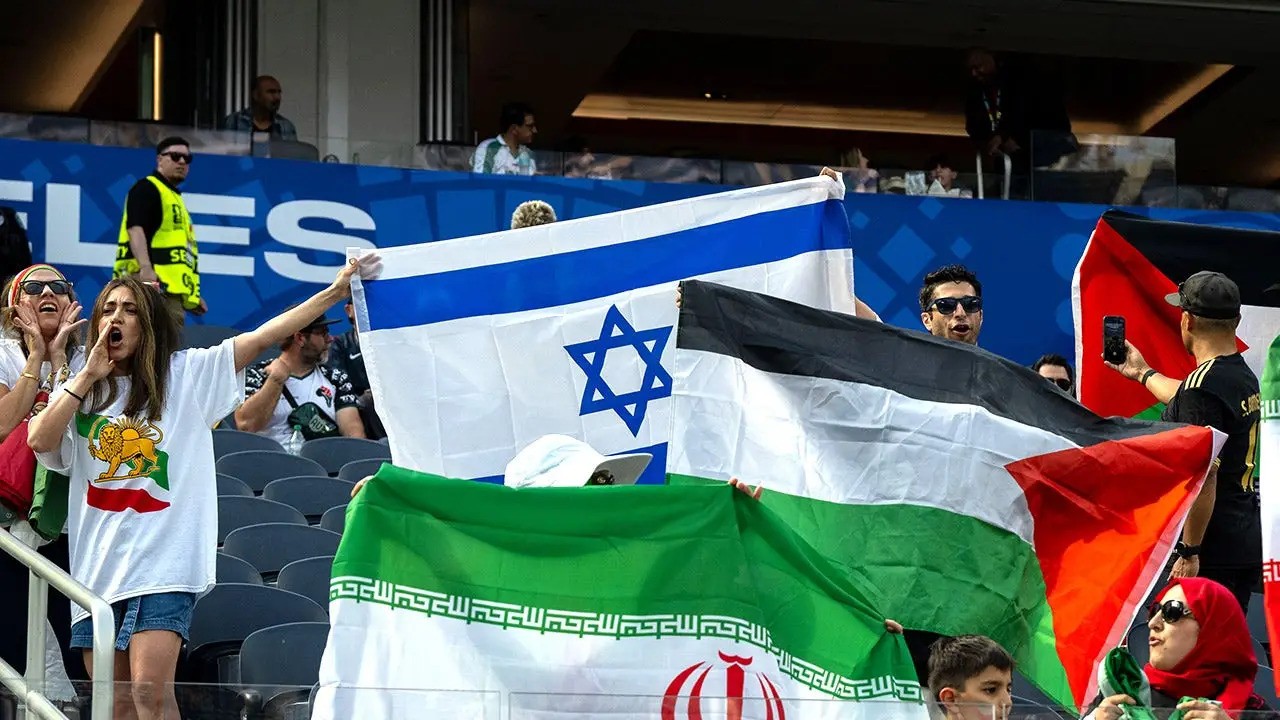
A contentious confrontation at the FIFA World Cup has ignited a fresh debate over the application of tournament regulations, freedom of expression in international sporting venues, and allegations of inconsistent enforcement after a video circulating on social media appeared to show security personnel confronting a spectator displaying an Israeli flag during a match between Iran and New Zealand at SoFi Stadium.
The incident, which rapidly spread across multiple social media platforms and generated intense online discussion, has become the latest flashpoint in the increasingly complex intersection of sports, politics, national identity, and security policy at major international competitions.
According to a report on Wednesday in The New York Post, the video depicts a man draped in an Israeli flag engaging in a prolonged exchange with several stadium security personnel. During the encounter, the fan repeatedly questioned why Palestinian flags visible elsewhere inside the venue appeared to be permitted while security officers were allegedly directing him to remove, conceal, or otherwise discontinue displaying the Israeli flag.
The footage, which has generated hundreds of thousands of views and extensive commentary across social media, appears to capture the fan accusing officials of enforcing a double standard.
At several points during the exchange, the individual characterized the situation as discriminatory and suggested that the differing treatment constituted antisemitism.
“Why are those flags allowed?” the fan repeatedly asked, referring to Palestinian flags reportedly visible elsewhere in the stadium.
The incident has quickly become a subject of intense public debate, particularly given the highly charged geopolitical environment surrounding the tournament and the broader international attention focused on the Middle East.
The New York Post has frequently reported on controversies involving political symbolism at major sporting events, where organizers often find themselves balancing competing concerns involving free expression, public safety, and regulations designed to maintain political neutrality.
In the video, security personnel largely avoided engaging directly with the fan’s political arguments.
Instead, the officers repeatedly emphasized that they were enforcing event policies rather than making political judgments.
According to the footage, one security official appeared to explain that only flags representing teams actively participating in the match would be permitted within the venue.
That explanation suggested the issue may have centered on tournament regulations rather than the specific national identity represented by the Israeli flag itself.
However, the explanation immediately generated further questions among observers because it did not appear to address the fan’s central complaint.
If Palestinian flags were indeed visible throughout the stadium, critics argued, then questions naturally arise regarding whether the same rules were being applied consistently.
That unresolved issue has become the focal point of much of the controversy.
Supporters of the fan contend that the apparent discrepancy warrants further explanation.
Some observers argue that if FIFA regulations prohibit the display of non-participating national flags or politically sensitive symbols, those restrictions should be enforced uniformly regardless of the specific flag involved.
Others maintain that isolated video clips may not capture the full context of what occurred and caution against drawing definitive conclusions without additional evidence.
The New York Post documented how disputes involving flags, symbols, and political messages have become increasingly common at major international sporting competitions.
Global tournaments attract supporters from diverse political, cultural, and national backgrounds, often transforming sporting venues into arenas where broader geopolitical tensions become visible.
The Iran-New Zealand match presented particularly unique circumstances.
Any contest involving Iran inevitably attracts heightened attention from members of the Iranian diaspora, political activists, human rights advocates, and supporters of various causes connected to developments in the Middle East.
As a result, security personnel often face complex challenges when attempting to distinguish between expressions of national identity and political demonstrations.
FIFA’s longstanding commitment to political neutrality has repeatedly been tested in such environments.
The organization has traditionally maintained rules restricting political banners, slogans, demonstrations, and symbols within official venues.
Supporters of those restrictions argue that sporting events should remain focused on athletic competition rather than political disputes.
Critics counter that sports and politics have been intertwined throughout modern history and that efforts to separate them often produce inconsistent outcomes.
The latest controversy appears to fall squarely within that broader debate.
The fan featured in the video maintained throughout the encounter that the Israeli flag should be treated no differently than other national symbols displayed inside the stadium.
According to the footage, he repeatedly challenged security officials to explain what he viewed as unequal treatment. Security personnel, meanwhile, largely confined their responses to references to event policies and venue regulations.
Notably, FIFA had not publicly commented on the incident at the time the video gained widespread attention. The absence of an official explanation has contributed to ongoing speculation and competing interpretations regarding what precisely occurred.
Some observers have called upon FIFA to clarify whether any specific policy was violated and whether identical enforcement measures were applied to all flags displayed during the match.
Others argue that stadium security personnel often must make rapid decisions in crowded environments and that isolated incidents should not automatically be interpreted as evidence of institutional bias.
The broader significance of the controversy extends beyond a single flag or a single match.
The incident highlights the increasingly difficult task facing international sports organizations as geopolitical conflicts become more visible within global sporting events.
Major tournaments now unfold in an environment shaped by social media, instantaneous video distribution, and heightened political polarization.
As a result, even relatively brief interactions between fans and security personnel can quickly become international controversies.
For supporters of Israel, the video has raised concerns regarding whether Israeli symbols receive equal treatment in international venues. For others, the incident underscores the challenges of implementing tournament regulations consistently across enormous events attended by tens of thousands of spectators.
The New York Post has documented similar disputes in recent years involving a variety of national, political, and ideological symbols. Each incident has fueled broader debates regarding fairness, neutrality, and freedom of expression.
As the World Cup continues, the controversy surrounding the Iran-New Zealand match serves as another reminder that the world’s largest sporting competitions often become stages for conversations extending far beyond the field of play.
Whether the dispute ultimately proves to be a misunderstanding, an enforcement inconsistency, or evidence of a broader problem remains uncertain.
What is clear is that the video has struck a nerve among many observers and has generated questions that tournament organizers may eventually be compelled to address.
Until FIFA offers a public explanation, the incident is likely to remain a source of discussion among fans, commentators, and advocates on all sides of the debate.



