
















|
Getting your Trinity Audio player ready...
|
By: Jeff Gorman
By any cinematic metric, the scene that unfolded Monday morning inside a packed federal courtroom in Lower Manhattan would have strained credulity had it been scripted for film. Yet, as The New York Post reported repeatedly throughout the day, this was not fiction. It was the historic first appearance in U.S. custody of Nicolás Maduro Moros, the toppled Venezuelan strongman once thought untouchable, now clad in orange prison garb, shackled at the ankles, and insisting to the world that he was “a decent man” who had been “kidnapped.”
The Post described the extraordinary tableau: the 63-year-old former president entering the courtroom flanked by U.S. marshals, headphones perched on his ears to capture the English-to-Spanish translation, greeting reporters with a disarmingly casual “Happy New Year,” as if arriving at a diplomatic summit rather than an arraignment on charges that include narco-terrorism conspiracy, cocaine importation and weapons offenses.
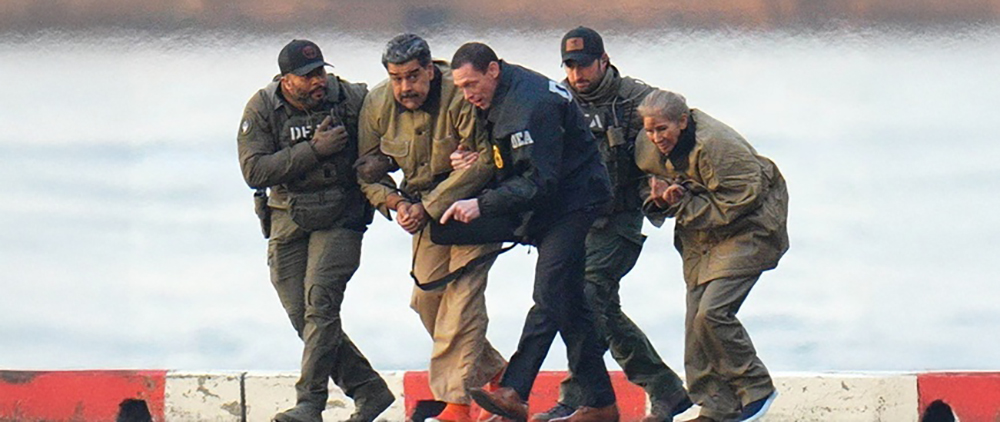
Maduro’s courtroom appearance followed what The New York Post repot called a “made-for-Hollywood” operation just two days earlier, when U.S. forces seized him and his wife, Cilia Flores, from Caracas in a predawn mission that instantly destabilized Venezuela and electrified global politics. By Monday, the man who once presided over rallies in Miraflores Palace was sitting in a jury box repurposed for media overflow, scribbling furiously on a blank sheet of paper as the full weight of American justice bore down upon him.
When 92-year-old U.S. District Judge Alvin K. Hellerstein asked him to confirm his identity, Maduro launched into a monologue worthy of the balcony at the United Nations.
“I am the president of the republic of Venezuela… I am here kidnapped,” he proclaimed in Spanish, according to the Post, forcing the judge to interrupt.
“Let me interfere,” Hellerstein replied with judicial patience. “There will be a time and a place to go into all of this.”
Pressed again, Maduro finally acknowledged: “I am Nicholas Maduro Moros.”
The New York Post report noted the uncanny persistence of Maduro’s presidential posture. Even as the judge read the charges—alleging that from 1999 through 2025 he conspired to provide material support to terrorist organizations—Maduro maintained the cadence of a head of state addressing an assembly, repeatedly interjecting, “I am innocent. I am not guilty. I am a decent man. I am still president of my country.”
It was theater layered upon tragedy: a man accused of overseeing a criminal empire stretching across continents insisting on the trappings of legitimacy, even while bound by the federal system he once denounced.
His attorney, Barry Pollack—the same lawyer who famously brokered the release of WikiLeaks founder Julian Assange—raised questions about the legality of Maduro’s capture, though he stressed that his client was not currently seeking immediate release. Judge Hellerstein, an appointee of former President Bill Clinton and a jurist with a reputation for steely independence, reminded the defendant of his rights, including the option of court-appointed counsel.
“I did not know of these rights,” Maduro replied, in a moment the Post report described as almost surreal.
Moments later, Maduro’s wife entered the courtroom for her own arraignment. The Post reported that Cilia Flores, 69, appeared with her blond hair tied in a tight bun, bandages on her eyelid and temple—injuries her lawyer attributed to the circumstances of her capture.
When asked to identify herself, she replied not with her name, but with a title: “I am the first lady of the Republic of Venezuela.” She, too, pleaded complete innocence.
Together, the couple embodied a dynasty that once seemed immovable, now reduced to co-defendants in a Manhattan courtroom.
The drama did not end inside the courthouse walls. As The New York Post report detailed, several hundred protesters gathered outside the federal building, divided into sharply antagonistic camps. On one side were left-wing activists decrying Maduro’s capture as imperial overreach; on the other, Venezuelan and Cuban expatriates who had fled authoritarian regimes and came to cheer his downfall.
The NYPD erected barricades to prevent clashes, but words still flew like shrapnel.
“Today we are here happy because he’s going to face justice,” said Rafael Escalante, a Venezuelan American quoted by the Post. Nearby, Dario Blanzo, who emigrated from Cuba, shouted angrily at pro-Maduro demonstrators, accusing them of ignorance about life under dictatorship.
Inside the courtroom, that tension briefly erupted when a man identified as Pedro Rojas stood up and heckled Maduro in Spanish, calling him an illegitimate president who would now face “real justice.” The deposed leader turned and replied, “I am a man of God” and “I am a prisoner of war” as marshals escorted him out.
The indictment against Maduro is staggering in scope. As the Post report summarized, he is accused of orchestrating a narco-terrorist conspiracy spanning more than two decades—allegedly working with militant groups, traffickers and corrupt officials to flood the United States with cocaine while financing terrorism.
The charges carry potential life sentences and, in certain counts, the possibility of capital punishment. For a man who once derided U.S. courts as instruments of empire, the stakes could scarcely be higher.
Judge Hellerstein scheduled the next court date for March 17, setting the stage for a trial that may rival Noriega’s in historical consequence.
The New York Post reminded readers that Hellerstein is no stranger to high-profile political cases. He has ruled against President Trump in unrelated matters, including blocking the use of the Alien Enemies Act to deport undocumented migrants and rejecting attempts to move a hush-money case involving adult film actress Stormy Daniels into federal court.
That independence looms large now, as he presides over a defendant whose capture alone has already altered geopolitical alignments.
For now, Nicolás Maduro sits in a Brooklyn detention facility, stripped of the pageantry that once insulated him from consequence. Yet even in chains, he clings to the language of sovereignty, declaring himself kidnapped, a prisoner of war, a man of God.
What remains to be seen is whether this trial will mark the definitive end of his myth—or whether, as he himself seems determined to prove, the theater of defiance will continue until the final gavel falls.