



|
Getting your Trinity Audio player ready...
|
By: Fern Sidman
A night traditionally defined by wit, ceremony, and the symbolic convergence of political power and journalistic inquiry descended into chaos and fear on Saturday evening, as gunfire erupted during the White House Correspondents’ Dinner in Washington, prompting the immediate evacuation of President Donald Trump, First Lady Melania Trump, and senior members of the administration. The shocking breach of security at one of the capital’s most closely guarded events has ignited urgent questions regarding public safety, institutional vulnerability, and the evolving nature of domestic threats.
According to a detailed report by The New York Post on Saturday night, the suspect—identified as 31-year old Cole Allen, a teacher from Torrance, California—was swiftly apprehended after opening fire near the main security checkpoint of the Washington Hilton, the longstanding venue of the annual gathering. The suspect now faces multiple serious federal charges, including the use of a firearm during the commission of a violent crime and assault on a federal officer with a dangerous weapon.
US Attorney Jeanine Pirro said, “It is clear, based upon what we know so far, that this individual was intent on doing as much harm and as much damage as he could.”
Watch: Trump and JD Vance rushed from the stage
Close up footage shows Vice President JD Vance and President Trump being escorted from the stage as gunfire erupted at the White House Correspondents Dinner. @JDVance @realDonaldTrump #whitehousecorresoondentsdinner pic.twitter.com/aF761XPwOa
— The Jewish Voice (@TJVNEWS) April 26, 2026
The White House Correspondents’ Dinner, an institution steeped in decades of tradition, had drawn an array of prominent figures from across the political and media spectrum. The president was scheduled to deliver the customary keynote address, a moment often marked by a blend of humor and reflection on the relationship between the press and the presidency.
Yet, as the evening progressed and attendees settled into the early courses of the formal dinner, the atmosphere of conviviality was abruptly shattered. At approximately 8:36 pm, the sound of gunfire reverberated through the vicinity of the event’s primary screening area, triggering immediate alarm and confusion.
Eyewitness accounts, compiled by The New York Post, describe a scene of sudden panic as guests instinctively sought cover. Tables were overturned, and attendees crouched beneath them in an effort to shield themselves from potential harm. The rapid transition from ceremony to crisis underscored the fragility of even the most carefully orchestrated public events.
In accordance with established emergency protocols, security personnel acted with remarkable speed to secure the premises and evacuate high profile individuals. President Trump, alongside the First Lady and key members of his cabinet, was escorted from the venue under heavy protection. The efficiency of this response has been widely credited with preventing what could have escalated into a far more devastating incident.
The president later condemned the assailant in unequivocal terms, describing him as a deeply disturbed individual. His remarks, as reported by The New York Post, reflected both relief at the swift resolution of the immediate threat and outrage at the audacity of the attack.
Law enforcement officials have disclosed that Allen was equipped with an alarming array of weapons at the time of the incident. Interim Washington police chief Jeffrey Carroll confirmed that the suspect carried a shotgun, a handgun, and multiple knives as he advanced toward the security checkpoint. Such an arsenal suggests a level of premeditation that has intensified the seriousness with which authorities are approaching the investigation.
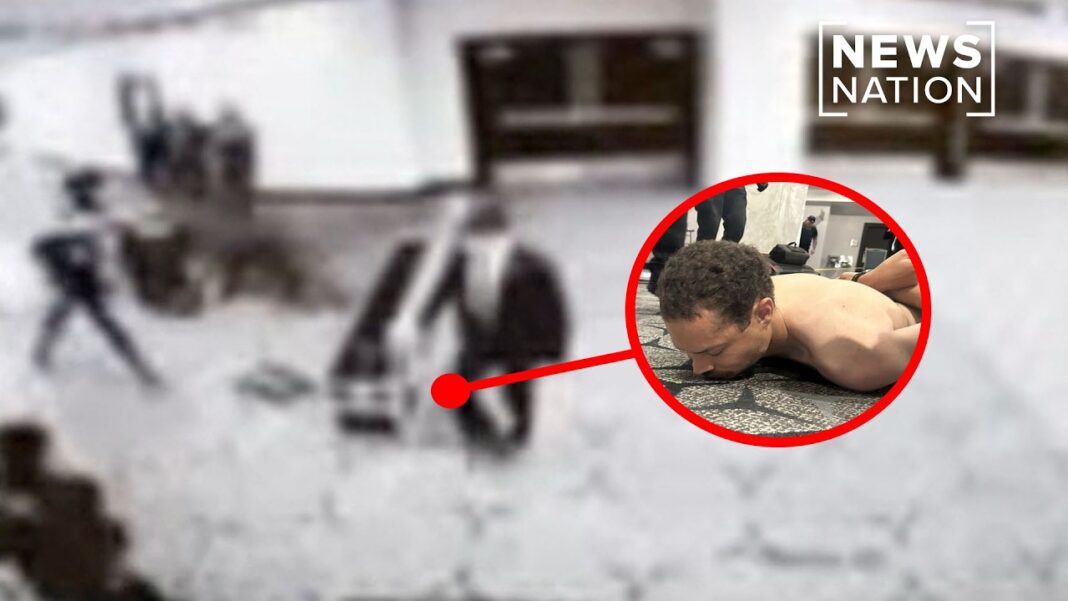
Photographs released in the aftermath, and described by The New York Post, depict the suspect lying face down on the floor, shirtless and restrained, a stark visual representation of the abrupt end to what could have been a catastrophic assault.
Despite the gravity of the situation, Chief Carroll emphasized that current evidence indicates the suspect acted alone. “At this point,” he stated, “there is no indication of a broader conspiracy or ongoing threat to the public.” Nevertheless, investigators remain vigilant, undertaking a comprehensive examination of the suspect’s background, motives, and potential affiliations.
One of the most troubling aspects of the incident is the revelation that the suspect was not an external intruder but rather a registered guest at the Washington Hilton. This detail, confirmed by Chief Carroll and reported by The New York Post, raises significant concerns regarding internal security measures and the challenges of monitoring individuals within controlled environments.
Authorities have secured the suspect’s hotel room and are conducting a thorough search to determine whether additional materials or evidence may shed light on his intentions. The possibility that weapons were brought into the venue undetected has prompted calls for a reassessment of existing screening procedures.
While the swift intervention of law enforcement prevented mass casualties, the incident was not without injury. Assistant Attorney General for Civil Rights Harmeet Dhillon sustained a facial bruise during the ensuing panic. According to accounts cited by The New York Post, the injury occurred when a Secret Service agent inadvertently stepped on her as attendees scrambled for safety.
Dhillon later confirmed the injury, characterizing it as minor but indicative of the intense confusion that gripped the room. Her experience serves as a reminder that even in the absence of widespread physical harm, the psychological and emotional impact of such events can be profound.
In light of the incident, organizers made the decision to postpone the remainder of the White House Correspondents’ Dinner. The event, which typically serves as a moment of reflection and levity in the political calendar, will be rescheduled at a later date.
The postponement reflects not only logistical necessity but also a broader recognition of the gravity of what transpired. As The New York Post report noted, the dinner’s symbolic significance makes any disruption particularly resonant, amplifying its impact beyond the immediate circle of attendees.
The events of Saturday evening have reignited a national conversation about security at high profile gatherings. Despite the extensive measures typically employed to safeguard such events, the ability of an armed individual to approach a critical access point underscores the inherent challenges faced by security professionals.
Experts have long warned that so called lone actors, operating independently and often without detectable networks, represent a uniquely difficult category of threat. Their unpredictability and capacity for rapid action complicate traditional approaches to prevention and response.
The incident also highlights the importance of adaptability in security protocols. As threats evolve, so too must the strategies designed to counter them. This may include enhanced screening technologies, more rigorous credentialing processes, and increased coordination among law enforcement agencies.
Beyond its immediate security implications, the attack carries significant symbolic weight. The White House Correspondents’ Dinner is more than a social event; it is a manifestation of democratic values, bringing together representatives of government and the press in a shared space.
An assault on such an event can therefore be interpreted as an attack on the institutions it represents. This dimension adds a layer of urgency to the response, emphasizing the need not only to address physical vulnerabilities but also to reaffirm the resilience of democratic traditions.
As investigations continue and the nation processes the implications of this extraordinary breach, one conclusion is unmistakable: the balance between openness and security remains a delicate and ever shifting challenge.
The rapid and effective response of law enforcement undoubtedly prevented a far more tragic outcome, and for that, officials have received widespread commendation. Yet the incident serves as a stark reminder that vigilance must be constant, and that even the most secure environments are not immune to disruption.
In its comprehensive coverage, The New York Post has underscored both the immediacy of the threat and the broader questions it raises. As policymakers, security experts, and the public reflect on the events of that night, the imperative is clear: to learn, to adapt, and to ensure that the institutions at the heart of American public life remain both accessible and secure.
The White House Correspondents’ Dinner will return, as it has after past challenges, but it will do so in the shadow of a night that has irrevocably altered its history—a night when celebration gave way to crisis, and when the resilience of those present was tested in the most dramatic fashion imaginable.
