




















|
Getting your Trinity Audio player ready...
|
By: Fern Sidman – Jewish Voice News
Mayor Eric Adams delivered one of his most impassioned defenses of New York City’s Jewish community on Thursday, forcefully condemning a surge in antisemitic incidents and warning that anti-Jewish hatred is spreading “like a cancer across our city.” His remarks came amid a storm of public outrage over an unsanctioned art installation on Governors Island that displayed grotesque, antisemitic imagery — including a Star of David superimposed on a Ku Klux Klan hood and comparisons of Zionism to Nazism.
Calling the exhibit “a vile act of hate masquerading as activism,” Adams vowed that New York City “will never surrender to antisemitism, not on my watch.” Speaking from City Hall, he said, “This right here is beyond the pale. Activism is not an excuse for antisemitism or hate.”
According to a report on Thursday at VIN News, the offensive exhibit appeared briefly before being removed by city officials. It had not been authorized by the Governors Island Trust and sparked immediate condemnation from Jewish leaders, elected officials, and civil rights organizations. The Anti-Defamation League described it as “a grotesque display of antisemitic propaganda,” while local Jewish advocacy groups demanded an investigation into how it was allowed to appear on public property in the first place.
Adams’s speech on Thursday was more than a response to a single event — it was a broader denunciation of a rising tide of antisemitism that has unsettled New York’s Jewish residents and strained the city’s social fabric. “I am deeply concerned over what is playing out across our city and our country,” Adams said, his voice measured but firm. “Antisemitism is not just hate — it’s a virus that mutates, finding new ways to hide in plain sight.”
As VIN News reported, the timing of the mayor’s remarks could not have been more urgent. According to NYPD data, Jews make up 57 percent of all hate crime victims in New York City—a staggering statistic that Adams highlighted in his address. “If this were a stat for any other group, we would respond accordingly,” he said. “We must bring down the temperature and move forward with love and acceptance.”
The exhibit on Governors Island, he continued, symbolized a troubling normalization of antisemitic rhetoric in artistic and political spaces. “What we saw on that island was not free expression—it was free rein for hatred,” Adams declared. “To equate Jewish identity or Zionism with oppression or fascism is to deny the Jewish people their right to self-determination and safety.”
Adams, who has long described himself as a “friend and ally of the Jewish community,” reminded listeners that New York’s Jewish population — the largest outside Israel — has always been integral to the city’s identity. “When our Jewish brothers and sisters are attacked, the soul of this city is attacked,” he said, echoing a sentiment that has defined his mayoralty since his days as Brooklyn Borough President.
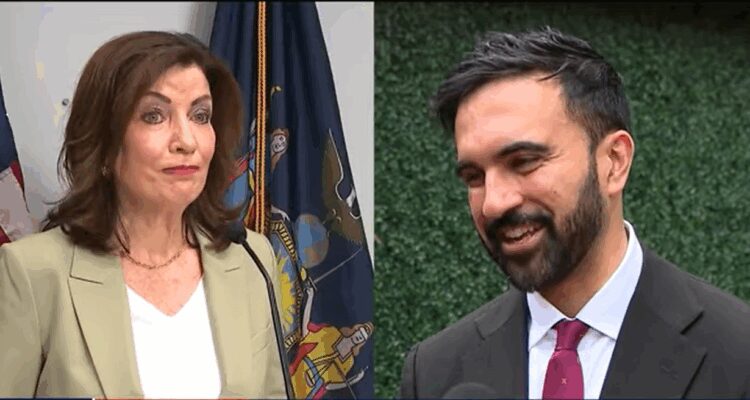
In an unusually direct rebuke, Adams also took aim at his potential successor, Assemblyman Zohran Mamdani, the Democratic Socialist frontrunner in next year’s mayoral race. As the VIN News report noted, Mamdani has come under fire for previously defending the slogan “Globalize the Intifada,” a chant that Jewish organizations and Israeli officials have condemned as an incitement to violence.
“Let me be clear,” Adams said. “We will never surrender our city to hate or to those who refuse to condemn it, because that phrase—‘Globalize the Intifada’—literally means death to Jews all over the world.”
He went on to urge New Yorkers to reject political extremism from any direction. “Whether it comes cloaked in ideology, in art, or in activism, antisemitism is still antisemitism,” Adams said. “There is no progressive excuse for it, and no political platform that can justify it.”
VIN News has documented growing tension between Adams and the city’s far-left factions, many of whom have accused him of suppressing protest movements linked to the Israel-Hamas conflict. Yet Adams’s latest comments suggest he is unwilling to cede moral ground on antisemitism — even at the risk of alienating some progressive voters.
The Governors Island episode is the latest in a string of antisemitic controversies that have emerged in New York’s artistic and academic institutions. As VIN News reported, several university campuses, galleries, and cultural centers have faced backlash for hosting exhibitions and events that blur the line between political critique and hate speech.
Jewish leaders warn that these cultural expressions normalize antisemitic tropes under the guise of “anti-Zionism.” “We’ve seen the same patterns repeat,” one community advocate told VIN News. “Whether it’s a mural comparing Israel to Nazi Germany or a protest shouting for ‘intifada,’ the message to Jewish New Yorkers is the same: your pain doesn’t count.”
The mayor’s response reflects growing frustration among city officials who feel that antisemitism has become both intellectualized and excused in elite spaces. Adams said his administration would work with cultural institutions to ensure stronger oversight of publicly displayed art. “We support free expression,” he said, “but hate speech that endangers a community has no place in New York City.”
Jewish leaders praised Adams’s remarks as both courageous and overdue. “The mayor said what so many of us have been feeling,” said Rabbi Joseph Potasnik, executive vice president of the New York Board of Rabbis, in comments to VIN News. “Antisemitism today hides behind politics, art, and academia — but its impact is as dangerous as ever. We needed to hear a strong, moral voice from City Hall, and that’s what we heard.”
Others emphasized that Adams’s speech must translate into policy action. “Condemnation is important,” said Michael Miller, CEO emeritus of the Jewish Community Relations Council of New York, speaking to VIN News. “But we also need enforcement, education, and accountability. The NYPD must be empowered to investigate hate crimes swiftly, and schools must teach what antisemitism really is — not as an abstract concept, but as a lived experience of fear and exclusion.”
Adams’s description of antisemitism as a “virus that mutates” struck a chord with many observers. The analogy, as the VIN News report noted, reflects a growing understanding among scholars that antisemitic ideology adapts to the times, shifting from overt religious hatred to coded political rhetoric.
“Just as a virus evolves, so too does this hatred,” Adams said. “It moves from the synagogue to the social media feed, from the street corner to the art gallery. And every time we ignore it, it grows stronger.”
In response, the mayor announced new initiatives to strengthen the city’s Office for the Prevention of Hate Crimes, expand public education campaigns, and increase funding for security at Jewish schools and synagogues. His administration will also launch a task force to review cultural programming in city-funded venues to prevent the recurrence of incidents such as the one on Governors Island.
“New York must remain a city where every person, regardless of faith, feels safe walking the streets,” Adams said. “That’s not just our responsibility—it’s our identity.”
As the city grapples with its post-pandemic recovery and a volatile political climate, Adams’s stance may mark a defining moment in his mayoralty. The VIN News report observed that the mayor’s condemnation was not only moral but strategic: a clear message that New York will not tolerate the mainstreaming of antisemitism at a time when Jewish New Yorkers feel increasingly vulnerable.
In closing his remarks, Adams invoked the legacy of New York’s pluralism — a reminder that the city’s strength has always been its unity in diversity. “We’ve stood together after 9/11, through the pandemic, through every test that tried to divide us,” he said. “And we’ll stand together again against this plague of hate.”
He added, “When you attack one community, you attack all of us. When you desecrate Jewish identity, you desecrate the values of New York City itself.”
As the VIN News report noted, Mayor Adams’s message was not merely about confronting antisemitism — it was about defending the moral core of the city he leads.
For a city that has long prided itself on being the beating heart of global Jewish life, the mayor’s words carried both urgency and defiance: “We will never surrender our city to hate.



